
Energy Technologies Initiative to receive new leadership
Stuart Rowan will serve as the new leader, while the Founding Faculty Director Shirley Meng will continue leading the Energy Transition Network
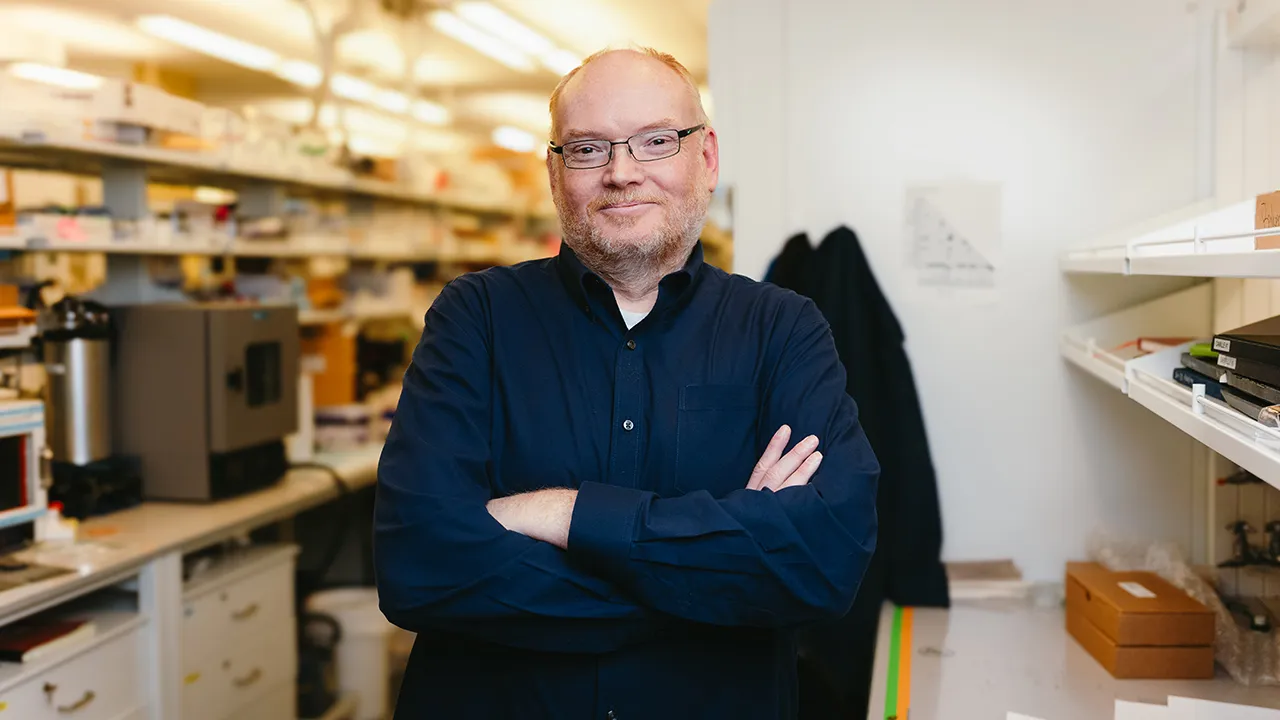
Prof. Stuart Rowan will serve as the new leader of the Energy Technologies Initiative. (Photo by Jason Smith)
The University of Chicago’s Energy Technologies Initiative (ETI), a partnership between the Institute for Climate and Sustainable Growth and the UChicago Pritzker School of Molecular Engineering (UChicago PME), is announcing a transition in leadership. Stuart Rowan, the Barry L. MacLean Professor for Molecular Engineering Innovation and Enterprise, will serve as the new faculty director, succeeding founding faculty director Y. Shirley Meng, who will join Nanyang Technological University, Singapore, effective July 1 but will also retain a partial appointment to UChicago. Chibueze Amanchukwu, the Neubauer Family Assistant Professor of Molecular Engineering, and Associate Professor of Molecular Engineering Shrayesh Patel, will serve as co-deputy directors.
“ETI reflects the kind of interdisciplinary collaboration that defines the UChicago Pritzker School of Molecular Engineering and the University of Chicago,” said UChicago PME Dean Nadya Mason. “We are excited to build on this strong foundation and continue advancing discoveries in battery materials and energy storage, including through our growing research presence at Hyde Park Labs.”
Institute for Climate and Sustainable Growth Founding Director Michael Greenstone said of the new leadership, “Shirley’s leadership in launching ETI has elevated the University of Chicago’s standing on these topics. I look forward to seeing more of the pioneering work ETI faculty will develop in the years ahead as they redefine the field of battery innovation and energy storage technologies that are crucial to addressing climate change and building sustainable economic growth worldwide.”
We are excited to build on this strong foundation and continue advancing discoveries in battery materials and energy storage.
Dean Nadya Mason
Since its founding in 2024, ETI faculty have advanced energy storage and battery innovation across multiple fronts, including the development of new materials, improvements in safety and cost, and breakthroughs in next-generation systems such as sulfur-based solid-state batteries that could extend the range of electric vehicles.
“I am honored to serve as faculty director for ETI and to work closely with colleagues across the UChicago Pritzker School of Molecular Engineering and the Institute for Climate and Sustainable Growth,” said Rowan. “ETI has built strong momentum, and I look forward to supporting continued growth in research, partnerships, and real-world impact in energy storage and related technologies.”
Rowan also serves as Director of UChicago PME’s Institute for Materials and Sustainability at UChicago PME, where his research focuses on the design of advanced materials with applications in energy, sustainability, and circular systems.
Notably, the UChicago Pritzker School of Molecular Engineering, together with partners at Argonne National Laboratory, is home to the nation’s largest concentration of energy science and technology experts.
Meng will continue to collaborate with ETI faculty and partners through her leadership of ETI’s Energy Transition Network, which connects fundamental research with startups and industry to accelerate the development and deployment of energy technologies.
“It has been an honor and an extraordinary journey to launch ETI,” said Meng. “I am enormously proud of the team we have built, and of the exciting research my colleagues are continuing to lead, and I look forward to furthering my work with the Energy Transition Network while taking on new challenges at my alma mater in Singapore.”
Alongside ETI’s core research, the Institute for Climate and Sustainable Growth will continue to advance battery and energy storage innovation through venture and seed-stage projects led by faculty across the University, including researchers affiliated with ETI. These efforts are supported by shared research infrastructure, including Hyde Park Labs, and strengthened through collaborations with Argonne National Laboratory, Gachon University in Korea, and Xanadu. Together, these partnerships help translate fundamental research into scalable energy technologies that address climate challenges while supporting long-term economic growth.
A search for a permanent faculty director for ETI will begin in the coming months.
Related News
-

UChicago Prof. Shirley Meng’s Laboratory for Energy Storage and Conversion creates world’s first anode-free sodium solid-state battery – a breakthrough in inexpensive, clean, fast-charging batteries
July 03, 2024UChicago Pritzker Molecular Engineering Prof. Y. Shirley Meng’s Laboratory for Energy Storage and Conversion has created the world’s first anode-free sodium solid-state battery. With this research... -
Using computational modeling to tackle science’s biggest questions
July 19, 2024Experts from around the globe gathered at the University of Chicago this week to push the boundaries on using artificial intelligence, machine learning, and other computer modeling innovations to... -
Reducing electronic waste with biodegradable luminescent polymers
July 22, 2024From your car’s navigation display to the screen you are reading this on, luminescent polymers — a class of flexible materials that contain light-emitting molecules — are used in a variety of today’s...