UChicago PME research in AI is centered around three broad goals
AI-guided design-build-test-learn loops and/or autonomous discovery (“self-driving labs”)

UChicago PME researchers are augmenting traditional theoretical, computational, and experimental modes of inquiry with AI to massively accelerate molecular modeling and simulation, design new molecules, proteins, drugs, and quantum materials with higher efficiency and accuracy, and develop self-driving labs combining AI and automated robotics.
(PME faculty currently engaged in this area include Junhong Chen, Laura Gagliardi, Margaret Gardel, Liang Jiang, Andrew Ferguson, Y. Shirley Meng, Samantha Riesenfeld, Sihong Wang)
Development of AI-enabled algorithms and computing hardware

UChicago PME researchers are developing new AI and ML algorithms (including eXpalinable AI and physics-aware AI) to extract patterns and correlations in high-dimensional complex biological data sets, design new molecules, proteins, and reticular materials for carbon capture and catalytic applications, and enable new quantum technologies. They are also working on the development of novel electronics (e.g., neuromorphic computing) that can serve as the hardware for implementing AI and ML with lower power consumption and lower carbon emissions.
(UChicago PME faculty currently engaged in this area include Chibueze Amanchukwu, Andrew Ferguson, Rama Ranganathan, Sihong Wang)
Core Faculty and Researchers Using AI at UChicago PME
- Chibueze Amanchukwu: Uses generative AI models to map out, predict, and design complete, multi-component battery electrolyte formulations.
- Junhong Chen: Employs machine learning to optimize chemical and gas sensors (such as work to detect PFAS "forever chemicals") and tackle global water challenges.
- Joyce Huanhuan Chen: Applies Quantum Machine Learning (QML) to early cancer detection. The technique, published in the journal Bioactive Materials, did better than classical methods at telling apart exosomes (tiny particles released by cells) from cancer patients and those from healthy people.
- Aaron Esser-Kahn: Combines machine learning with automated high-throughput screening to explore vast chemical spaces. His lab collaborated with computer scientists to develop an ML algorithm that optimized vaccine design, discovering record-performing immunomodulators by testing only 2-3% of a 140,000-compound library.
- Andrew Ferguson: Uses machine learning, data science, and AI-guided design loops for molecular and macromolecular engineering, helping to map out materials exploration.
- Laura Gagliardi: Applies AI and advanced computational methods to accelerate molecular modeling, quantum chemistry, and chemical discovery.
- Giulia Galli: Utilizes quantum mechanics-based computational modeling alongside machine learning to predict and design the properties of materials for quantum information technologies and solar energy conversion.
- Margaret L. Gardel: Uses computational and AI-driven modeling to study cellular and tissue mechanics.
- Supratik Guha: Implements AI and data-driven sensor networks for cyber-physical water and soil monitoring systems, while also researching new materials for energy-efficient neuromorphic (brain-like) AI hardware.
- Po-Chun Hsu: Develops dynamic materials and metamaterials for light and heat management, including smart cooling textiles, and nanofibrous air filters for carbon capture, with AI and data-driven optimization as part of his toolkit.
- Liang Jiang: Merges quantum computing with classical machine learning to make AI processes more sustainable, secure, and computationally efficient.
- Y. Shirley Meng: Integrates machine learning to discover novel electrolytes, membranes, and electrodes for next-generation energy storage and battery tech.
- Shrayesh Patel: Develops functional polymers (plastic-like materials) for energy storage and conversion. Directs the Center for Organic Battery Innovation (COBI), which is working toward safer, recyclable batteries made from abundant carbon-based materials instead of scarce metals like lithium or cobalt, and uses AI-guided discovery and high-throughput robotic synthesis to rapidly screen candidate molecules.
- Rama Ranganathan: Trains machine learning models on evolutionary sequence data to uncover the design principles of biological macromolecules and engineer entirely new proteins.
- Samantha Riesenfeld: Develops and applies genomics-based machine learning methods, including for single-cell data, to study inflammatory immune responses, neuroimmune interactions, and solid tumor cancers.
- Sihong Wang: Develops flexible AI computer chips and bio-compatible neuromorphic computing hardware for wearable health monitoring devices.
- Jie Xu (joint appointment with Argonne National Laboratory): Leads research on autonomous “self-driving” labs, including the Polybot platform and an AI advisor model that lets humans and AI share control over materials discovery.
Collaborations and Opportunities in AI
UChicago Pritzker Molecular Engineering researchers collaborate with colleagues at the University of Chicago, at Argonne National Laboratory, and at more than twenty other research institutions. UChicago PME also provides unique opportunities to early-career scientists and engineers who wish to advance AI methods and applications in the domains of immunoengineering, materials systems, and quantum engineering.

Generative AI in Science and Research – Andrew Ferguson
PoLARIS
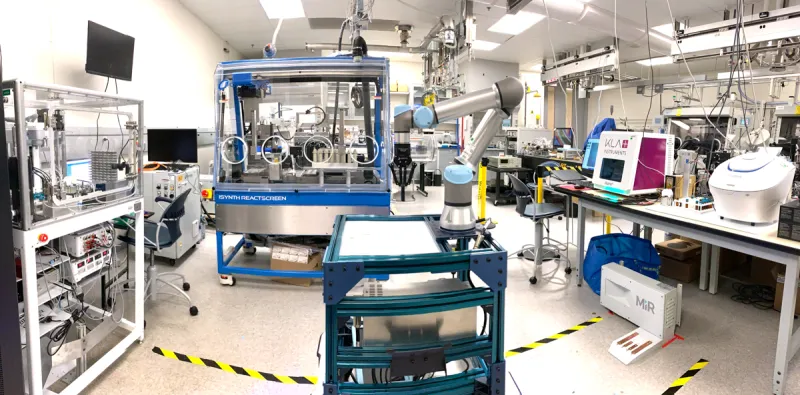
PoLARIS (Polymer Laboratory for AI, Robotics, Informatics, and Standards) is a remotely accessible, robot-operated laboratory that lets researchers across the United States design and run experiments on next-generation materials without traveling.
- Leverages the expertise of UChicago PME, Department of Computer Science, and Argonne National Laboratory
- Connects AI, robotics, specialized instruments, and data infrastructure into a cloud laboratory that researchers from universities, industry, government labs, and under-resourced institutions can access remotely
- Executes autonomous experiments at more than 20 stations spread across five labs at UChicago and Argonne