
Getting the future ‘quantum-ready’
A pilot partnership between Quantum Machines, UChicago and City Colleges is developing the new quantum workforce
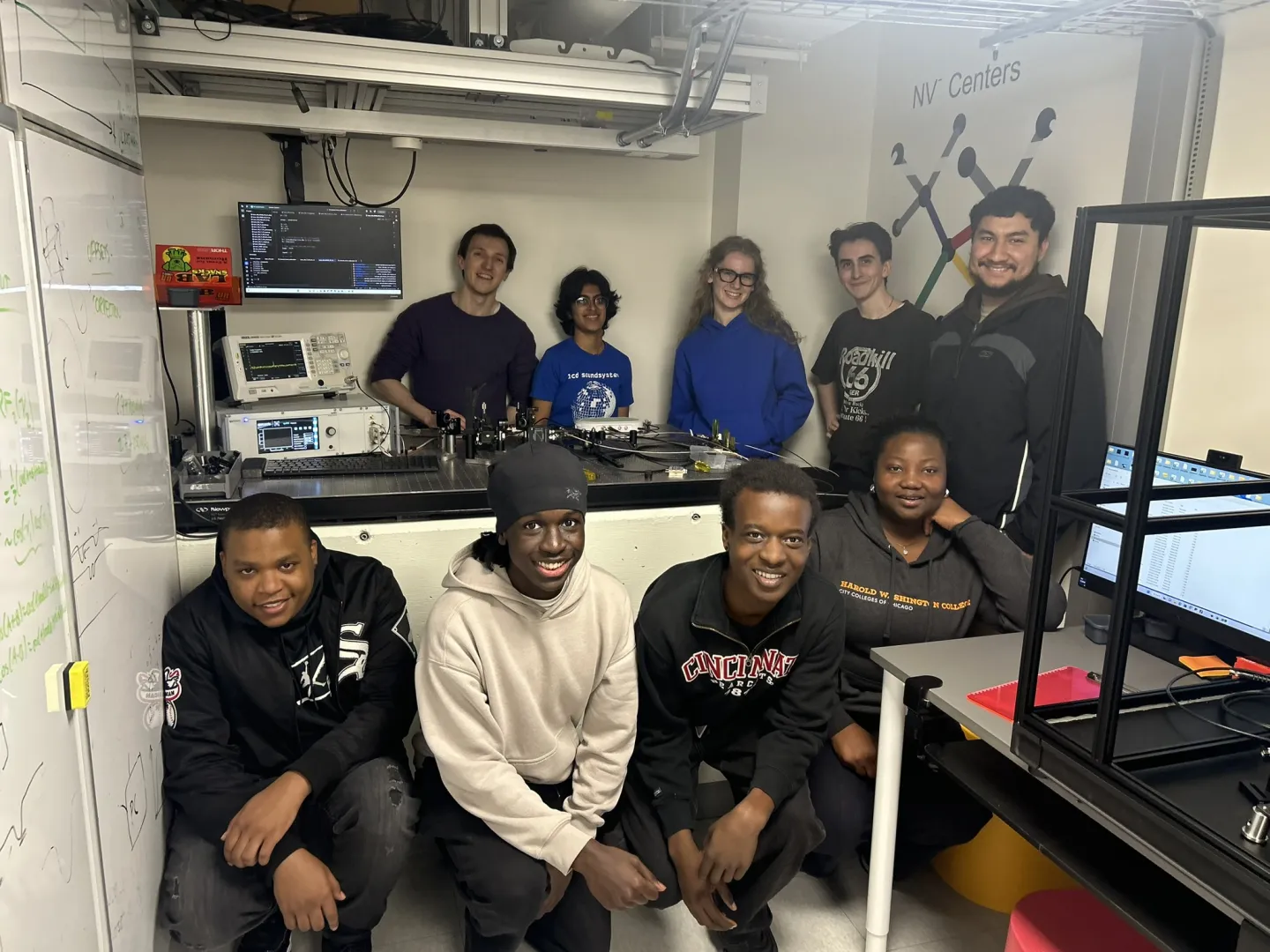
Seven City Colleges of Chicago students and recent alumni spent the spring studying quantum engineering through a University of Chicago Pritzker School of Molecular Engineering (UChicago PME) pilot program developed in partnership with quantum computing company Quantum Machines (QM) and organized by the Chicago Quantum Exchange (CQE).
Caleb Harris has his associate degree in Computer Science and is currently studying Electrical Engineering, but to be ready for a career in STEM, he knew he had to learn about quantum science and engineering.
“I want to get in on the ground floor with quantum and get the knowledge and experience needed to take the next step in this field as it continues to grow and evolve,” Harris said.
Harris, a graduate of Olive-Harvey College now studying at Purdue University Northwest, was one of seven City Colleges of Chicago students and recent alumni who spent the spring studying quantum engineering through a University of Chicago Pritzker School of Molecular Engineering (UChicago PME) pilot program developed in partnership with quantum computing company Quantum Machines (QM) and organized by the Chicago Quantum Exchange (CQE), a UChicago PME–based consortium building a full-spectrum quantum ecosystem that advances quantum research, workforce development, and economic innovation.
The series of weekend workshops in UChicago PME’s Quantum Education Laboratory (QuantumLab) was designed to prepare tomorrow’s STEM professionals for a field that’s going to change everything.
A recent CQE report estimates that the Midwest’s quantum job market might be as large as 191,000 within a decade, as projects like the planned Illinois Quantum and Microelectronics Park (IQMP) make Chicago a major hub for industry and innovation. Quantum Machines is a partner at IQMP, where it operates a quantum computing hub and collaborates with researchers, startups and industry partners on advancing scalable quantum computing technologies. The workforce program is one example of the company's broader commitment to the region's quantum ecosystem.
“The quantum industry of the future can only succeed if there is a workforce of technicians and engineers ready to tackle the challenge of deploying and escalating these technologies. This means we need people across all levels of experience to be ‘quantum-ready,’” UChicago PME Instructor Danyel Cavazos said. “Once I realized we’d be collaborating with the company Quantum Machines I knew we could do something really meaningful.”
Cavazos co-designed the course with QM’s Quantum Education and Workforce Development Program Manager Kristina Callaghan.
“The need now is to put the foundations in place to train up a quantum workforce,” she said. “One way that we see to do that is through industry and academia partnerships, where we develop out the pipeline from when someone comes in and maybe is interested in quantum all the way to when they get that first job.”
Quantum Control
The program builds on the Introduction to Molecular Engineering course that each summer brings City Colleges students to UChicago PME for a cross section of engineering, including a smattering of quantum.
“For this program, however, we were laser-focused: one platform, one application, and one set of specific skills for it,” Cavazos said.
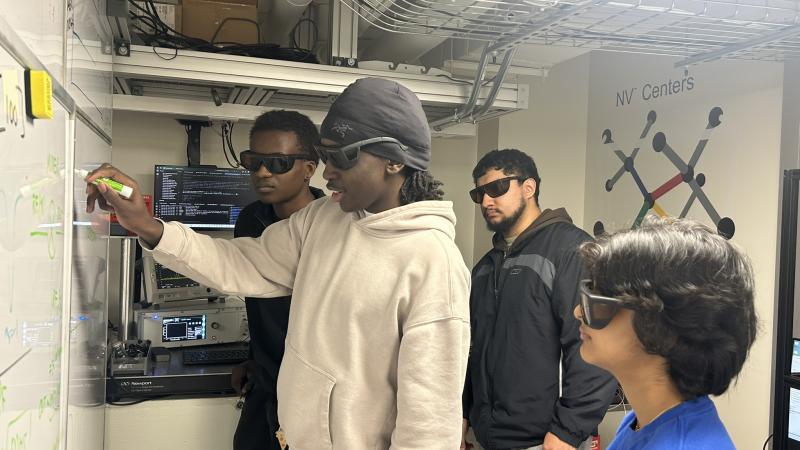
Cavazos and Callaghan focused the curriculum on “quantum control,” organizing all the inputs and outputs from the devices and signals into coherent quantum commands from researcher to qubit.
“I like to think of it being similar to how an orchestra director puts together a set of instruments and the talent of a group of musicians into a wonderful concert,” Cavazos said. “Here, our students were orchestrating lasers, switches and sensors around quantum hardware, and just like you want all instruments to play in harmony, a successful experimental sequence requires all the components to be in sync.”
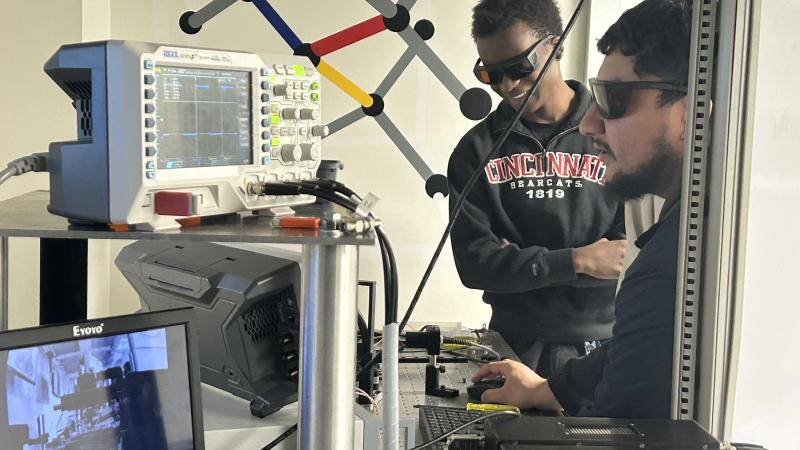
For the course, QM provided its premium OPX+, a hybrid controller unit that can be used to interface with multiple types of quantum hardware.
“Every week we ran a different experiment that a researcher or a grad student would run as part of their daily tests or large research projects,” said course TA Srimaye Peddinti. “They’re actually doing something that, professionally, is a very valuable skill.”
The weekends spent helping qubits dance became so meaningful to Andriana Chyzhyk, a Chemical Engineering student at Wilbur Wright College, that she skipped her own graduation to attend one of the lab sessions.
“I just decided this one is more fun,” she said, laughing. “And it will bring more opportunities and more knowledge for me than just attending a ceremony.”
Building the Pipeline
Developing that pipeline requires buy-in at all levels, said UChicago PME Dean Nadya Mason.
“Academia has a crucial role in building the pipeline to deep tech careers and industries, like those emerging in the Chicago quantum ecosystem,” Mason said. “These partnerships give students highly sought-after skills, connect them to real-world opportunities, and help accelerate the translation of research into impact. It’s a win for students, for industry, and for the future of the field.”
The idea for the course grew out of workforce planning for the Illinois Quantum and Microelectronics Park.
“This workshop reflects what is possible when deep regional partnerships come together around a shared workforce strategy,” said Emily Easton, director of education and workforce development at CQE and co-lead for workforce development at the IQMP. “By connecting lab space, instructors, students, and industry partners across institutions, we were able to leverage the region’s existing assets to pilot something new—and build a model that can grow with the needs of the quantum ecosystem.”
Developing a job-ready quantum workforce is a key to that growth, said David Awschalom, the Liew Family Professor of Quantum Engineering and Physics at UChicago PME and the founding director of the CQE.
“Industry-led training and hands-on learning are both essential pieces of preparing the future quantum workforce for the specific demands of the fast-growing sector,” Awschalom said, referencing two of the five key priorities highlighted in the CQE’s recently released report, “Advancing Together: A Unified Strategy for Scaling Midwest Quantum Talent.” “This pilot is a good example of the programming we want to build — and scale — as the Midwest continues to drive US leadership in this potentially transformative sector.”
City Colleges Deputy Provost Stacia Edwards said that as more tenants join the IQMP, currently under construction in South Chicago, leveraging partnerships to create programs focused solely on quantum is vital.
“We want to be setting up an ecosystem where the businesses that decide to locate there, that make an investment to locate there, can find the talent that they need in real time,” said Edwards, who is also an IQMP Board of Managers member. “Right now the challenge is that quantum still feels very sci-fi-esque. The quantum park shows people this is here and this is happening now.”
Callaghan said that Quantum Machines is looking to repeat, grow and expand the program not just in Chicago but across the Midwestern quantum frontier. It is one of many future academia-industry partnerships with they hope to build to advance this burgeoning, world-changing field.
“This program was a success on all fronts,” she said. “Now the idea is ‘Okay, what next?’”
Related News
-
New method could yield fast, cross-country quantum network
July 09, 2024Quantum computers offer powerful ways to improve cybersecurity, communications, and data processing, among other fields. To realize these full benefits, however, multiple quantum computers need to be... -
Innovative phonon-based quantum computing research at UChicago Engineering gets a $3 million boost by the U.S. Department of Defense
July 15, 2024UChicago Pritzker School of Molecular Engineering Prof. Andrew Cleland has been named a 2024 Vannevar Bush Faculty Fellow, the U.S. Department of Defense’s flagship single-investigator award for basic... -

US Defense Department, State of Illinois announce multimillion-dollar quantum testing program
July 16, 2024The US Department of Defense will invest up to $140 million to develop a national proving ground for quantum technologies in the Chicago region, Illinois Governor JB Pritzker announced Tuesday morning...