
Quantum Horizons aims to open up the quantum landscape
Biennial conference is aimed at democratizing quantum technologies, opportunities
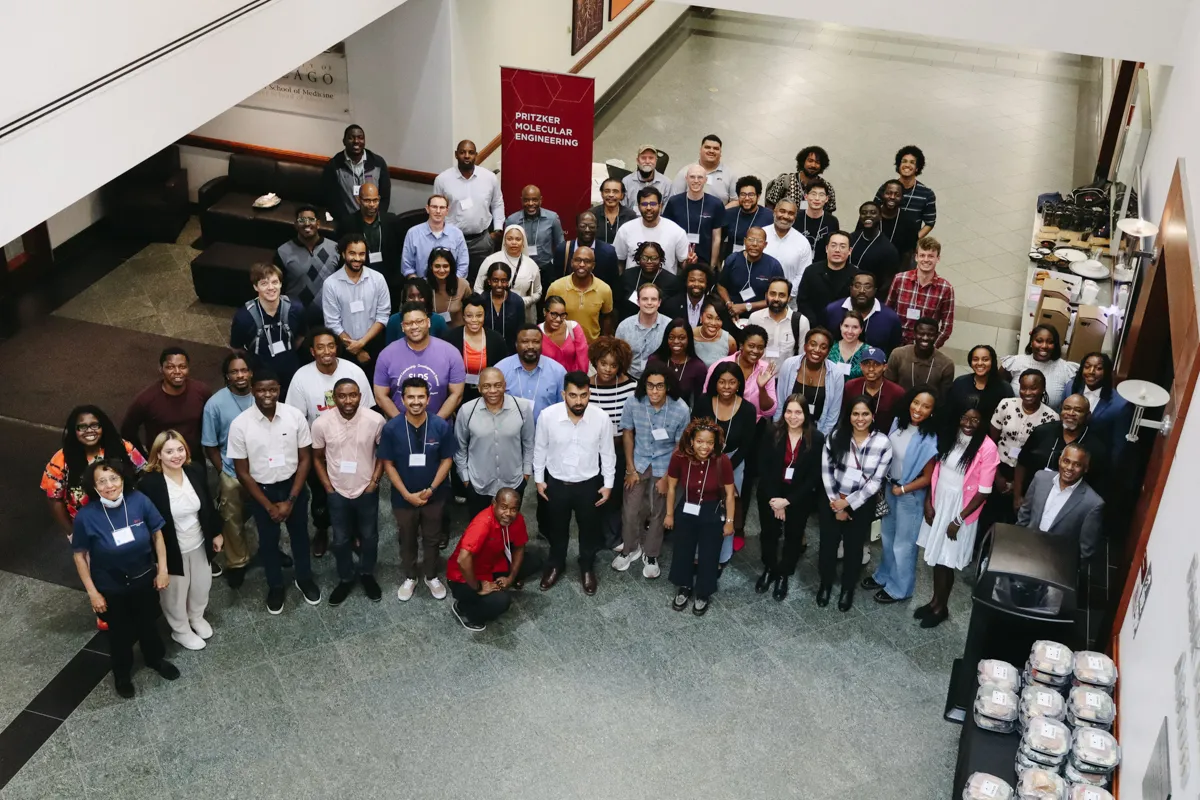
Over three days of talks, lectures and networking, the Quantum Horizons conference brought more than 265 in-person and online attendees to the University of Chicago, representing 118 different institutions across the nation. (Photo by Paul Dailing)
Oyeyemi Oyebode, a second-year PhD student in Computer Science focused on cybersecurity at Northern Illinois University, had a simple reason for coming to the University of Chicago for three days of lectures, networking and conversations about the growing field of quantum.
“Quantum is the future,” she said.
Oyebode was one of more than 265 in-person or virtual attendees at Quantum Horizons, a biennial conference aimed at democratizing the technologies, jobs and opportunities of quantum science and engineering.
The attendees – the bulk of whom were undergraduate or graduate students – represented 118 different institutions across the nation. Modeled after the Conference for African-American Researchers in the Mathematical Sciences (CAARMS) events held at Princeton, Quantum Horizons debuted in 2024 at Harvard to fill a gap for researchers in smaller, non-R1 universities.
“Almost every large corporation used to maintain an advanced technology laboratory that did forward-looking research, and a lot of faculty from small schools took advantage of internships in those spaces, just to keep abreast of what was going on. It was how they stayed informed about emerging technologies. Today those opportunities don’t really exist so many of their students don’t get a glimpse into these advanced technologies.” said the event’s creator, Executive Director of the Center for Nanoscale Systems at Harvard University Bill Wilson. “Our goal is to fill this gap, expanding the talent pool available to the nation.”
Wilson said a conversation with UChicago Pritzker School of Molecular Engineering (UChicago PME) Dean Nadya Mason and Argonne Deputy Laboratory Director for Science and Technology Sean Jones led to holding the second conference in Chicago.
“You guys are leaning into developing an ecosystem here, so there are real opportunities there for these students to actually work,” Wilson recalled telling Mason and Jones. “I think they need to see that.”
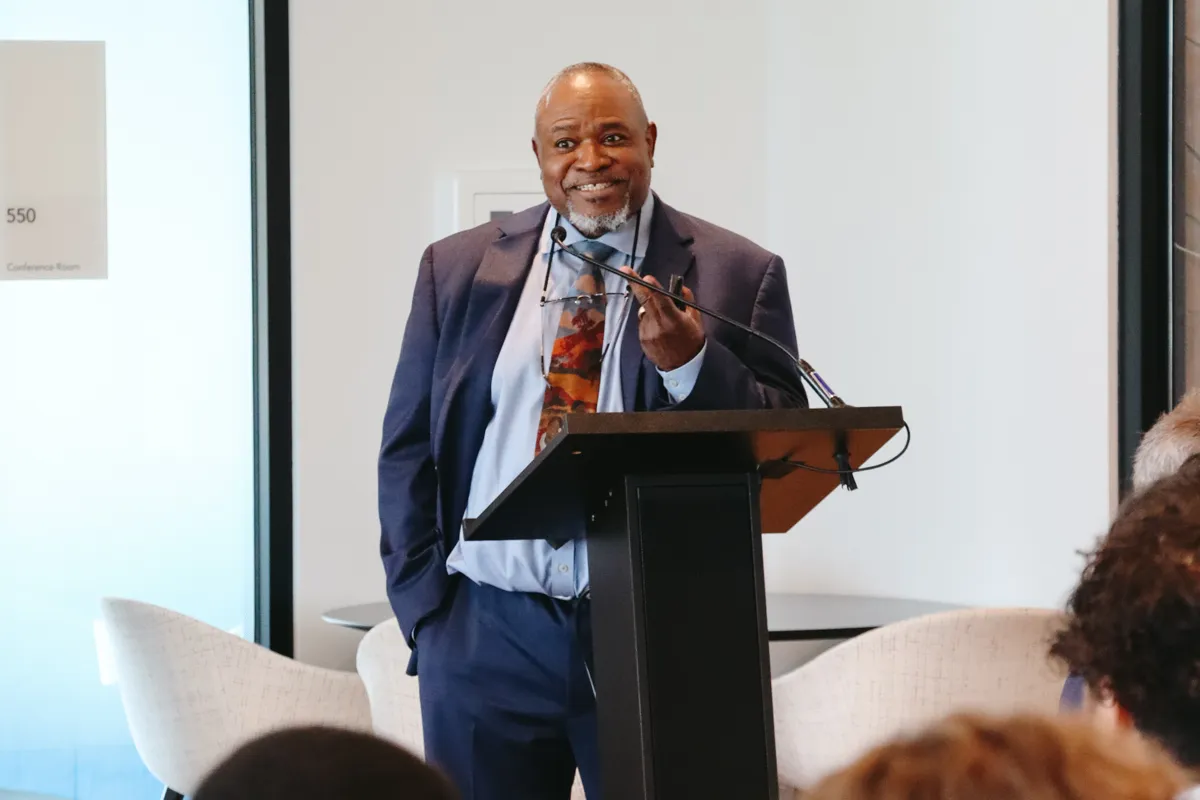
Through regional investment, projects including the new Illinois Quantum and Microelectronics Park under construction in South Chicago and partnerships between universities, industry and national labs, quantum is expected to bring as many as 191,000 new jobs to the region within a decade.
“The history here in Illinois runs deep and runs long,” said Chicago Quantum Exchange (CQE) Director of Education and Workforce Development Emily Easton. “Some of the foundational technologies that underlie the quantum science that is happening now, and charging forward, were developed right here in Illinois, but even more specifically in Chicago and on Chicago's South Side.”
The task now is to build on the strong foundation created by early investment from Argonne National Laboratory, Fermilab and the University of Chicago, taking it across the Midwestern “Quantum Prairie.”
“We have a strong pool of STEM graduates from our universities and colleges, a diverse industry base that includes more than 30 quantum and enabling companies … and we're home to four of the nation's 10 National Quantum Initiative Act quantum research centers – more than any other region,” said CQE Senior Director of Communications & Strategic Reporting Becky Beaupre Gillespie. “We're a region that's built for scale and for breakthroughs.”
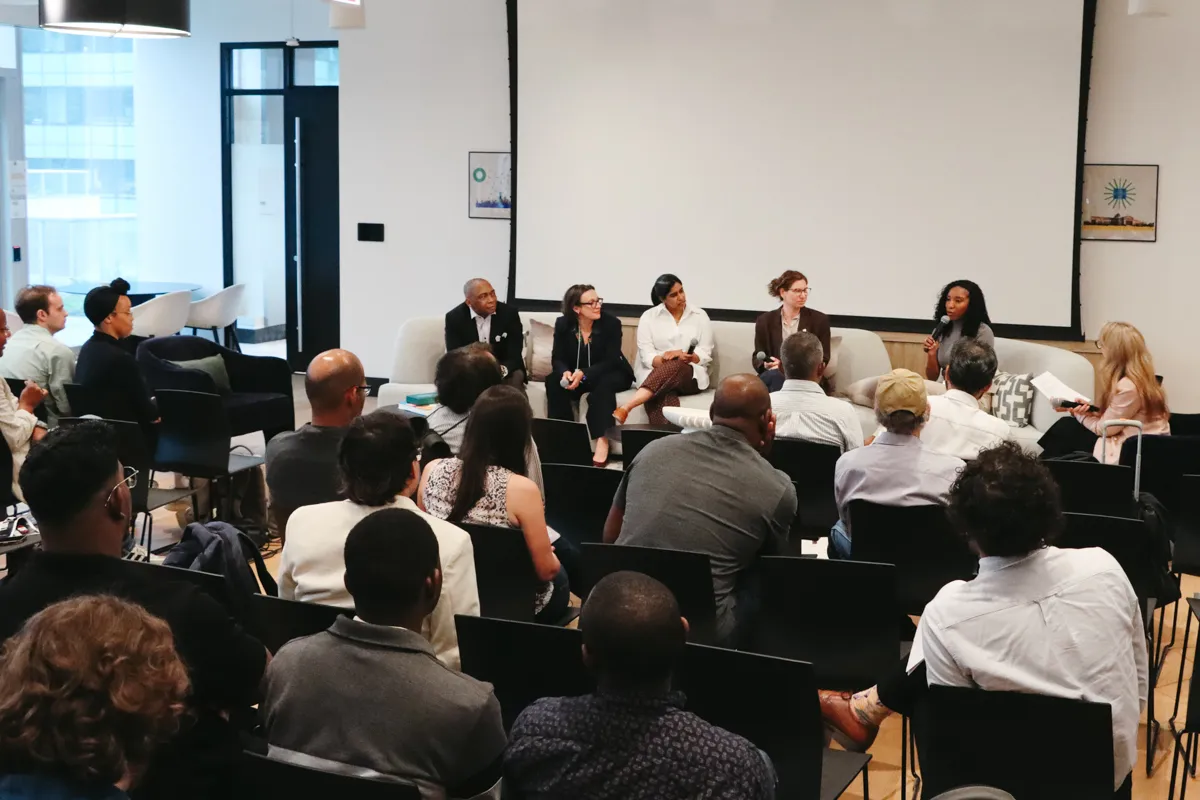
Over the three days, attendees enjoyed lectures on the cutting edge of quantum science and other emerging technologies. They showed how quantum is enabling breakthroughs in more than just high-speed computing, networking and cryptography, but also drug discovery, machine learning – even biology.
UChicago PME Neubauer Family Asst. Prof. Allison Squires, for example, gave a talk about quantum sensing. The qubits that enable quantum communications are finicky and delicate, highly affected by the outside environment. This complicates the development of quantum computers, but allows for microscopic readings and measurements with precision and accuracy never before seen.
“In quantum sensing, coupling to the environment is the advantage; it is the technology,” Squires said. “When coupling to the environment changes coherence, for example, or any other feature of the signals that you're reading, you now have a sensor rather than just a sub-optimal quantum object, and you're reading out information about the environment.”
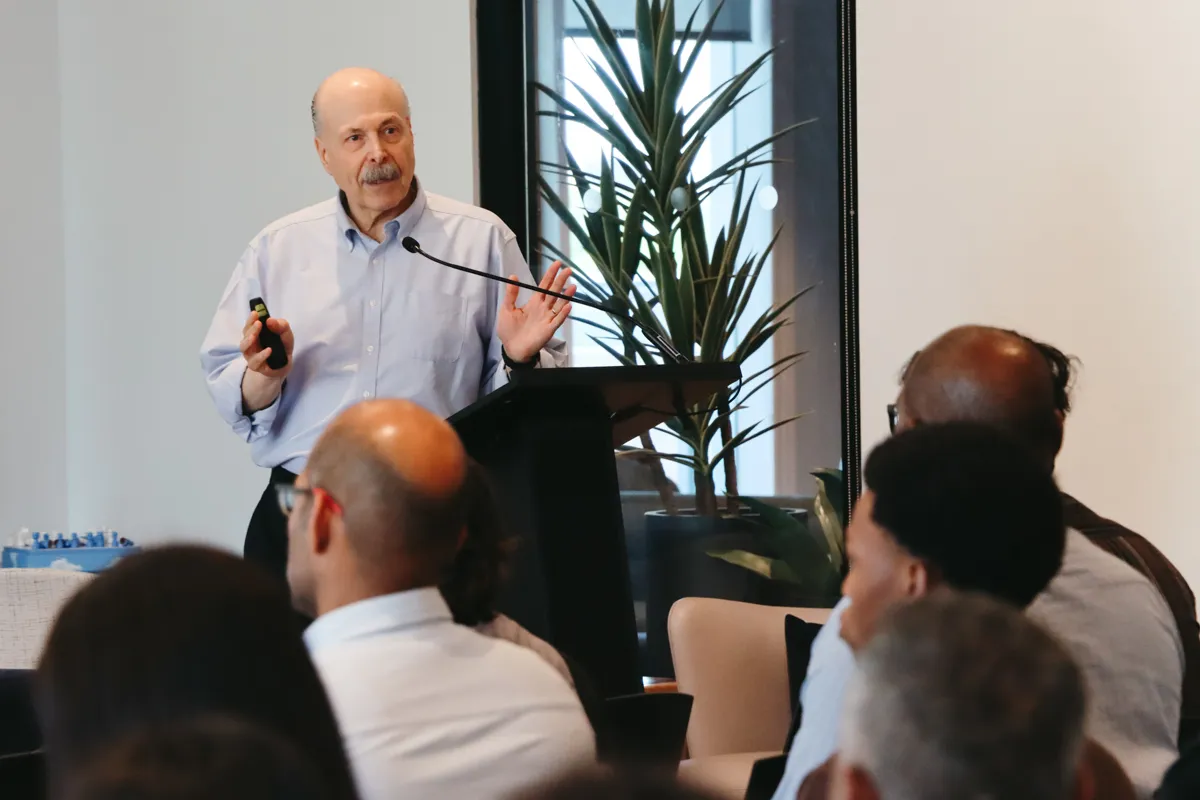
UChicago PME Assoc. Prof. Peter Maurer talked about his research on quantum biosensors, using these precise tools to study human life and disease on the cellular level. He spoke both about his work with UChicago PME Prof. David Awschalom creating “biological qubits” - entangled, living proteins – and his work with UChicago PME Prof. Aaron Esser-Kahn in creating a protective “shell” to allow diamond biosensors to insert into living cells safely and effectively.
“The University of Chicago is taking the ideas of using quantum systems that take very precise measurements and using them to study biological systems,” Maurer said. “This offers new opportunities in both developing applications and advancing fundamental science.”
Attendees learned about other areas of advanced research beyond quantum, like UChicago PME Neubauer Family Asst. Prof. Chibueze Amanchukwu’s development of an artificial intelligence to create advanced battery electrolytes.
“We want to unlock the next generation of batteries, but there are different ways you could actually use AI or machine learning,” Amanchukwu said. “If you want to port some of what I'm going to talk about today to quantum, the question becomes ‘Can I predict the properties of this compound or any modifications of this compound virtually on the computer?’ Then when you go into the lab, the likelihood of success will be far greater.”
The conference was a homecoming of sorts for attendee Alejandro Aponte García, a PhD student at The Ohio State University who was part of the inaugural cohort of CQE’s Open Quantum Initiative Undergraduate Fellowship while he was at the University of Illinois Urbana-Champaign.
“I've been connecting, networking and doing a lot of science since then, so having Quantum Horizons be here in Chicago is full circle for me,” he said. “I lived here for a summer, and now I get to see the new facilities like Hyde Park Labs that were being built when I was an intern. ‘Horizons’ is a great name for this conference. It shows there's still a lot to look forward to into the future.”
Awschalom, who is also the head of CQE and UChicago PME’s Chicago Quantum Institute advised the attendees to be open to all the possibilities quantum technologies are opening, both in their research and in their careers.
“Think very broadly, don't pick a modality, don't think about just computing – think about how this field is accelerating in so many directions,” Awschalom said. “I think the one thing that all of us who work in the field agree is that the biggest impacts are yet to be seen.”
Related News
-
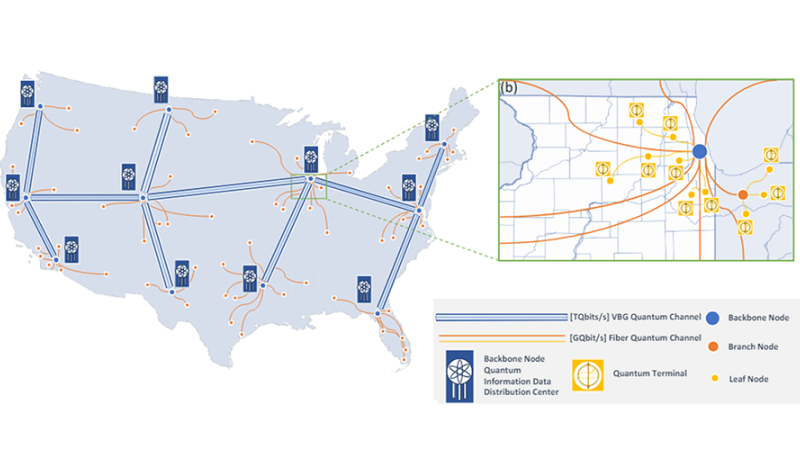
New method could yield fast, cross-country quantum network
July 09, 2024Quantum computers offer powerful ways to improve cybersecurity, communications, and data processing, among other fields. To realize these full benefits, however, multiple quantum computers need to be... -
Innovative phonon-based quantum computing research at UChicago Engineering gets a $3 million boost by the U.S. Department of Defense
July 15, 2024UChicago Pritzker School of Molecular Engineering Prof. Andrew Cleland has been named a 2024 Vannevar Bush Faculty Fellow, the U.S. Department of Defense’s flagship single-investigator award for basic... -

US Defense Department, State of Illinois announce multimillion-dollar quantum testing program
July 16, 2024The US Department of Defense will invest up to $140 million to develop a national proving ground for quantum technologies in the Chicago region, Illinois Governor JB Pritzker announced Tuesday morning...