
Turning electrochemistry toward lithium extraction
New research takes major strides towards an unconventional – and promising – way to harvest the vital battery material
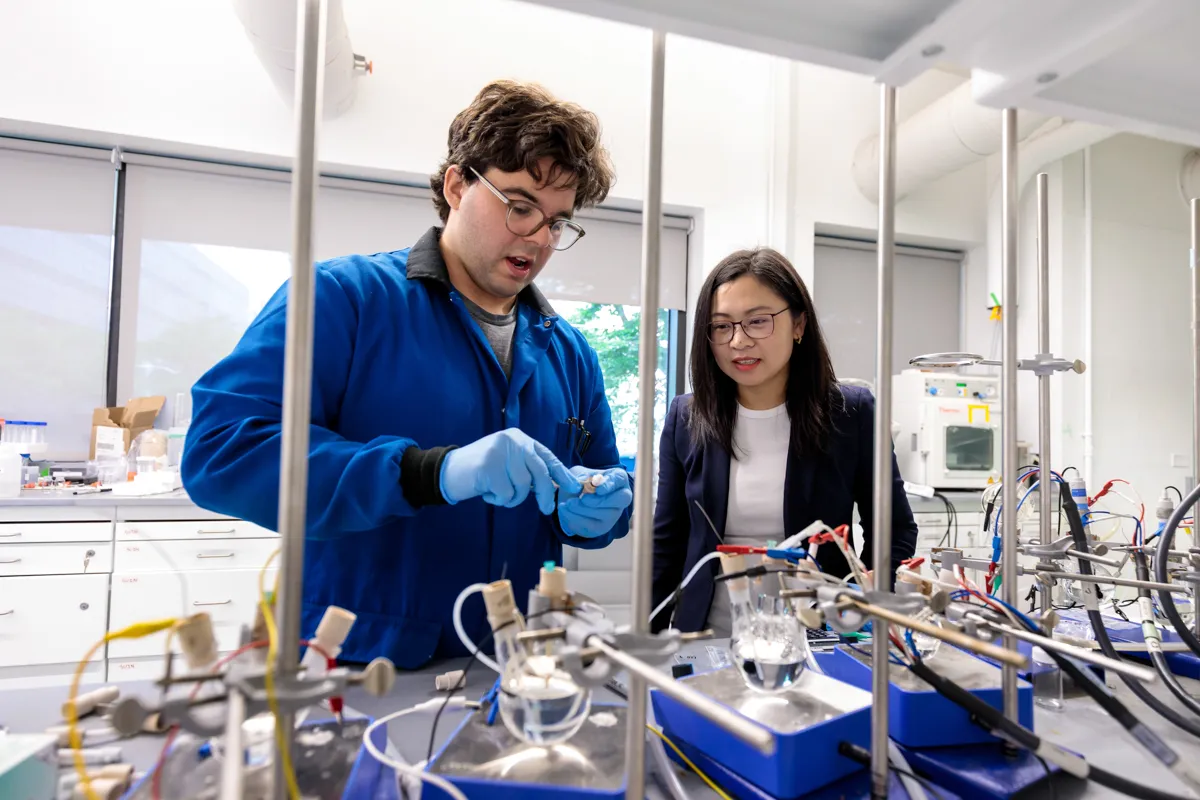
Former UChicago Pritzker School of Molecular Engineering graduate student Grant Hill, PhD’24, and UChicago PME Assoc. Prof. Chong Liu are behind a new paper in Nature Communications exploring a new, promising way to extract the battery material lithium from water. (Photo by John Zich)
The supply of lithium – the battery material that keeps digital devices humming, EVs racing and renewable energy on the grid – will not meet even half the expected demand by 2040.
Ramping up production using old methods will create new problems, including environmental damage, pollution, cost and water scarcity. Unconventional ways must be found to fill this lithium gap.
One promising solution is electrochemical intercalation. Common in the world of batteries and supercapacitors, it’s when researchers apply electricity to insert ions between the layers of a different material.
Using this technique to extract materials from water creates force-fed filters, using electrical currents to pull charged lithium ions through microscopic pathways. But the pathways that let lithium ions through will also admit other ions, including the vastly more common sodium.
In new research published in Nature Communications, a team from the University of Chicago Pritzker School of Molecular Engineering (UChicago PME) was able to crack this problem. They used electrochemical intercalation to extract 99% pure lithium from a solution where the ratio of sodium to lithium was 1,000 to 1.
“Our goal is to develop materials that can selectively separate lithium from other salts,” said the paper’s first author, former UChicago PME graduate student Grant Hill, PhD’24. “For this class of materials, the main competitor is sodium, because they’re just so chemically similar in charge and size.”
The work reveals that the ion pathways that let lithium through layered material – in this particular research, cobalt oxide – are governed by the push and pull between two forces. This represents both an advance in pure science and a way forward for developing new, real-world extraction techniques.
“We know there are two parallel reactions that will always occur at the same time,” said UChicago PME Assoc. Prof. Chong Liu, corresponding author of the new work. “One is driven by the charge, when put current in the material. The other one is that naturally, the materials will find equilibrium.”
‘The parking lot is full’
Batteries are the workhorses of the global transition off fossil fuels, but the methods used to harvest the common battery material lithium are far from eco-friendly. They require huge quantities of acid to melt roasted spodumene ore or massive brine pits to pull millions of gallons of salt water from deep under the earth and let dry in the sun.
Battery researchers across UChicago PME are exploring ways around this problem. For the Liu Group, this means advanced materials and methods for extracting lithium directly from water.
The challenge is making sure they only extract lithium. Before they could apply electrochemical intercalation to this problem, they had to discover how materials respond when multiple ions are inserted at the same time. This co-intercalation is the real-world situation faced when extracting lithium from salty water – and a major blind spot in pre-existing research.
Liu’s team first explored this class of material in a 2021 Matter paper and a 2024 Nature Materials paper.
“People might not realize the interactions could be that complicated, and that there is a phase equilibrium that’s governing the ion exchange behavior,” Liu said.
One major problem is lithium’s downstairs neighbor on the periodic table – sodium.
Sodium ions are also a third larger than lithium ions, similar enough in size and charge to be pulled by the electric field along with lithium, but large enough to cause problems. The Liu Group’s new research found sodium ions pushed the smaller lithium ions to the side of the pathway, toward lithium-friendly open sites in the material.
Hill describes the ion pathways as a highway surrounded by parking lots.
“Every lithium ion when it’s starting has a lot of open sites next to it, and when the sodium is getting put in, it ends up squeezing all the lithium sites next to each other,” Hill said. “For the lithium-friendly areas of the material, that parking lot’s all full.”
Speed limits
Overcoming this challenge required both optimizing the particle size of the lithium ions and finding a balance between two competing reactions.
The first of the two reactions is the intercalation itself, caused by the researchers using current to add ions between the layers. That’s the traffic down the highway. The second is the ion exchange as the competing sodium and lithium ions find equilibrium, the rate ions pull into the metaphoric parking lot.
Equilibrium occurs at its own rate, but the researchers can determine how quickly they pump ions in. This means they can set the “speed” of the first reaction to one of three options: faster, slower or the same as the speed of the second reaction.
“We discovered that the three regimes behave very differently, and it’s only that when you allow enough time to let the ion exchange to catch up with the intercalation, then we can have this very reversible material response,” Liu said.
Slowly inserting the ions and finding the ideal particle size allowed this reversibility.
“Reversibility means that the material can repeatedly take up and release lithium without getting stuck in an undesirable state,” Hill said. “By designing smaller particles that can quickly adapt to their environment, we ensure the material can reliably return to its preferred state each cycle. This reversibility allows us to keep extracting lithium efficiently over many cycles, improving both selectivity and total recovery.”
Hill said the lithium cobalt oxide material the team studied is near-ideal for this kind of work. But cobalt is comparatively costly and difficult to source, with most of the world’s reserves found in the Democratic Republic of Congo.
“Expanding this research to more abundant and economically friendly transition metals, especially the manganese-rich ones, would really make this breakthrough an attractive opportunity for future applications,” Hill said.
Citation: “Asymmetric pathways for lithium extraction and recovery based on the two-phase equilibrium of layered oxides,” Hill et al, Nature Communications, May 8, 2026. DOI: 10.1038/s41467-026-72755-4
Related News
-

UChicago Prof. Shirley Meng’s Laboratory for Energy Storage and Conversion creates world’s first anode-free sodium solid-state battery – a breakthrough in inexpensive, clean, fast-charging batteries
July 03, 2024UChicago Pritzker Molecular Engineering Prof. Y. Shirley Meng’s Laboratory for Energy Storage and Conversion has created the world’s first anode-free sodium solid-state battery. With this research... -
Using computational modeling to tackle science’s biggest questions
July 19, 2024Experts from around the globe gathered at the University of Chicago this week to push the boundaries on using artificial intelligence, machine learning, and other computer modeling innovations to... -
Reducing electronic waste with biodegradable luminescent polymers
July 22, 2024From your car’s navigation display to the screen you are reading this on, luminescent polymers — a class of flexible materials that contain light-emitting molecules — are used in a variety of today’s...