
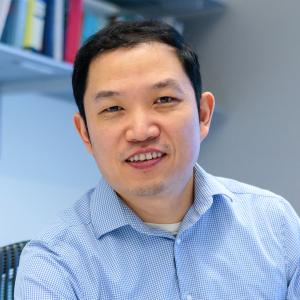
Tian Zhong
Research Topics
Research and Scholarly Interests
Research Groups
Websites
Office Location
Eckhardt Research Center
Room 291
5640 South Ellis Avenue
Chicago, IL 60637
Contact
Tian Zhong’s research focuses on developing enabling nanophotonic and molecular technologies for building an efficient, global-scale Quantum Internet. In the past decade, Prof. Zhong’s work has contributed to significant progress in nanoscale quantum network nodes and high-throughput quantum communication links interconnecting distant nodes. His efforts from atomic-molecular physics and photonics aspects converge to a vision to advance state-of-the-art quantum information technologies to bring Quantum Internet one step closer to reality.
Prof. Zhong has pioneered the field of rare-earth quantum nanophotonics. Rare-earth ion doped crystals are attractive quantum materials with exceptional coherence properties. By leveraging the modern photonic technologies, he has developed a versatile rare-earth nanophotonic platform that could enable scalable quantum optical networks.
Prof. Zhong was a postdoctoral fellow in the Institute of Quantum Information and Matter and the Department of Applied Physics and Material Science at the California Institute of Technology. He completed his PhD in Electrical Engineering at the Massachusetts Institute of Technology in 2013. Before his PhD, he obtained his Master of Science degree at MIT in 2009 and finished his undergraduate studies at Nanyang Technological University in Singapore in 2007.
Zhong earned the Faculty Early Career Development (CAREER) Award from the National Science Foundation in 2020 and earned the Sturge Prize in 2025.
Zhong Lab focuses on developing enabling nanoscale photonic and molecular (e.g. rare-earth-ion doped crystals) technologies for building quantum hardware to realize an efficient, scalable quantum internet.
Positions are available for students and postdocs.