Frank Noé - Materials Seminar
Molecular Science in the age of AI
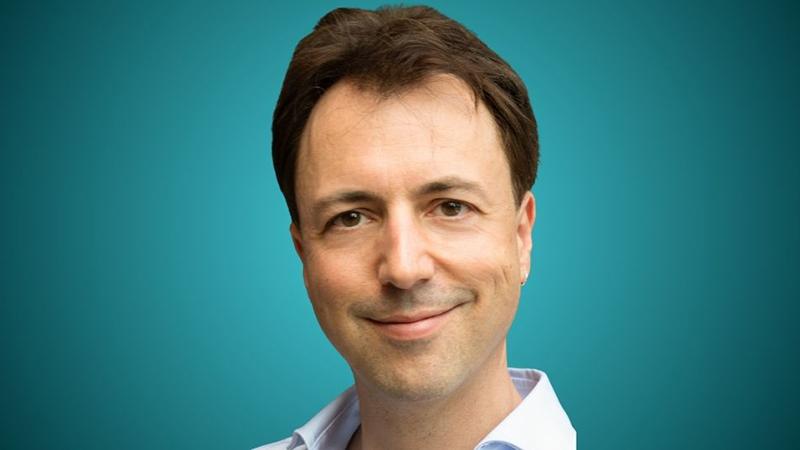
Frank Noé
Partner Research Manager, Microsoft Research AI for Science
Professor for AI4Science, Freie Universität Berlin
Deep learning, aka AI, has already made profound impact in the sciences, as highlighted by the 2024 Nobel prizes in Chemistry and Physics. In this talk I will discuss how deep learning can continue to disrupt some of the fundamental challenges in the molecular sciences, e.g., by solving the Schrödinger equation with unprecedented accuracy or emulating large molecular Systems at unprecedendet throughput. I will focus on discovering biomolecular mechanisms that lead to function at scale by a biomolecular emulator (BioEmu). BioEmu can predict the flexibility and conformational states of proteins, emulate the distributions generated by long-term molecular dynamics (MD) simulations orders of magnitude faster and predict protein stabilities consistent with experiment. I will highlight opportunities for drug discovery and discuss limitations of faithful physics representation and training data availability and how they might be overcome.
Frank Noé has a Bachelor degree in Electrical Engineering, a Master degree in Computer Science and a PhD from University of Heidelberg (Germany) in Computer Science and Biophysics. For 10 years he has been professor for AI for Science at Freie Universität Berlin and since 2022 he is Partner Research Manager at Microsoft Research AI for Science, leading the lab in Berlin. Frank is still honorary professor at Freie Universität Berlin and adjunct professor at Rice University Houston. Frank's research focuses on the development of AI methods to advance the molecular sciences, in particular addressing fundamental challenges such as the electronic structure problem in quantum Chemsitry, the many-body sampling problem in statistical Mechanics and the modeling and simulation of biomolecular structure, dynamics and function. His research was awarded with two grants of the European Research Council (ERC), the Hirschfelder award for theoretical Chemistry, Frank is an ISI highly cited fellow, a member of Berlin-Brandenburg Academy of Sciences, a fellow of the European Laboratory for Learning and Intelligent Systems (ELLIS) and a fellow of the American Physical Society (APS).
Host: Professor Giulia Galli