
Ramamoorthy Ramesh - Quantum Colloquium Series
Solving global scale problems with basic science
ABSTRACT: More than five decades ago, President Kennedy exhorted the nation to rise up and meet the biggest challenges of that period, amongst them being the Race to the Moon, that led to the "Moonshot", and the establishment of the Apollo program. It is quite likely that we, as a nation (and the world), are once again at crossroads, from many perspectives. I will use Energy and Computing as a "Clear and Present" example of where we need to rise up and meet the challenges that we are faced with. An area that has not received sufficient attention until recently relates to the exponential growth of electronics, driven by the proliferation of AI and the Internet of Things. A decade ago, we had made some simple calculations and had suggested that it was quite possible that ~20% of primary energy could be used in Computing, globally. More recently, this was also reflected in the Semiconductor Research Corporation's Decadal Report. Thus, there is an urgent need to find pathways to significantly reduce the energy consumption in electronics, mainly logic & memory, for example, in data centers. Although the problems are at the macroscopic global scale, powerful solutions can emerge from fundamental science, as reflected in the transition from bipolar to CMOS in the early 1980's. There is a belief that a similar "transition" is required to enhance the energy efficiency of electronics. In this talk, I will attempt to take you through from the "Macro", global energy economics down to what fundamental materials physics in the form of Quantum Materials can do to help solve the key problems in Energy Efficient Electronics.
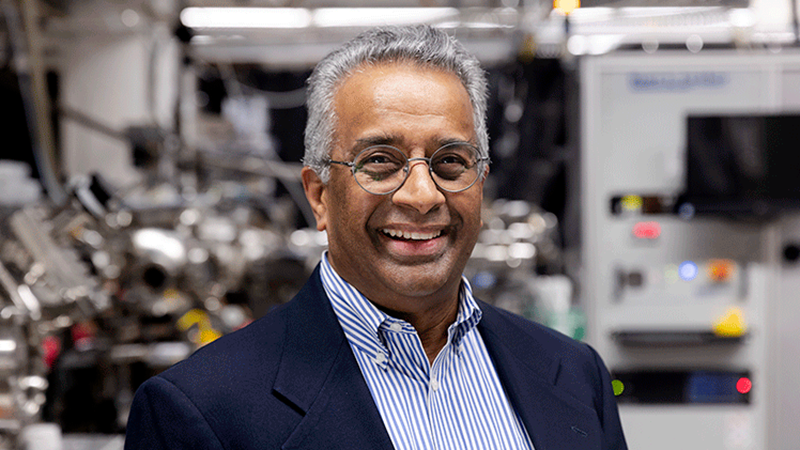
BIO: Ramesh pursues key materials physics and technological problems in complex multifunctional oxides. Using conducting oxides, he solved the 30-year enigma of polarization fatigue in ferroelectrics. He pioneered research into manganites coining the term, Colossal Magnetoresistive (CMR) Oxides. His work on multiferroics demonstrated electric field control of ferromagnetism, a critical step towards ultralow power memory and logic elements.
His extensive publications on the synthesis and materials physics of complex oxides are highly cited (over 100,000 citations, H-factor >150). He is a fellow of APS, AAAS & MRS and an elected member of the U.S. National Academy of Engineering, a Foreign member of the Royal Society of London, the Indian National Science Academy, the Indian National Academy of Engineering and a Fellow of the American Academy for Arts and Sciences. His awards include the Humboldt Senior Scientist Prize, the MRS Turnbull Lectureship Prize, the APS Adler Lectureship and McGroddy New Materials Prize, the TMS Bardeen Prize and the IUPAP Magnetism Prize and Neel Medal and the Europhysics Prize in 2022. He was recognized as a Thomson-Reuters Citation Laureate in Physics for his work on multiferroics.
He served as the Founding Director of the successful Department of Energy SunShot Initiative in the Obama administration, envisioning and coordinating the R&D funding of the U.S. Solar Program, spearheading the reduction in the cost of Solar Energy. He also served as the Deputy Director of Oak Ridge National Laboratory and the Associate Lab Director at LBNL. Most recently, he served on the Biden-Harris Transition Team for Energy. He is also a co-founder of Kepler Computing, which is focused on low power computing using ferroelectrics.
From August 2022-2025, he served as the Executive Vice President for Research at Rice University