Argonne and UChicago PME researchers receive funding to advance portable PFAS detection
NSF-funded research will develop a portable sensor that uses AI-designed molecular probes to detect specific “forever chemicals” in water within minutes
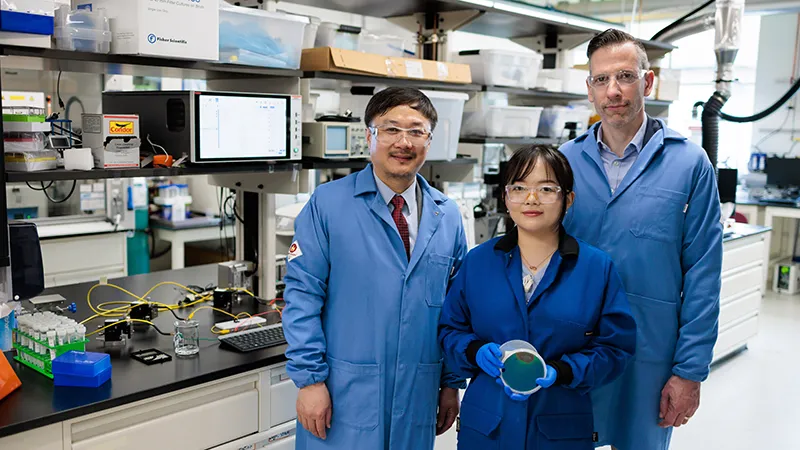
From left: Junhong Chen, lead water strategist at Argonne and the Crown Family Professor at UChicago PME; first author Yuqin Wang of Argonne, UChicago PME and AMEWS; Seth Darling, Argonne and UChicago senior scientist and AMEWS director. (Image by John Zich)
Researchers at the University of Chicago Pritzker School of Molecular Engineering (UChicago PME) and the U.S. Department of Energy’s Argonne National Laboratory and the have received funding through Great Lakes RENEW, a National Science Foundation (NSF) Regional Innovation Engine led by Chicago-based water innovation hub Current, to develop a portable sensor that uses AI-enabled molecular probes to detect specific per- and polyfluoroalkyl substances (PFAS) in water at very low concentrations, delivering faster results without requiring specialized laboratory equipment.
The project, titled “Portable PFAS Detection Using AI-Enabled Molecular Probes,” is one of 12 new research and development projects receiving a combined $5.4 million through Great Lakes RENEW. Funded projects aim to address pressing water challenges, including detecting and removing harmful contaminants, reducing water use in data centers, and recovering valuable materials and nutrients from wastewater.
Great Lakes RENEW brings together universities, researchers, businesses and water utilities across six Great Lakes states to develop innovative water technologies and create new economic opportunities. The initiative connects scientific discoveries with industry partners and communities to help move promising technologies out of the laboratory and into practical use.
The announcement follows NSF's March 2026 commitment of $45 million in additional funding to Great Lakes RENEW, supporting the initiative's continued work through 2029. Of that funding, $5.4 million is being directed toward this new group of research projects, bringing RENEW's total research and development investment to approximately $12 million across 24 projects.
Led by Junhong Chen, lead water strategist at Argonne, Crown Family Professor at UChicago PME and co-principal investigator of Great Lakes RENEW, alongside Seth Darling, senior scientist at Argonne and UChicago and director of the Advanced Materials for Energy-Water Systems (AMEWS) Energy Frontier Research Center, and Andrew Ferguson, professor of molecular engineering at UChicago PME, the project will advance a chip-based sensor that can identify individual PFAS compounds in a water sample.
When a target PFAS molecule attaches to a probe on the sensor’s silicon surface, it changes the electrical conductivity across the chip, producing a measurable signal. To make each sensor respond to only one PFAS compound, the team uses computer simulations and machine learning to rapidly screen large numbers of candidate probes and predict which ones will bind most selectively. The collaboration pairs the Chen group’s 15 years of experience developing portable, chip-based sensors with materials expertise from Argonne and AMEWS and computational modeling and machine learning from Ferguson’s group at UChicago PME.
PFAS are oil- and water-resistant chemicals used in products such as nonstick cookware, food packaging, firefighting foam and stain-resistant fabrics. Often called “forever chemicals,” they do not break down naturally and instead build up in the environment and in people’s bodies, and studies have linked them to health concerns including cancers, thyroid problems and weakened immune systems.
“Existing methods to measure levels of these contaminants can take weeks and require state-of-the-art equipment and expertise,” said Chen. “Our field test can measure these contaminants in just minutes.”
In work published in Nature Water in 2025, the team showed that a computationally predicted probe could selectively detect perfluorooctanesulfonic acid (PFOS) in tap water, even when other common chemicals were present at much higher levels. The sensor detected PFAS at 250 parts per quadrillion, roughly 16 times below the U.S. Environmental Protection Agency’s limit of 4 parts per trillion for PFOS and perfluorooctanoic acid (PFOA) and kept its accuracy through repeated cycles of detection and rinsing, suggesting potential for real-time monitoring.
“PFAS detection and elimination is a pressing environmental and public health challenge,” said Ferguson. “Computer simulations and machine learning have proven to be an incredibly powerful tool to understand how these molecules bind to molecular sensors and can guide experimental efforts to engineer more sensitive and selective molecular probes.”
“Even though they are typically present at miniscule concentrations, PFAS do have certain molecular characteristics that differentiate them from other things dissolved in water, and our probes are designed to recognize those features,” said Darling.
Related News
-
Electrochemical engineer Chibueze Amanchukwu earns prestigious AIChE 35 Under 35 Award
November 16, 2026Every three years, the American Institute of Chemical Engineers recognizes 35 early-career scientists already making an impact in the field. -
The faces of iridium: One metal, many reactions
November 10, 2026Crystal face and liquid environment strongly influence how the metal iridium drives key energy reactions. -

From a self-moving chessboard to self-driving labs
November 03, 2026Master’s student Jared Porter's tinkering and computational skills led him to studying AI and computation for materials at UChicago PME.