
Engineering the Summer: Building tomorrow’s quantum computers
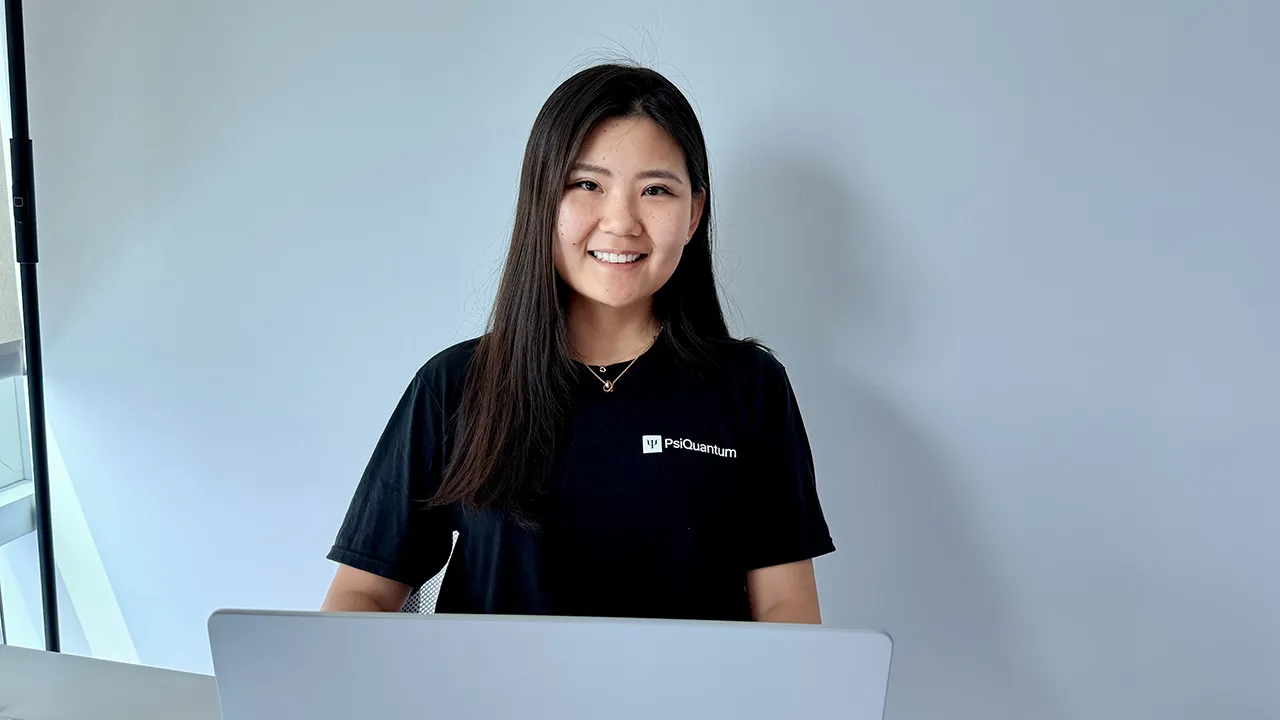
University of Chicago Pritzker School of Molecular Engineering's Qiaohong (Joanna) Wang, a PhD student in the Gagliardi Group, is spending the summer interning at quantum computer company PsiQuantum.
Engineering the Summer is an annual series following UChicago Pritzker School of Molecular Engineering students as they embark on summer internships and career experiences.
University of Chicago Pritzker School of Molecular Engineering PhD student Qiaohong (Joanna) Wang isn’t just excited about the future of the field of quantum science and engineering. She’s excited about quantum’s future impact on every field.
“I believe quantum computing can transform several fields over the next 10 to 20 years by enabling new approaches to problems that are impossible for classical computers,” said Wang, a rising fifth year in the Gagliardi Group. “In particular, it may accelerate advances in chemistry, materials science, drug discovery, and energy by allowing researchers to model complex quantum systems more accurately.”
Wang is helping to bring that future closer through a summer internship with quantum computing company PsiQuantum, which is developing utility-scale, fault tolerant quantum computers using silicon photonics.
She shared her experience for UChicago PME’s Engineering the Summer series:
This interview has been edited for length and clarity.
What has been your experience so far this summer at your internship?
My experience at PsiQuantum this summer has been really exciting and intellectually rewarding. I have had the opportunity to learn from many talented researchers while strengthening my ability to work in areas that are outside my usual research focus.
Because PsiQuantum focuses on fault-tolerant quantum computation, rather than the near-term quantum algorithms I study as part of my PhD, I have been able to explore and learn a fundamentally different theoretical and computational framework for addressing both familiar and entirely new challenges. This experience has broadened my perspective and really challenged me to grow as a PhD student.
How does your internship connect with your field of study at UChicago PME?
PsiQuantum’s mission is to develop the hardware and software required for fault-tolerant quantum computing, which allows me to apply my background in quantum algorithms for quantum chemistry, while gaining exposure to a different theoretical and computational framework.
Although my PhD research focuses primarily on near-term quantum computing, both areas seek to use quantum computation to address complex scientific problems that are difficult for classical methods. Working within this different paradigm has deepened my understanding of the broader quantum computing stack and how multiple approaches may contribute to future advances in chemistry and materials science.
What role do you hope to play in the future of quantum science and engineering?
I hope to remain closely connected to many different stacks in quantum computing research while helping translate scientific advances into practical applications. In particular, I would like to continue developing quantum algorithms for chemistry and materials science and contribute to technologies that address meaningful challenges in areas such as energy, medicine, and sustainability. I also hope to help bridge academia and industry so that emerging discoveries can ultimately create real-world impact.
Related News
-
New method could yield fast, cross-country quantum network
July 09, 2024Quantum computers offer powerful ways to improve cybersecurity, communications, and data processing, among other fields. To realize these full benefits, however, multiple quantum computers need to be... -

Innovative phonon-based quantum computing research at UChicago Engineering gets a $3 million boost by the U.S. Department of Defense
July 15, 2024UChicago Pritzker School of Molecular Engineering Prof. Andrew Cleland has been named a 2024 Vannevar Bush Faculty Fellow, the U.S. Department of Defense’s flagship single-investigator award for basic... -

US Defense Department, State of Illinois announce multimillion-dollar quantum testing program
July 16, 2024The US Department of Defense will invest up to $140 million to develop a national proving ground for quantum technologies in the Chicago region, Illinois Governor JB Pritzker announced Tuesday morning...