
George Shultz Innovation Fund awards $250K to UChicago PME-founded startup Signl
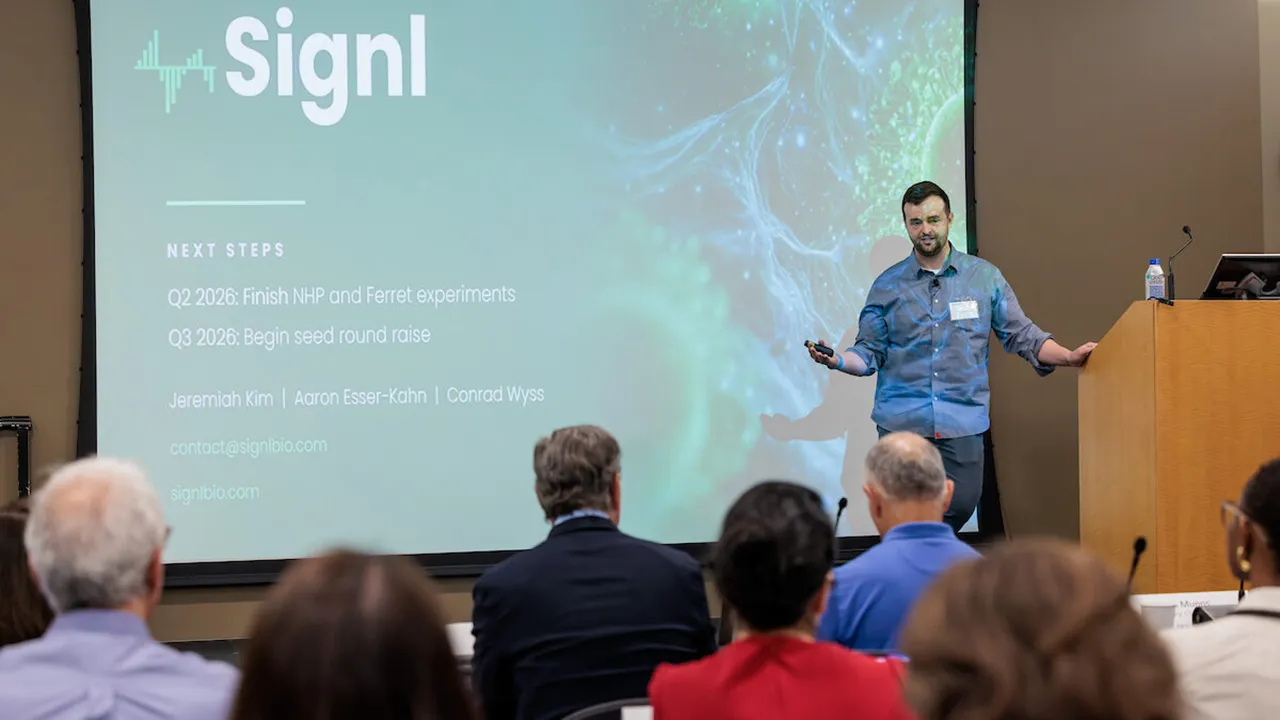
Prof. Aaron Esser-Kahn leads a presentation about his startup Signl, which he cofounded with Jeremiah Kim, PhD’24. (Image courtesy of the Polsky Center)
The George Shultz Innovation Fund has selected two University of Chicago startups, Parasol Medtech and Signl, for an investment of $250,000 each.
This year’s finals marked 15 years of the George Shultz Innovation Fund. Over that time, the fund has invested $10.4 million in 83 startups, which have raised more than $327 million in follow-on funding. Of these startups, five have exited, and 53% are still active.
“I have no doubt that both Signl and Parasol are going to make a big impact on society, and I’m excited that we are able to help support their ambitious goals with an investment from the George Shultz Innovation Fund. Congratulations to both awardees. We look forward to seeing what comes next,” said Shyama Majumdar, senior director, science accelerators and investments, Polsky Center.
Announced in March, the four 2026 finalists pitched last month to the Innovation Fund Advisory Committee, which consists of advisors, entrepreneurs, and industry experts. Two startups were ultimately selected for an investment of $250,000 each.
Signl was cofounded by Aaron Esser-Kahn, professor of molecular engineering at the University of Chicago Pritzker School of Molecular Engineering, and his former graduate student Jeremiah Kim, PhD’24, who is the startup’s chief science officer.
Building on years of research, the startup has discovered medicines that act like a “sound mixer” for the immune system — letting scientists “turn down” a vaccine’s side effects, while “boosting” its protection.
The approach has already worked in animal studies, and the funding will help the work move out of the lab and toward patients.
“The funding helps us take our next steps as we start scaling up our compounds for clinical-grade materials, exploring partnerships, and hiring key individuals,” said Esser-Kahn. “We are grateful for the Polsky Center with the quality of their advisors, programming, and resources for innovation coming out of UChicago.”
Signl is starting with mRNA vaccines and treatments, where side effects often limit how much medicine a patient can be given safely.
“The funding helps expand our already robust ties with the University of Chicago,” added Kim. “The advisors were instrumental in iterating our storytelling, supporting us on multiple fronts.”
—Article was adapted from a story originally posted on the Polsky Center website
Related News
-

Small molecules induce trained immunity, opening a new approach to fighting disease
July 08, 2024Vaccines provide a front-line defense against dangerous viruses, training adaptive immune cells to identify and fight specific pathogens. But innate immune cells — the first responders to any bodily... -

Chan Zuckerberg Biohub Chicago awards $4.8M to PME faculty
July 10, 2024Nearly 125 million Americans live with some form of chronic inflammatory disease, and when the inflammation that accompanies the human body’s immune response malfunctions, the result can be harmful... -
Engineering the Summer: Innovating for consumer health
July 11, 2024Engineering the Summer is an annual series following molecular engineering students as they embark on summer internships and career experiences. Carlos Medina Jimenez's path to working at the...