IBM’s most advanced quantum computer unveiled at UChicago’s Hyde Park Labs
IBM Quantum System Two marks a milestone for the University’s quantum partnerships and for state of Illinois
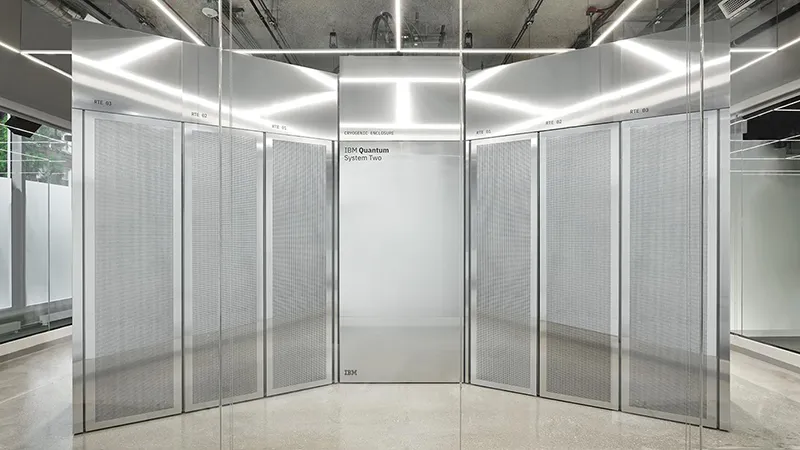
IBM Quantum System Two is IBM’s first quantum computer in Illinois. The system will help researchers and companies develop quantum algorithms for problems ranging from drug discovery to more efficient power grids. (Photo courtesy of IBM)
IBM’s most advanced quantum computer is now running at the University of Chicago’s Hyde Park Labs.
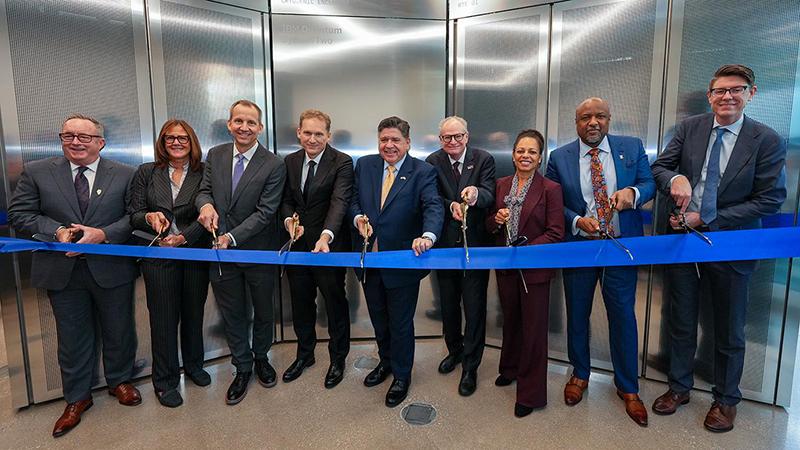
On Nov. 6, leaders from UChicago, IBM, and the Illinois Quantum and Microelectronics Park joined Gov. JB Pritzker to unveil a new IBM Quantum System Two computer at Hyde Park Labs near the UChicago campus. The system will help researchers and companies across Illinois develop quantum algorithms for problems ranging from drug discovery to more efficient power grids.
IBM Quantum System Two is IBM’s first quantum computer in Illinois. It sits on the ground floor of Hyde Park Labs, a research building at 5207 S. Harper Ave. that opened in 2025 to advance science research and entrepreneurship on Chicago’s South Side.
“I want the next generation of breakthroughs to happen in Illinois and the jobs and opportunity that come with them to benefit the people of Illinois,” said Governor JB Pritzker. “With the unveiling of IBM’s Quantum System Two in Hyde Park, we are giving researchers and businesses the tool to turn big ideas into real-world solutions. With our growing partnership with IBM, we are building an industry that will give Illinoisans more career opportunities and build a future right here at home.”
Passersby can see the quantum system through street-level windows facing Harper Avenue, making it a focal point for education about quantum computing and technology. The building also houses the UChicago Science Incubator, researchers from the UChicago Pritzker School of Molecular Engineering and Biological Sciences Division, and the Southside STEM Station, which runs free hands-on science programs for students and families in nearby neighborhoods.
“The deployment of IBM’s Quantum System Two represents the culmination of a years-long partnership that brought together academia, government and private industry to usher in a new generation of discovery,” said President Paul Alivisatos. “I am delighted that this machine is being unveiled here in Hyde Park, where our neighbors and community will have a view into the future.”
IBM Quantum System Two anchors the National Quantum Algorithm Center, where researchers from universities, national laboratories, startups and industry work alongside IBM scientists to turn quantum computing’s potential into practical applications. UChicago is hosting the new system; it will move to a permanent home at the Illinois Quantum and Microelectronics Park after that campus is complete.
The new system is powered by IBM Quantum Nighthawk, which IBM describes as the most powerful quantum chip it has ever built.
“IBM is proud to deploy the first quantum computer of IQMP — an IBM Quantum SystemTwo. Today, it can deliver scientifically useful results to organizations across the state of Illinois and beyond,” said Arvind Krishna, chairman and CEO of IBM. “As IBM's first quantum computer in Illinois, the system’s deployment marks a milestone for Illinois’ quantum community and builds on IBM's partnerships across the state as we expand quantum research across academia and industries.”
Nighthawk connects 120 qubits through 218 tunable couplers in a square lattice, linking each qubit to its four nearest neighbors. That denser connectivity lets users run more complex circuits than IBM’s previous processor, while keeping error rates low. Systems like this are central to quantum-centric supercomputing, which combines quantum and classical computing resources to do what neither can do alone.
-
From left: Ill. Governor JB Pritzker, UChicago President Paul Alivisatos, and UChicago Vice President for Research Nadya Mason, at the Nov. 6 ribbon-cutting event for the IBM Quantum System Two - IBM's first quantum computer in Illinois. (Photo by Jason Smith)
-
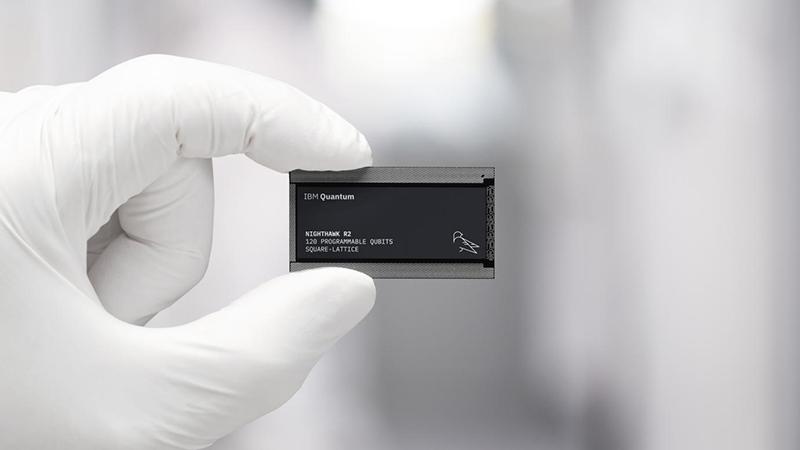
The IBM Quantum System Two is powered by "Quantum Nighthawk," which IBM describes as the most powerful quantum chip it has ever built. (Photo courtesy of IBM)
-
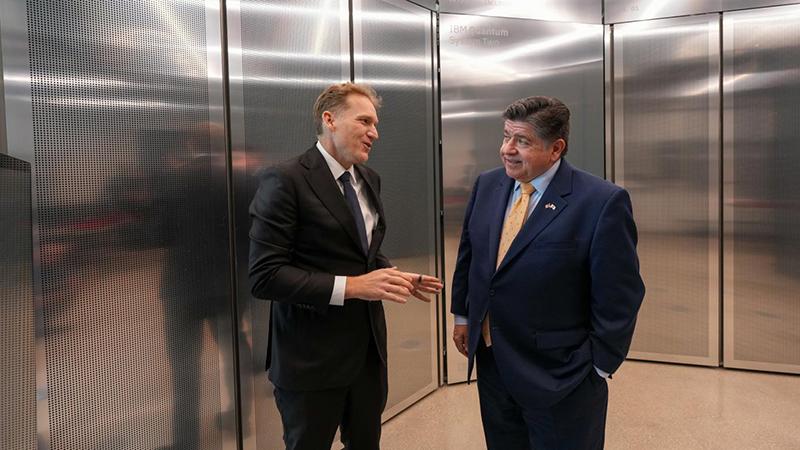
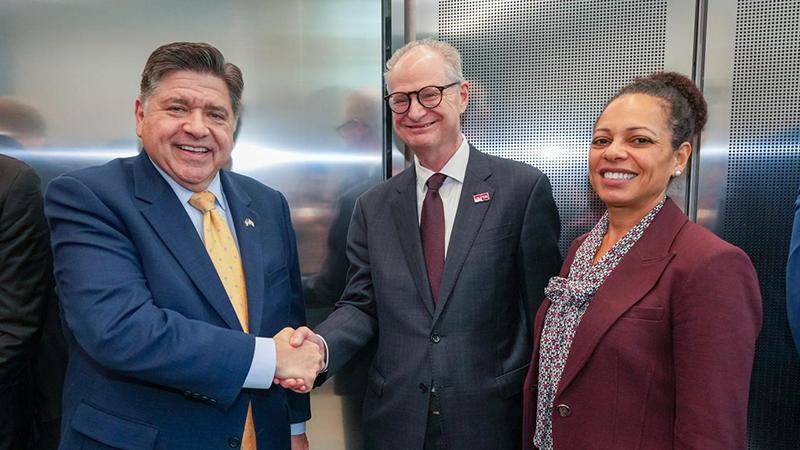
Ill. Gov. JB Pritzker (at right) and IBM director of research Jay Gambetta at the ribbon-cutting ceremony at Hyde Park Labs. The new system will help researchers and companies across Illinois develop quantum algorithms for problems ranging from drug discovery to more efficient power grids. (Photo by Jason Smith)
A partnership years in the making
The unveiling builds upon a UChicago–IBM relationship that has grown steadily in recent years. In 2023, at the G7 Summit in Japan, UChicago, IBM and the University of Tokyo launched a 10-year, $100 million initiative to develop blueprints for a quantum-centric supercomputer powered by 100,000 qubits.
“Our ambitious collaboration with IBM and the University of Tokyo is emblematic of a new approach with the potential to transform quantum computing technology,” said Nadya Mason, vice president for research and the Robert J. Zimmer Professor of Molecular Engineering and Physics. “By working together with these and other partners, we are able to accelerate innovation far beyond what any of us could accomplish alone.”
The collaboration is already producing results. In July, IBM and UChicago researchers, including Bill Fefferman, Associate Professor of Computer Science, announced a demonstration that meets the fundamental criteria for quantum advantage—the point at which quantum computers can perform computations that would be beyond the reach of classical computers. The quantum computer finished the task in about 15 minutes, while many leading classical approaches faced prohibitive runtimes.
With the unveiling of IBM’s Quantum System Two in Hyde Park, we are giving researchers and businesses the tool to turn big ideas into real-world solutions.
— Gov JB Pritzker
Building a quantum workforce and economy
The system will also open opportunities for entrepreneurs and students.
Duality, the nation’s first quantum startup accelerator, is led by UChicago’s Polsky Center for Entrepreneurship and Innovation. IBM has committed to supporting Duality startups with funding, technical expertise and access to IBM’s quantum computers, including IBM Quantum System Two, so they can develop quantum software.
Since 2023, IBM and UChicago have also worked with universities in Japan and South Korea on an effort to prepare 40,000 students for quantum computing careers over the next decade. Earlier this year, IBM announced it would establish a FutureNow Chicago center at the Illinois Quantum Microelectronics Park, bringing 750 jobs to the region. As part of that effort, IBM is helping City Colleges of Chicago design a new apprenticeship program and has committed to hiring one-third of qualified graduates.
The system also strengthens a growing effort to turn quantum research into companies and jobs on the South Side. Startups in the UChicago Science Incubator, located in the same building as Hyde Park Labs, have access to a dedicated quantum suite; and Harper Court Ventures, a $25 million fund formed through a cooperation agreement with UChicago, targets high-impact sectors including quantum computing.
This work takes place within one of the world’s most concentrated quantum ecosystems, convened in large part by the Chicago Quantum Exchange, founded and housed at UChicago. It is anchored by Argonne National Laboratory and Fermilab, the University of Illinois Urbana-Champaign, the University of Wisconsin–Madison, Northwestern University and Purdue University, and it works with more than 50 corporate partners, as well as dozens of international and nonprofit partners, making it one of the largest collaborative quantum science organizations in the world. IBM is a core CQE partner, and its researchers collaborate with scientists across the consortium on quantum hardware and software.
Related News
-

Quantum research leads to startup for PhD Student
November 05, 2026Sagar Kumar Seth, PhD’26, has found success in commercializing the processes he helped develop as a graduate student studying quantum engineering. -
UChicago, Toyota collaborate to advance quantum technologies for future mobility and transportation
November 03, 2026The University of Chicago and Toyota have entered into a multi-year collaborative research agreement to accelerate the development of quantum technologies for future mobility, sustainable... -

Aaron Fluitt joins the Chicago Quantum Exchange as CEO
November 02, 2026A ‘mobilizer’ known for unifying people around big ideas, Fluitt brings experience — and big wins — from industry, national lab