A powerful platform for studying ions in solids
New insights into how ions move through solids can have applications from batteries to microelectronics to water filters
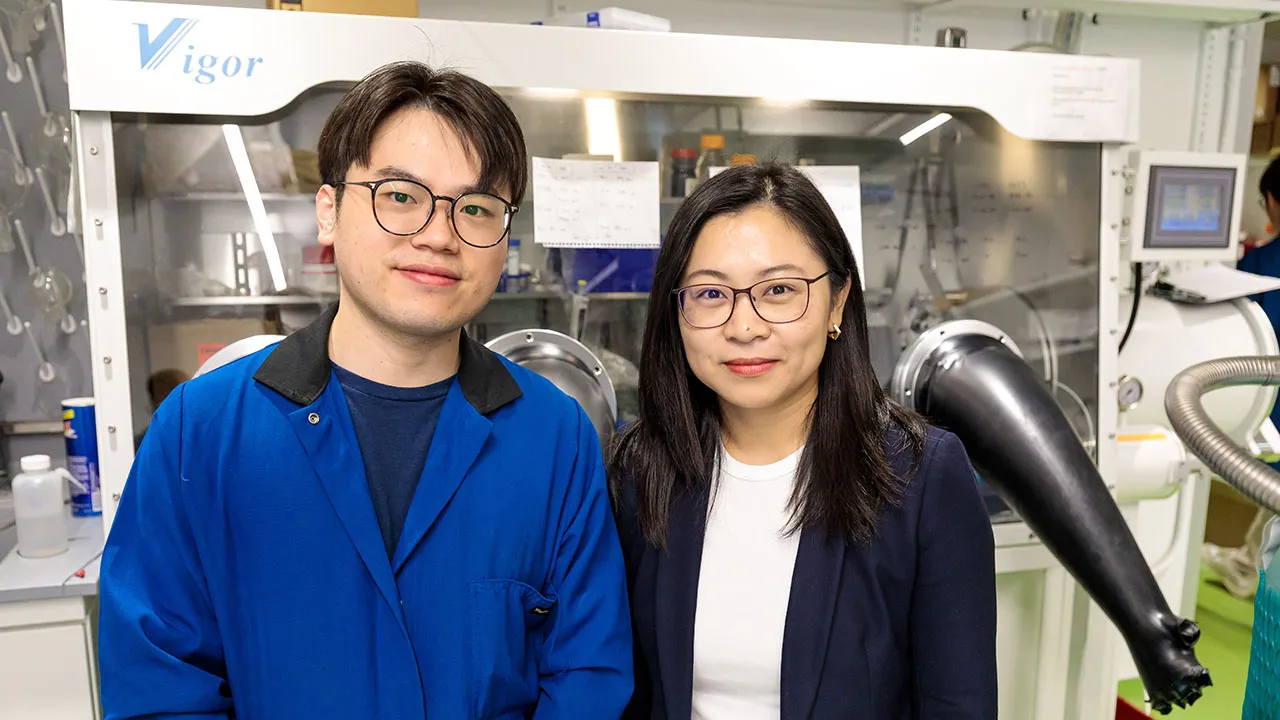
UChicago Pritzker School of Molecular Engineering graduate Gangbin Yan, PhD'25, (left) and Assoc. Prof. Chong Liu are two of the authors of a new collaboration between UChicago PME and Delft University of Technology (TU Delft) in the Netherlands that pioneered a new way to study coupled multi-ion and electron transport in solids, showing that the picture in solids is more complicated than previously assumed. (Photo by John Zich)
Understanding how ions diffuse in solid materials is essential for technologies including batteries, electronics and chemical catalysts, but has been hard for a simple reason: They’re solids.
“When we think about diffusion processes in liquid, you drop ink in water and then you see how the ink will spread,” said UChicago Pritzker School of Molecular Engineering (UChicago PME) Assoc. Prof. Chong Liu. “There are a lot more constraints in solids than in the liquid environment, so diffusion is not as well-studied.”
A team led by researchers at UChicago PME and Delft University of Technology (TU Delft) in the Netherlands has pioneered a new way to study coupled multi-ion and electron transport in solids, showing that the picture in solids is more complicated than previously assumed.
“Those assumptions break because the self-exclusion and the cross-channel hopping are different for highly confined materials,” said UChicago PME graduate and co-first author Gangbin Yan, PhD’25. “You cannot describe this just using the traditional diffusion model.”
The team, which included researchers from the Massachusetts Institute of Technology (MIT) and the University of Illinois at Urbana-Champaign (UIUC), created a “tracer exchange” technique similar to the isotope tracking used to follow individual atoms through chemical reactions or cellular processes.
Their results were published in Nature Communications.
When we think about diffusion processes in liquid, you drop ink in water and then you see how the ink will spread. There are a lot more constraints in solids.
UChicago PME Assoc. Prof. Chong Liu
By tracing the paths of sodium and lithium ions as they passed through a solid lithium iron phosphate, they found traditional “Fickian” diffusion, yes. But they also found a complicated web of nanoscale confinement, structural dynamics, spots where one-dimensional channels forced ions to march in single file, spots where chemical reactions or lattice softening rush ions down the path and other complexities previous models missed.
“This work demonstrates that something as apparently well-known and described as diffusion of ions is much more intricate and can transition between different modes,” said TU Delft Prof. Marnix Wagemaker, co-corresponding author along with Liu. “These fundamental insights as well as the methods developed to establish this represent building blocks for better understanding of these processes that are relevant for materials for electrochemical energy storage and conversion.”
The results establish tracer exchange as a powerful platform for studying diffusion in solids, with major applications for building new batteries, electronics or membranes to extract pollutants or valuable materials from water.
“Fundamental understanding of diffusion in highly concentrated solids can extend the ways we characterize and optimize these systems,” said co-first author Pierfrancesco Ombrini, a PhD candidate at TU Delft. “The developed methodology could distinguish between surface ionic reactions, electronic limitations and solid diffusion in an important material such as lithium iron phosphate (LFP), widely used in batteries and, more recently, in lithium extraction technologies. The same method can be used to evaluate other exchange phenomena, such as hydrogen inclusions in metals or catalysts.”
Roads less traveled
Imagine someone meandering aimlessly on the side of a hill, going back and forth with no destination in mind. Eventually, just following the path of least resistance, that person will end up at the bottom of the hill.
That’s similar to how ions diffuse in liquid. Ions engage in random, directionless “Brownian motion” as “Fickian diffusion” passively pulls them toward lower-concentration areas.
“The particle or the ions don’t know where they have to go, and they’re just going back and forth in a random motion,” Liu said. “Each of the steps is usually similar in size, so that it will go to the left, to the right, and up and down. At the end you see a net direction, like how a gradient will drive things to a low gradient, like a high concentration will drive ions to low concentration.”
Our main focus in this paper was understanding the materials themselves, but there are several directions this research opens up.
Co-first author Gangbin Yan, PhD’25
Fickian diffusion has been the working model for liquids – imagine pouring ink in water or milk in tea – since 1855. But solids are different.
“People sometimes would just take Brownian motion as the default movement for ions in solid, and sometimes it’s still true, but not necessarily true,” Liu said. “In this paper, we discovered anomalous diffusion, which is how people describe diffusion that deviates from Brownian motion like subdiffusion or superdiffusion. We actually saw both.”
“By revealing this previously unseen world of rich ion dynamics, this research establishes tracer exchange as a powerful new way to probe coupled multi-ion and electron transport in solids,” added UIUC Prof. Qian Chen, one of the senior authors of the work.
MIT Prof. Martin Bazant, also a senior author, said the discoveries are ripe for future study and possible applications.
“This work reveals the exquisite physics of multicomponent intercalation and ionic diffusion in anisotropic crystal nanoparticles, including regimes of both super- and sub-diffusion transitioning to normal diffusion, driven by ion exchange or coupled-ion electron transfer reactions,” Bazant said. “The combined theoretical and experimental insights provide a fundamental basis for the design of improved batteries and electrochemical lithium extraction systems.”
In establishing tracer exchange as an important tool for studying diffusion in solids, the study reveals several paths for future work, Yan said.
“Our main focus in this paper was understanding the materials themselves, but there are several directions this research opens up,” Yan said. “You can go practical by using it to design new technologies, go even deeper in using it to explore our fundamental understanding of ion exchange, or be universal, trying to translate this powerful tracer exchange platform to other material systems.”
Citation: “Crossover dynamics of non-Fickian ionic diffusion in solids,” Yan et al. Nature Communications, May 30, 2026. DOI: 10.1038/s41467-026-73937-w
Related News
-

Polymer insights, biological impact
October 21, 2026Research sheds light on liquid-liquid phase separation, a process that helps cells form life-sustaining structures. -

Matthew Tirrell elected to the National Academy of Medicine
October 19, 2026Tirrell has been elected to the National Academy of Medicine for pioneering the design and synthesis of self-assembling polymers to deliver peptide, protein, and nucleotide drugs in cardiovascular... -

Battery Day lights up the Museum of Science and Industry
October 15, 2026Yearly event has Amanchukwu Lab researchers help children build and understand the batteries that power their lives.