To prepare engineering students in Nigeria for graduate school, UChicago PME program offers research experience
Research Experience for Nigerian Undergraduates (RENEU) provides up to 10 students in Nigeria with a virtual summer research experience to help prepare them for careers in engineering or for PhD programs abroad
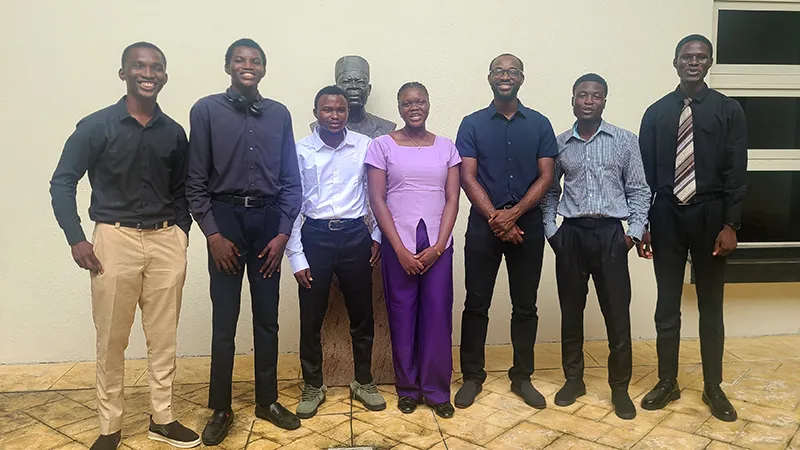
Participants in the Research Experience for Nigerian Undergraduates (RENEU) are paired with graduate students or postdoctoral fellows under the tutelage of professors and scientists from US universities and research institutions to work virtually on research projects. (Photo courtesy of Asst. Prof. Chibueze Amanchukwu)
As a chemical engineering student in Nigeria, Daramola Mayowa has his sights set on a research career at the intersection of computational modeling and sustainability.
But to pursue a graduate degree in the field, he needs research experience—the kind that are not plentiful at his university, Obafemi Awolowo University in Ilé-Ifẹ̀.
In fact, “that’s a big challenge for students from Nigerian universities,” said University of Chicago Pritzker School of Molecular Engineering (UChicago PME) Asst. Prof. Chibueze Amanchukwu, who is from Nigeria. “Because there are limited research opportunities, it can be difficult for them to be competitive in applying to top PhD programs.”
That’s where the Research Experience for Nigerian Undergraduates (RENEU) comes in. The UChicago PME program provides up to 10 students in Nigeria with a virtual summer research experience to help prepare them for careers in engineering or for PhD programs abroad.
In the program, students are paired with graduate students or postdoctoral fellows under the tutelage of professors and scientists from US universities and research institutions to work virtually on research projects. Students also meet weekly to learn about professional development topics, including the US PhD application process.
“This program exposes really high-performing students to what research is like,” said Amanchukwu, who founded the program in 2023 after seeing the success of virtual research during the COVID-19 pandemic shutdowns.
After finishing its fourth year this summer, the program is seeing results. Many alumni have gone on to PhD programs in the United States and around the world, and word of the program has spread. This year, more than 300 people applied for seven spots.
“Because we have seen these real-world outcomes, the program has blossomed and has become very prestigious,” Amanchukwu said.
Virtual projects to give students a taste of research
Another reason the program is popular is that mentors design research experiences specifically for undergraduate students. Alex Acquah, a PhD student at the University of Illinois Chicago, designed a project for Mayowa to investigate how the molecular structure of certain liquids influences how they coordinate ions of critical minerals—an important step in designing better and greener solvents for critical mineral extraction.
“A lot of the early effort went into setting everything up, so he could focus on the science rather than the software problems,” Acquah said.
Still, the project had a steep learning curve.
“I had some experience with engineering simulations, but molecular dynamics and its associated workflow were completely new to me,” Mayowa said. Working on the research project at home also presented difficulties: Mayowa’s power supply wasn’t stable, and his laptop’s slow processor made the work take even longer.
But Acquah provided the structure and guidance Mayowa needed. “It was clear that he put a great deal of effort into preparing us for the project,” Mayowa said. “The quality of the resources he provided made it much easier for me to understand the research problem and get started effectively.”
Teaching Mayowa the workflow was helpful for Acquah, too. “It made me re-examine parts of my own workflow that I had stopped questioning,” he said.
Ultimately, Mayowa was able to run the full workflow himself, from building molecular structures to analyzing the simulation output. “Research is not always a straightforward progression from a question to an answer,” he said. “There is troubleshooting, uncertainty, and unexpected results. But RENEU strengthened my interest in pursuing research.”
Because we have seen these real-world outcomes, the program has blossomed and has become very prestigious.
Asst. Prof. Chibueze Amanchukwu
Combining disciplines to learn the research process
For Jimoh Abdulrahman, a chemical engineering student at Abubakar Tafawa Balewa University, the experience provided an end-to-end look at how research happens: from literature review to learning new concepts to solving problems.
Under the mentorship of Zhiyuan Han, a postdoctoral scholar at UChicago PME, Abdulrahman used AI-driven agents to accelerate the design of next-generation electrolytes for batteries.
“The project required combining concepts from battery science, computational chemistry, and artificial intelligence, making it a highly interdisciplinary effort,” Han said. Abdulrahman’s efforts “became an important part of our research progress and left a lasting impression on me.”
The project worked so well that the pair is discussing how to continue the research, even though the summer program has ended. “The experience has helped enhance and clarify my research interests,” Abdulrahman said. “I’m confident the research experience I have gained will make post-graduate research a little bit easier for me.”
The experience has helped enhance and clarify my research interests.
Jimoh Abdulrahman, chemical engineering student at Abubakar Tafawa Balewa University
Expanding the program beyond Nigeria
In addition to research experiences, students also learn best practices for applying to PhD programs, including how to write statements of purpose and get letters of recommendation. Those sessions are taught by a program partner, the educational consulting group Savvy Afro Success. After the program is over, all students meet in person in Nigeria to present their research to Amanchukwu and a broader audience.
Now, Amanchukwu is looking for additional funding opportunities to recruit more students from Nigeria and expand the program to students in other African countries.
“That way, students can work on research problems that are important to the continent,” he said. “But to do that, we need to build institutional knowledge and have a wealth of people who are equipped with the capacity to tackle research challenges. We’re excited to help do that.”