In Taiwan and Chicago, students say yes to the unfamiliar
Through the UChicago-Taiwan Student Exchange, undergraduates and fellows conduct hands-on research abroad while finding new paths forward
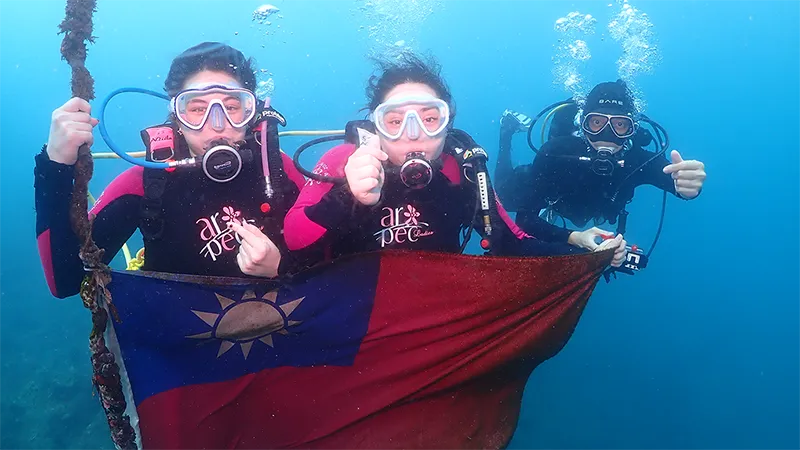
(In center) UChicago College student Melanie Vazquez-Pita scuba-diving off Liuqiu island, Taiwan. (Photo courtesy of Melanie Vazquez-Pita)
Editor’s note: This story is part of Dispatches from Abroad, a series highlighting UChicago community members who are researching, studying and working around the world.
For University of Chicago students abroad, helping with cutting-edge research is sometimes just one part of the impact.
In the UChicago-Taiwan Student Exchange (UCTS), which sends undergraduates and fellows across the Pacific in both directions for hands-on research, labmates became friends and the summer a turning point for life.
Launched in 2023, the exchange offers students a unique experience while building research collaboration between faculty on both sides. This summer, eight UChicago students worked in Taiwan, and 39 Taiwanese fellows came to Chicago. More than 100 principal investigators from Academia Sinica, National Cheng Kung University (NCKU), National Tsing Hua University (NTHU) and National Taiwan University (NTU) participated, as did more than 60 from UChicago.
“One particularly fascinating thing about the summer fellowship is the pleasant surprises that take students outside their comfort zone,” said Po-Chun Hsu, assistant professor of molecular engineering at UChicago’s Pritzker School of Molecular Engineering (UChicago PME) and the program’s director. “Because of the cultural difference, students often find themselves tackling problems with different perspectives and toolkits.”
The exchange also benefits host labs, Hsu said. Many fellows took on exploratory questions that were beyond the scope of ordinary research grants, which gives the principal investigators more breadth and flexibility.
For the students, the research was only part of the experience. Each arrived a little unsure of themselves but left with once-in-a-lifetime memories.
From spectroscopy to sea turtles
Melanie Vazquez-Pita, a fourth-year student who studies physics and visual arts, spent 11 weeks this summer at NCKU in Tainan, in a photonics lab working toward a nano-laser, a laser built from atomically thin semiconductor materials.
They’re like the nicest people ever. They will try to help you in any way they can.
Fourth-year student Melanie Vazquez-Pita
She shone light on flakes of the material and read the spectrum they gave off to tell which ones were a single layer thick, the kind that can later be placed on patterned surfaces to strengthen the effect and bring the lab closer to a working laser.
Taiwan is a hub for the semiconductor industry, and she spent time talking with her graduate student labmates about how master’s and Ph.D. programs work there.
She arrived with no Mandarin, and it worried her. But her labmates made all the difference.
“They’re like the nicest people ever,” Vazquez-Pita said of the people she met in Taiwan. “They will try to help you in any way they can.”
They also became her guides. One weekend, her lab rented a car and drove her to Yujing District, known for its mango festival, and enjoyed the fruits fresh from the orchard. Another time, a grad student whose hobby is diving and photographing fish, took her and her roommate to Liuqiu, a small island off Taiwan’s southwest coast. She had never been scuba diving but gave it a try.
“It was a little nerve-racking at first,” she said. “But we were able to see so many turtles. It was an unforgettable experience.”
The summer also pointed toward what’s next. Vazquez-Pita is thinking about Ph.D. programs in photonics or quantum optics, in the U.S. or abroad, and she now has contacts in Taiwan.
Chin said the way those connections have deepened has been the biggest surprise.
“When we started UCTS in 2023, I hoped to create meaningful research opportunities for students and connections between researchers in Taiwan and at UChicago,” he said. “What has surprised me most now is how quickly these connections have grown into lasting academic relationships, friendships and new career opportunities for the students that extend well beyond the summer.”
Looking back, Vazquez-Pita said the language worry shouldn’t stop anyone.
“If you don’t know Chinese, you shouldn’t be scared,” she said. “It was very fulfilling.”
From first lunch to first lesson plan
On her first day in Taipei in 2024, Ingrid Appen, SB’26, sat down to lunch and realized she couldn’t order in Mandarin.
“Despite taking five to six years of Chinese class, I was still incapable of ordering food in a real-life context,” she said.
She and another fellow managed anyway, and the bowl of chicken rice was delicious. Taiwan had long pulled at her. Her mother spent a summer there at about the same age, and “always told me that she loved it so much,” Appen said.
Appen, a molecular engineering major who went to Taiwan in 2024 as a rising third-year student, found the program on an email list and wrote to professors whose work fit her interest in sustainability. One, a member of a group of sustainability researchers at NTU, told her about a project she hadn’t seen listed. In the lab, she studied bacteria that, in the presence of calcium and urea, turn calcium into calcium carbonate, a white, chalky mineral, while drawing carbon dioxide out of the air.
The process could one day be used in self-healing concrete, a promising application in an earthquake-prone region. Her job was to measure how much of the mineral the bacteria could produce, and how fast.
The summer she went came right after a major earthquake, and another shook her room on her last day in Taiwan.
“I was like, ‘Oh my god, everything’s shaking,’” she said. Her friends texted to ask if she’d felt it. After about 30 seconds, it stopped. “It was a little startling.” But she called the summer the “best summer of my life.”
The people made it. “When you’re new in a place, you screw up a million times, and they were very patient,” she said. When she practiced Mandarin with locals, “they’d help me practice in Chinese, even though it was so much harder for them than just doing English.”
Because of the cultural difference, students often find themselves tackling problems with different perspectives and toolkits.
Asst. Prof. Po-Chun Hsu
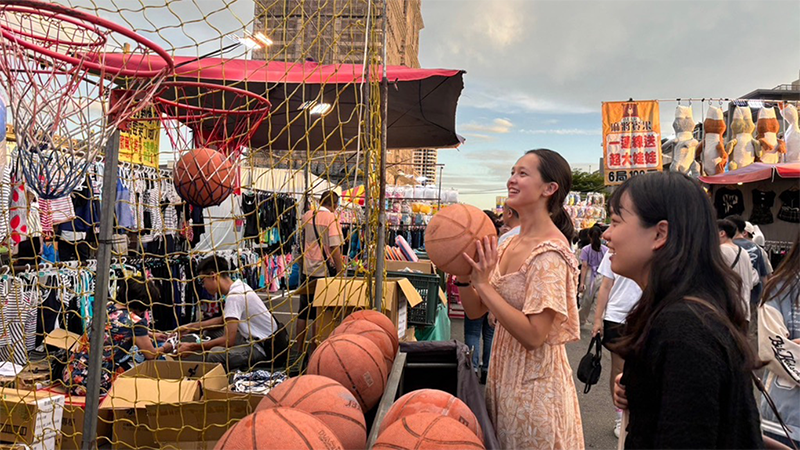
One weekend, a coworker who grew up in Tainan invited the whole lab to visit her hometown. They rode the high-speed rail from Taipei, and her father picked them up at the station. The next day, they ate fish soup, met her dog and sister, and ended the day at a night market.
Two years later, Appen is back in Taiwan as a Fulbright Scholar, teaching English in Yilan County. She was nervous on her first day.
“I honestly had no idea what to expect,” she said. She prepared slides with questions like “Where is Teacher Ingrid from?” and “What sports does Teacher Ingrid like?” and let the students guess. The local teacher helped her with classroom management, and then students got to ask questions of their own. “The most common question I got was, ‘Do you like hamburgers?’” she said.
“It’s nice to look back and realize how far my speaking skills have come,” she said.
She will start a chemical engineering Ph.D. at the University of California, Santa Barbara, a program she deferred to teach in Taiwan. Asked what advice she would give students considering UCTS, she emphasized an open mind.
“A lot of research is really about learning the research process and less about the specific topic,” she said. “Especially as an undergrad, it’s always great to branch out.”
Starting over in English
Half a world away, Wei-Kai “Walker” Shao was facing the same challenge in reverse. He arrived at UChicago in summer 2025 after two years as a master’s student at NTU, wanting to find out whether he could do research in English.
“I thought this program would be a very good opportunity for me to test if I could do research in this kind of environment,” he said. “And I think the answer is yes.”
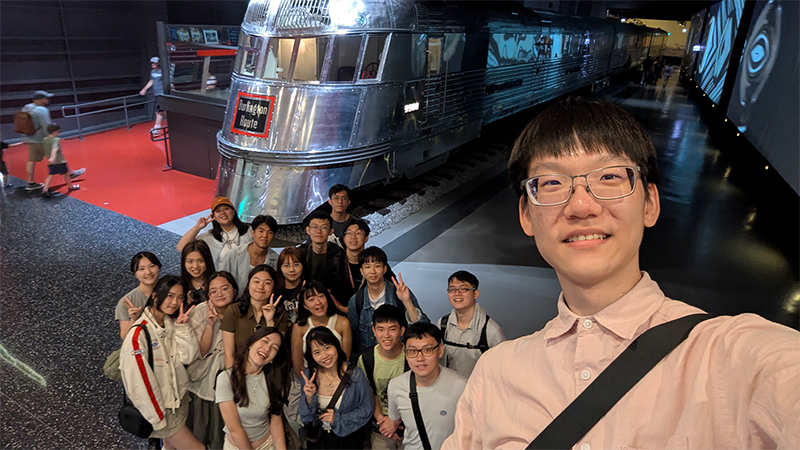
His first job was meeting other fellows at O’Hare and taking them to the dorm, jet-lagged and foggy, with everything suddenly in English.
“In Taiwan, I would say I’m very good at being efficient and planning things,” he said, “but in an English environment, it felt like I had to start over from zero.”
Each night he looked up what he might need to say the next day and practiced. Surrounded by other Taiwanese fellows, he was in what he called a “half-exposed, half-protected state,” and slowly got used to living in English.
“In those first days, I just thought everything was beautiful. I love houses and campus buildings full of details.”
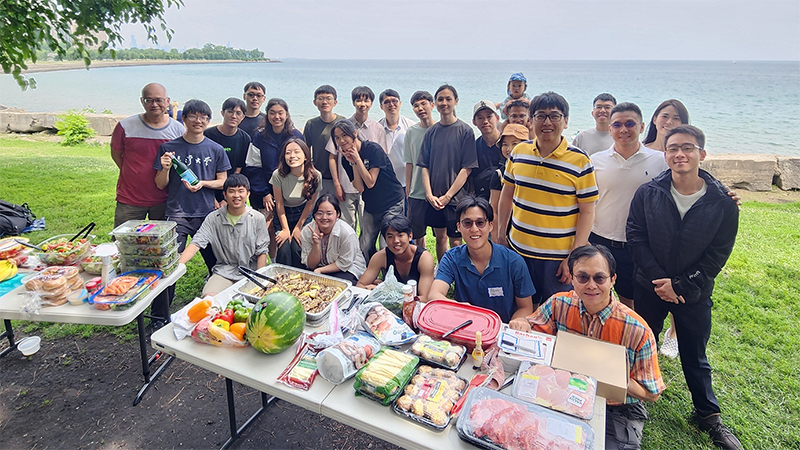
In the lab of Prof. Greg Engel, from the Department of Chemistry and UChicago PME, he worked on ultrafast spectroscopy, which uses extremely short laser pulses to watch molecules respond in real time. He learned how to design instruments, line up the optical path, write scripts to analyze data and filter noise from complex measurements.
Engel encouraged him to fully “experience the life of a Ph.D. student,” and gave him three questions to ask Ph.D. students and faculty about why they had chosen their programs and research groups.
“I only needed to try to understand and respond with the right feelings, so the other person felt I was following along,” he said. When it was his turn, “I would suddenly get stuck.” He kept trying, with more people and more topics, until he could share his research and even debate a concept.
Outside the lab, he served as UCTS Captain. He wanted his events open to everyone, with no cost barrier, so he planned visits to places that are free with a student ID, including the Art Institute, the Field Museum and the Griffin Museum of Science and Industry. By his count, he explored more than 200 places in Chicago and organized more than 100 events.
What excites me most about is seeing how this program builds lasting connections among students, faculty, and research communities in Taiwan and at UChicago.
UChicago Physics Prof. Cheng Chin
By the end of the summer, Chin, the program’s co-founder, had encouraged him to apply to doctoral programs directly.
He is one of four fellows from the 2025 cohort of 29 who have returned to UChicago in substantive roles: Shao and Mei-Chuan “Mabel” Peng as chemistry Ph.D. students, Yun-Chi “Yuki” Chen as a PME Ph.D. student, and Yi-Chia “Stacey” Huang as a research technician in the lab where she had been a fellow.
“What excites me most about UCTS is seeing it build lasting connections among students, faculty, and research communities in Taiwan and at UChicago,” said Cheng Chin, co-founder of UCTS and Horace B. Horton Professor in the Department of Physics. “I hope these collaborations and friendships will endure throughout the next generation’s academic careers.”
Full circle
Shao’s own field is computational chemistry, and he wants to apply AI to it “to discover new materials,” he said. “UChicago chemistry is famous for its theoretical and computational work. I can learn a lot here.”
This summer, he worked in the lab of Prof. Laura Gagliardi, where he built automated workflows for computer simulations of material interfaces. This fall, he also leads general chemistry lab and discussion sections for UChicago undergraduates.
“It’s hard to name one moment, but deep down, I could feel: ‘Ah, I’m not the same person I was when I first came to the U.S.,’” he said. “I’m no longer afraid to communicate in English, and I don’t really need to go through Chinese first.”
UChicago students interested in the 2027 UCTS program can apply by Jan. 31, 2027. Learn more here.