
UChicago Space Program takes stratospheric science to new heights
Undergraduate-built experiment collects particles 23 miles above Earth aboard a NASA high-altitude balloon
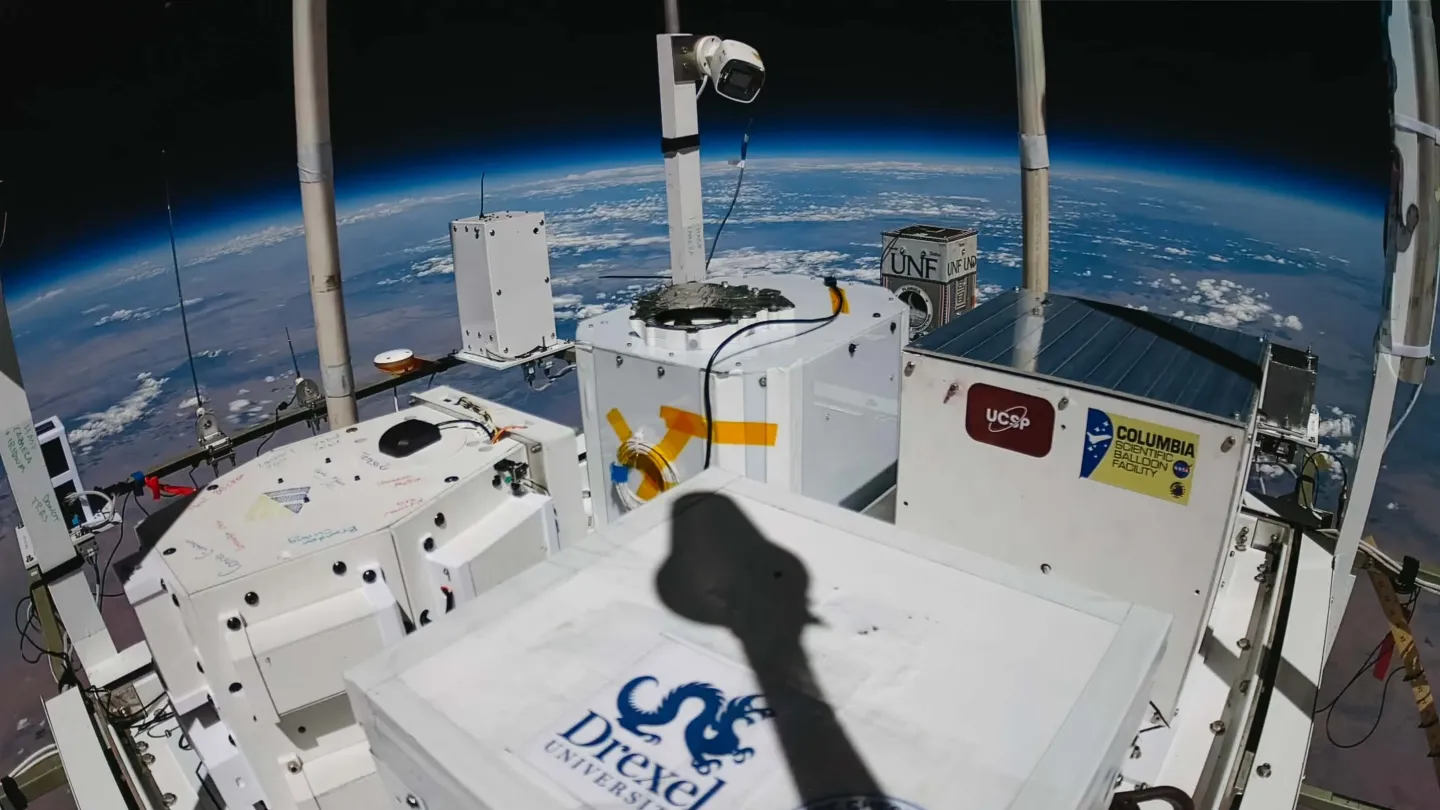
A view of the mid-stratosphere from NASA's High Altitude Student Platform (HASP) balloon. A project designed and built by University of Chicago undergraduates (right, with UChicago Space Progam logo) was one of 17 university student projects selected for HASP. (Photo courtesy NASA)
University of Chicago fourth-year Physics major Larry Li cruised through the New Mexican desert night in a tiny hatchback stuffed with toolboxes, a 3D printer and a payload that would soon float to the sky.
“I hit Albuquerque and there were three more hours to go,” Li said. “It was the middle of nowhere.”
The remote destination was NASA’s high-altitude balloon launch facility in Fort Sumner, New Mexico. The payload was PASCAL, a project designed, built, tested and operated entirely by University of Chicago undergraduates through the UChicago Space Program to capture and study human-created contamination within the mid-stratosphere. This is a region between 15.5 and 25 miles (25-40 kilometers) in altitude, well above where aircraft operate.
Twelve student volunteers created PASCAL, or Particle Acquisition from Stratospheric Conditions for Analysis in Laboratory, to fill a pressing research gap – understanding a level of the atmosphere greatly understudied since the Cold War.
“You could measure the scale of nuclear testing the Soviet Union was doing based on the radioactive particles in the stratosphere,” said project lead Mason McCormack, a fourth-year Astrophysics major. “That was a major reason to study this region back then. After the Cold War, that direct sampling mostly stopped and now, decades later, we have all these different questions and we don’t have great ways to sample the particles up there.”
In early September, PASCAL flew aboard NASA’s High Altitude Student Platform (HASP) balloon, collecting vital climate data 23 miles (37 kilometers) in the air. It was one of only 17 university projects accepted for this highly selective honor.
“Every sample collected from these altitudes matters because there have been so few,” said the team’s faculty advisor, Geophysical Sciences Assoc. Prof. Elisabeth Moyer. “It’s tremendously challenging to operate instruments when pressures are so low. Float altitude is over three times higher than the summit of Mount Everest. So there’s a bit of a race now to build a lightweight particle collector for the stratosphere.”
-
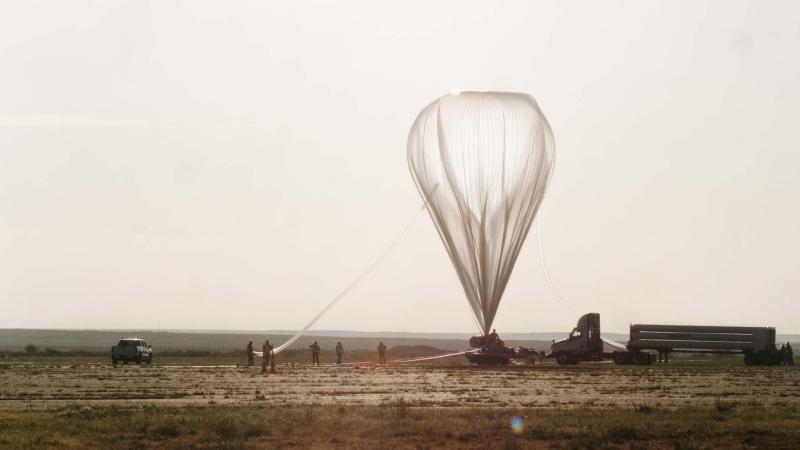
HASP prepares for launch over Fort Sumner, New Mexico. (Photo courtesy UChicago Space Program)
-
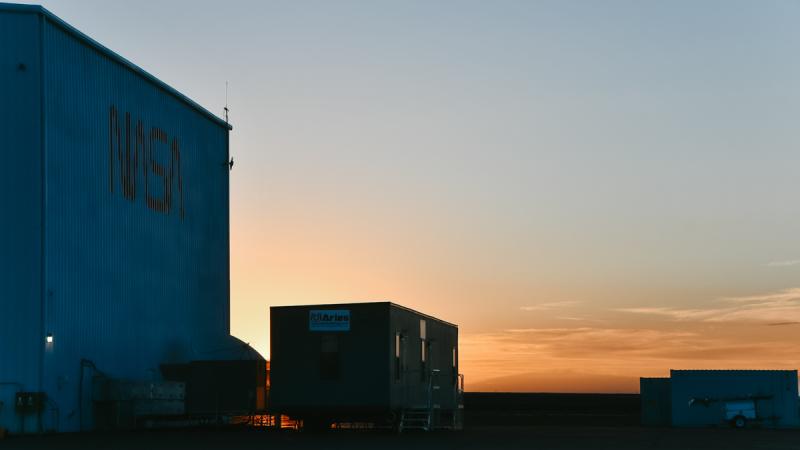
(Photo courtesy UChicago Space Program)
-
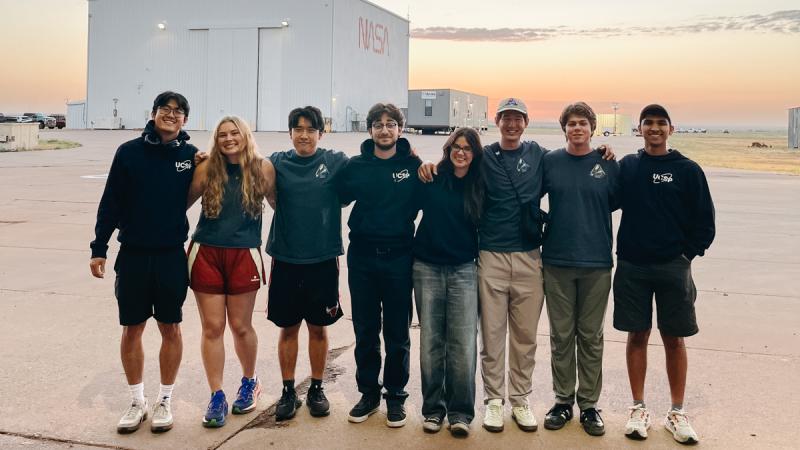
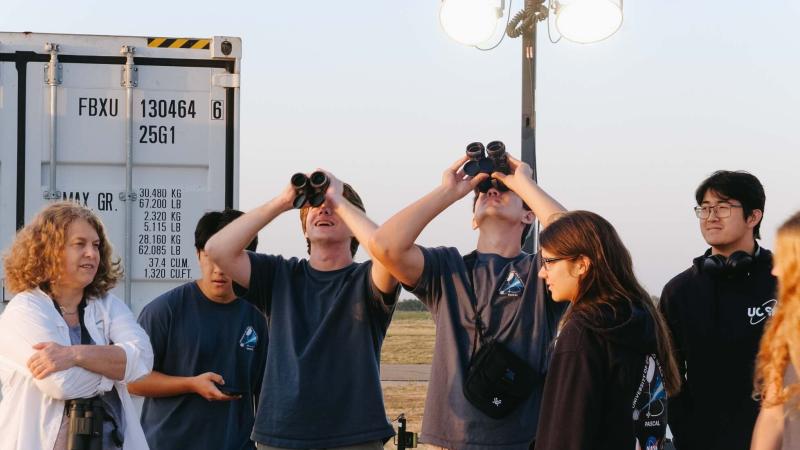
Eight of the 12 members of the UChicago Space Program who worked on PASCAL were able to attend the launch in early September. (Photo courtesy UChicago Space Program)
-
PASCAL flew for about seven hours of the planned 20-hour flight until weather conditions forced NASA to terminate the flight early. The UChicago Space Program team is currently analyzing the valuable particulate data the project collected. (Photo courtesy UChicago Space Program)
PASCAL was the UChicago Space Program’s first foray into high-altitude balloon work, having previously been selected to launch a student-designed satellite through NASA’s CubeSat Launch Initiative. The original idea grew out of a class McCormack was taking: a way to collect and study meteorite particles before they're contaminated by pollution in the lower levels of the atmosphere.
After talking to a few faculty members, the team realized the stratosphere held a more pressing research need.
“A lot of human contamination hangs out up there. Things like satellites that burn up in the atmosphere when they deorbit and particles from solid rocket fuel. Extreme wildfires will often have smoke that gets up into this layer,” McCormack said. “There are all these relevant modern questions we didn’t have an answer to because it had been 40 years since someone had concretely sampled the particles in this layer of the atmosphere.”
PASCAL receives financial support from the University of Chicago’s Climate Systems Engineering initiative (CSEi). The University created CSEi in 2024 as part of the then-new Institute for Climate and Sustainable Growth to advance bold solutions in the face of more than a century of accumulated carbon emission. The UChicago Pritzker School of Molecular Engineering PME is a core part of the Institute through its Energy Technologies Initiative.
“The PASCAL team found a gap in instrumentation for measuring stratospheric aerosols, a gap that could be filled by a small team with strong practical engineering skills,” said CSEi’s Founding Faculty Director, Geophysical Sciences Prof. David Keith. “I'm proud of the amazing job they've done. There’s no better way to learn practical science and engineering than building such an instrument.”
The first major challenge was technical: designing a way to collect particles in the thin stratospheric air.
“We didn’t know if it would work because the pressure is so low in the stratosphere, and we were looking at trying to pump air with a vacuum,” said Li, PASCAL’s lead engineer. “If there’s not a lot of air, you don’t get a lot of flow.”
“One of the big challenges we faced was that we were designing an entirely new instrument,” McCormack added. “Many of the projects selected for HASP were either improved versions of legacy projects that have flown before or were modeled off existing equipment. We were starting from scratch.”
The second big challenge was logistical: coordinating an entirely student-run volunteer project of 13 undergrads who had scattered to various locations over summer break. After four members received summer internships at NASA’s Jet Propulsion Laboratory and a few recent graduates landed jobs in Los Angeles, the team decided to complete PASCAL in Pasadena, working out of McCormack’s Caltech dorm room at night.
“It’s easy to underestimate the work that goes into putting together a finished project,” said embedded engineer Zumi Riekse, a third-year Physics major, who started on the project in Chicago and finished work remotely while working at an internship in Boston. “It takes longer than you think.”
After the midnight drive through the desert and a few days of delays waiting for weather conditions to be right, PASCAL and the other student projects lifted off, floating to the sky. Soon the team received shocking news: NASA initiated an emergency termination of the flight, sending the payload into freefall.
“The balloon had changed directions from where NASA thought it was going to go, and it was now going to go over some forests and mountains near Santa Fe,” McCormack said. “If the balloon comes down over mountains, it's much harder to recover, and we care about recovering our instrument.”
Although the balloon ended up flying for less than seven hours of the planned 20-hour flight, the retrieval was successful, with NASA shipping back PASCAL and its stratospheric particles back to UChicago for study. The UChicago Space Program plans to resubmit PASCAL for next year’s balloon launch as well, continuing to gather this important data.
“We have a lot of interested undergraduates and we will continue making payloads to enter in this competition, hopefully for years to come,” Riekse said.