Exploring sodium batteries down to the atom
After revealing how electron microscopes damage lithium battery samples, a new study explores the impact on – and implications for – more eco-friendly sodium devices
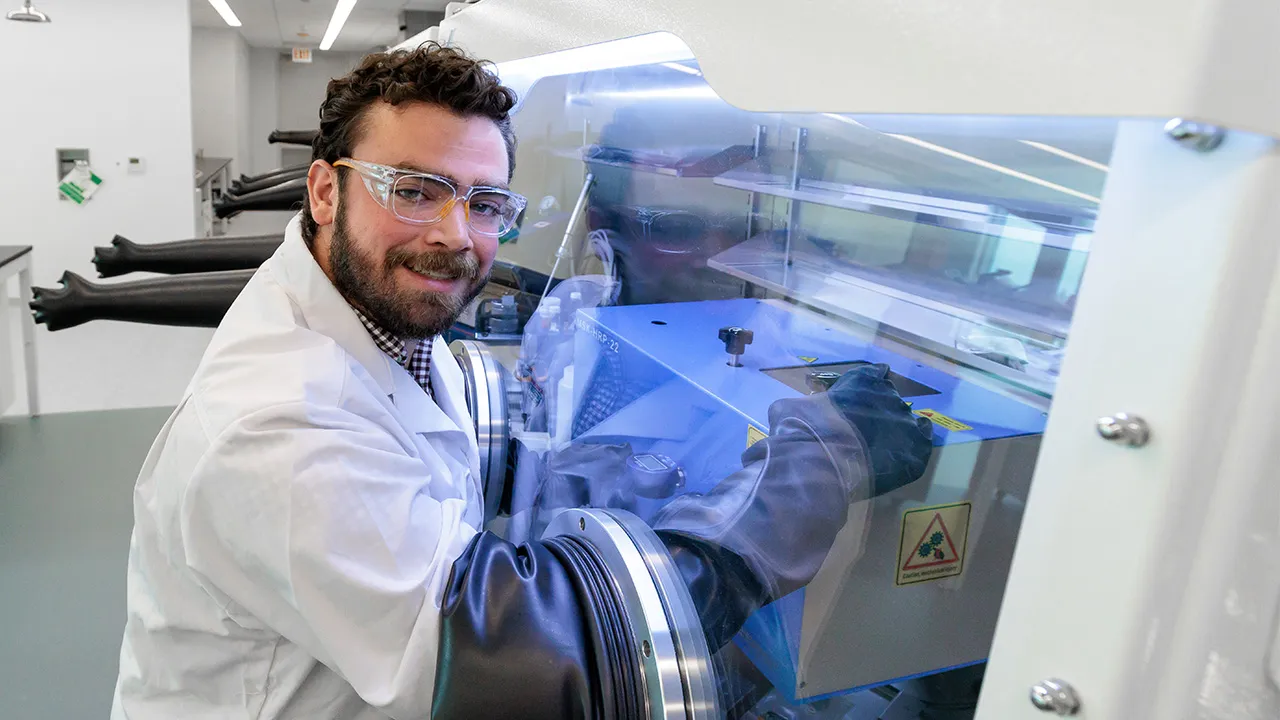
University of Chicago Pritzker School of Molecular Engineering PhD student Thomas Marchese is the first author of a new study exploring how common electron microscope practices can damage sodium-based battery components. (Photo by John Zich)
Understanding how battery components work at the molecular or atomic levels can help scientists create faster-charging, more powerful, longer-lived storage devices. But the electron microscopes powerful enough to give this view also change and distort the materials in ways scientists must cautiously appreciate.
“Zooming in and being able to see what happens at the interfaces between battery components is an invaluable tool to diagnose what's going wrong in our batteries and to figure out how we can heal that problem and fix it in the next generation,” said Department of Energy Energy Storage Research Alliance (ESRA) Deputy Assistant Director James Burrow. “To study this, we shine a beam of, in this case, electrons onto our sample. In this process, the electrons interact with the sample and also destroy it. This is something that's often overlooked in the literature.”
“If you think about water through a hose, the electron dose rate is how much pressure are we applying on the material with our microscope,” said University of Chicago Pritzker School of Molecular Engineering (UChicago PME) PhD student Thomas Marchese. “A lot of dose can create a pretty picture in the microscope but if the ‘pressure’ is too high, we can damage the sample. The material we ended up examining is no longer the material that we wanted to study, and our conclusions can be wrong.”
Marchese, of UChicago PME’s Laboratory for Energy Storage and Conversion (LESC), is the first author of a study recently published in Microscopy and Microanalysis that explores how this firehose of electrons interacts with the components of sodium batteries – and offers new insights on the utility of tools that are advancing the technology needed to get the planet off fossil fuels.
“Most rechargeable batteries are based on lithium ion, which is powerful but the lithium availability is limited and lithium batteries use some critical minerals such as copper and cobalt that are constrained resources,” said UChicago PME Liew Family Professor Shirley Meng, principal investigator of LESC and co-corresponding author of the new paper along with UC Berkeley Assoc. Prof. Mary Scott. “We need all available battery technologies, including lithium, each put to its best uses. But we also need to harness the practical benefits of readily available materials like sodium and sulfur.”
The research was supported through a cooperative research agreement between UChicago PME, Argonne National Laboratory and Thermo Fisher Scientific through ESRA.
“This paper is a direct result of that three-way collaboration and development process between industry, academia and the national labs,” said Burrow, who is also a co-author.
A lot of [electron] dose can create a pretty picture in the microscope but if the ‘pressure’ is too high, we can damage the sample.
University of Chicago Pritzker School of Molecular Engineering PhD student Thomas Marchese.
Together, they have developed a state-of-the-art electron microscope that combines some of the most efficient detectors for examining both structure and chemistry of materials which together provide complementary diagnostic tools to track the damage and study the materials before damage happens.
“For most materials that we look at in the electron microscope, the dose stability that we need for a typical experiment is in the tens of thousands or hundreds of thousands of electrons per square angstrom,” Marchese said. “With our detectors at Argonne that we’ve worked on with Thermo Fisher Scientific to develop and apply to energy and quantum materials, we’re able to get a lot of information in that first 10 to 50 electrons per angstrom squared before our materials undergo changes.”
This particular study led by Marchese all started with a question hauntingly familiar to anyone who owns electronics.
“Why does my phone, laptop, whatever, not keep the same charge that it usually does at the beginning of its life?” Marchese said. In many cases, “Those parasitic losses are often attributed to side reactions and solid electrolyte interphase (SEI) formation. In this study, we’re using electron microscopy to look at a very promising battery where that interphase doesn't form because we’ve replaced the liquid electrolyte with a stable sodium solid-state electrolyte.”
Advancing previous work
In 2024, LESC debuted the world’s first anode-free sodium solid-state battery, a fast-charging, powerful battery harnessing sodium’s cost and environmental benefits. To better study the reasons behind the success of this innovation, LESC researchers turned to another of their strengths – studying battery components and interfaces with electron microscopes. In a “milestone” paper earlier this year, the lab developed guidelines for electron microscopists examining battery samples. The guidelines review the importance of clean sample preparation and tracking beam damage as a function of electron dosage to prevent misleading results that invisibly hold back battery research.
While that paper looked at both lithium and sodium anodes, the new work dives into the promising sodium solid-state electrolyte used in the 2024 paper. Their careful, inert gas transfer method again allowed the team to bring the sample into their microscope at room temperature for a look at the sodium battery’s inner workings before the damage the electron microscope would commonly create.
“Typically for battery materials for the last decade now, everyone’s first instinct is to go to cryogenic temperatures because that helps mitigate a lot of radiolysis damage and give you a dose that you can work with,” Marchese said. “But with this material we found that benefit was absent, which was a first indication that we had a different damage mechanism on our hands from the previous anode studies. Through a campaign of conditions utilizing fast, low-dose direct electron detectors and state-of-the-art chemical spectroscopy, we tracked and identified the dominant beam damage mechanism to be electrostatic charging damage."
They then discovered an unintended benefit of the charging damage mechanism leading to the most important confirmation of the study. By design, the sodium ions are highly mobile within the sodium solid-state electrolyte and therefore the bias of the electron beam charging actually chased sodium ions from the ionically conductive framework. In selectively scanning the electron beam across just one portion of a sample, we gained control to nucleate sodium metal crystals onto the opposite side.
“We’re looking at a fresh interface between our sodium solid-state electrolyte and sodium metal which mirrors the first deposition in the anode free batteries of my colleagues' previous work,” Marchese said. “We have the proof we sought demonstrating that no reacted SEI forms between the components and is what enables this system to operate for so long without losing capacity. Next, we can study the crystallography of that sodium directly growing out of this at the interface is of great value towards better design of next-generation fuel cells.”
Citation: “Sodium Expulsion From Sodium closo-Hydroborates Under Electron Beam-Induced Bias,” Marchese et al., Microscopy and Microanalysis, September 25, 2026. DOI: 10.1093/mam/ozag104
Related News
-
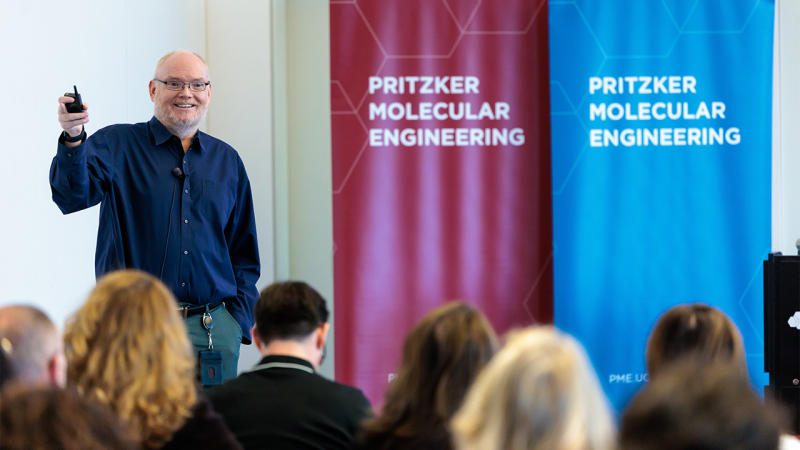
Dean’s Town Hall: Momentum and growth key to UChicago PME’s future
October 28, 2026The UChicago PME Fall 2026 Town Hall was the first for Interim Dean Stuart Rowan. -

Agilent and University of Chicago Launch Center of Excellence for Energy Materials Research
October 27, 2026Agilent CoE supports research on next-generation energy storage materials. -
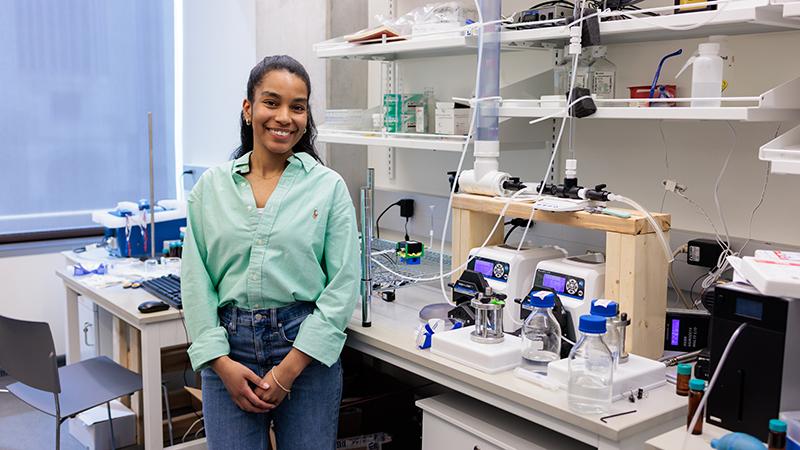
A passion for both research and teaching
October 22, 2026PhD student Jamila Eatman pursues water membrane research while educating the next generation of engineers.