The University of Chicago’s 2014 Convocation was a sea of maroon and velvet, with hundreds of graduates in caps, hoods and gowns proceeding across the stage, trailing their respective programs’ banners.
That year’s ceremony included a banner no one had ever seen before – the Institute for Molecular Engineering (IME), the predecessor of the University of Chicago Pritzker School of Molecular Engineering (UChicago PME). And walking behind that banner was a lone student: Paulina Rincon Delgadillo, PhD‘14.
“That was a huge honor for me,” she said. “I could not believe that I was the first one walking behind the banner.”
Over the years, 184 students have earned PhDs from what is now, after a transformative gift from the Pritzker Family Foundation in 2019, UChicago PME. Rincon Delgadillo was the very first.
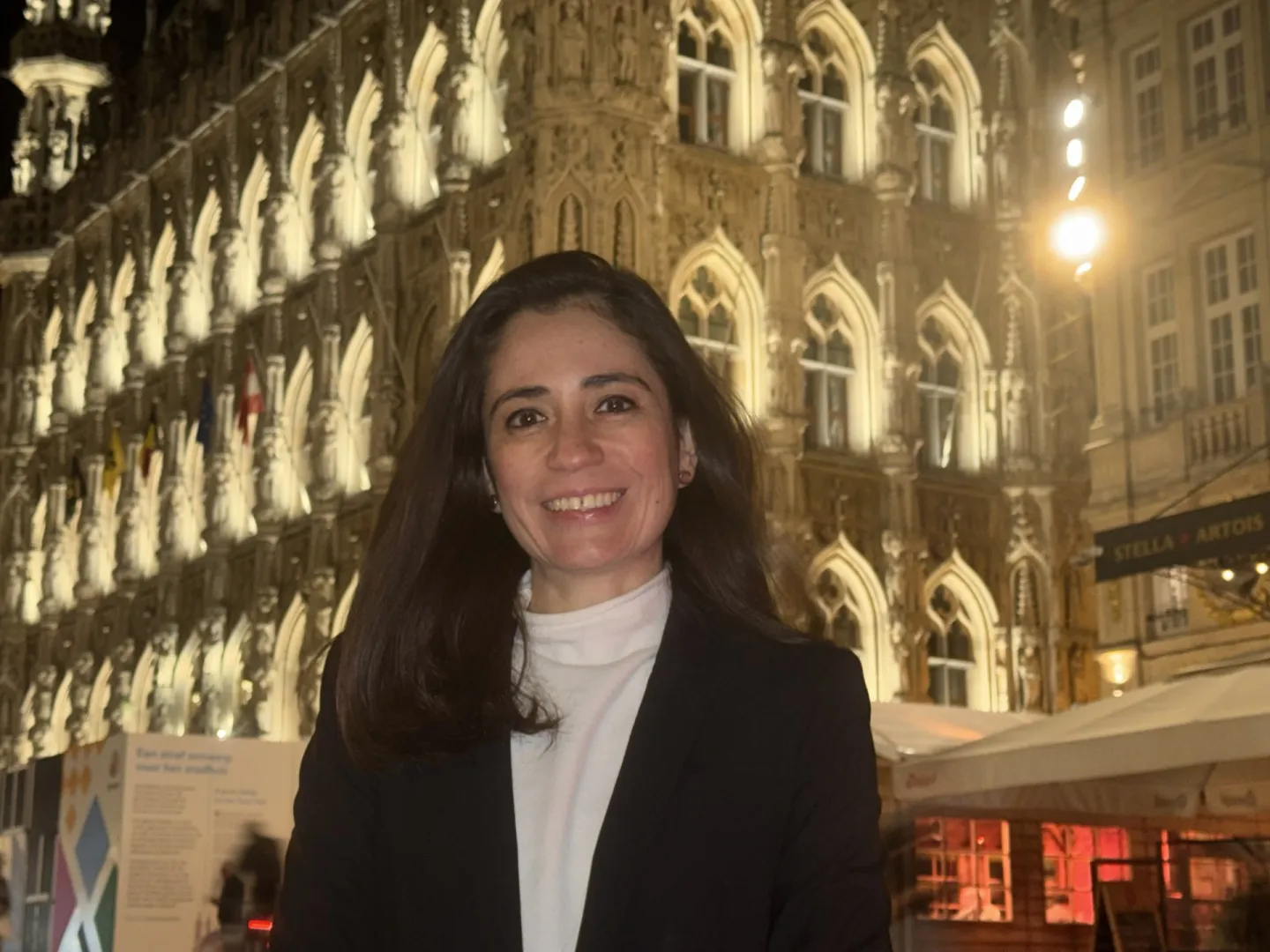
In the 11 years since she walked alone behind that banner, Rincon Delgadillo turned her expertise in extreme ultraviolet lithography into a career at the forefront of semiconductor manufacturing. After a decade at imec, the world’s largest independent research and innovation center for nanoelectronics and digital technology, the Belgian-based researcher last year started a new adventure at semiconductor foundry TSMC.
Through it all, she credited the lessons she learned – both about research and career-building – in the lab of Paul Nealey, the Brady W. Dougan Professor of Molecular Engineering lab at UChicago PME.
"He made sure that his students learn how to network,” Rincon Delgadillo said. “Not only did he challenge us on the academics, but Prof. Nealey helped us to take advantage of the infrastructure and the industry connections that he and the University of Chicago have.”
'Her adventurous spirit’
Born in Mexico, Rincon Delgadillo received her bachelor’s degree in chemical engineering from the Western Institute of Technology and Higher Education in Guadalajara and worked in the private sector for five years before coming to the U.S. for graduate school.
In 2009, she joined Nealey’s lab at the University of Wisconsin-Madison. A year and a half after that, he asked if Rincon Delgadillo would be willing to switch countries again, moving to Belgium to work with imec on next-generation semiconductor technologies.
It was meant to be one year. She ended up staying in Belgium for two and a half years, then moving back after graduation.
“One of the most amazing things about Paulina is her adventurous spirit,” Nealey said at the time of Rincon Delgadillo’s graduation in 2014.
Rincon Delgadillo didn’t know it, but she had another big adventure ahead.
‘Everything was new’
While she was in Belgium, Nealey told Rincon Delgadillo that he was leaving the University of Wisconsin for the what was then a tiny, unknown, one-year-old institute. He offered her the choice whether to finish her PhD at UW-Madison or to join him in UChicago’s experiment in interdisciplinary engineering.
“Given that it was University of Chicago, it was a no-brainer for me,” she said, laughing. “We knew that it was going to take some time, but there was no doubt that the program was going to be very successful.”
The small institute has since become one of the world’s top research institutions, with 42 faculty members, dozens of affiliated CASE scientists and hundreds of students and postdoctoral researchers working collaboratively to solve the world’s biggest problems across three interdisciplinary themes – Materials for Sustainability, Immunoengineering and the Chicago Quantum Institute.
“Everything was new when I came to University of Chicago,” she said. “The lab was new. Most of the people that were that were part of the lab were new to me - new students, junior students.”
After graduation, she returned to imec. She liked the freedom of a research institute but eventually felt a pull toward applied research that only industry could provide. Joining TSMC in 2024, she helps create the semiconductors that power the world’s devices.
“Graduating from the University of Chicago, anyone will have plenty of opportunities wherever they go,” she said. “That was my experience.”