Improving hydrogen production from water can support abundant global crops
Five factors determine whether trace iron improves performance or forms potentially harmful deposits
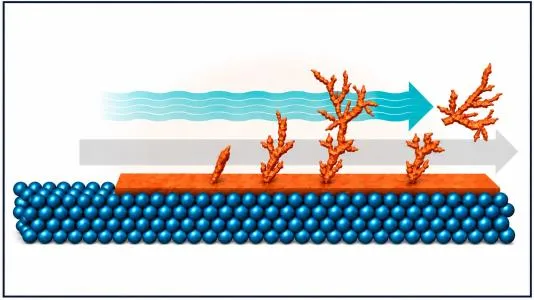
Schematic shows iron deposit (orange layer) forming on nickel-based cathode (blue circles) and expanding into iron-rich dendrites. Top arrow indicates electrolyte flow; bottom arrow, four other factors besides flow rate affecting dendrite growth. (Image: Argonne National Laboratory)
Water, at least in its purest form, contains hydrogen and oxygen. In 1800, scientists first used electricity to split water into hydrogen and oxygen gases. Today, this process, known as water electrolysis, is widely used to produce hydrogen for industrial purposes, including manufacturing ammonia for agricultural fertilizers that sustain global food production. One of the most widely used methods with a long history of commercial deployment is alkaline water electrolysis, which, despite its wide application, still benefits from fundamental research and development efforts to increase efficiency and prolong electrolyzer lifetime.
“Finding ways to make hydrogen more cheaply, and therefore more widely available, is still a bottleneck,” said Pietro Papa Lopes, an electrochemist at the U.S. Department of Energy’s (DOE) Argonne National Laboratory and a Consortium for Advanced Science and Engineering (CASE) senior scientist at the University of Chicago Pritzker School of Molecular Engineering.
Because of the involvement of the private sector, … we were able to bring the tools available at national laboratories to solve a problem that industry can apply and then even modify and generate intellectual property.
Argonne electrochemist and UChicago PME CASE senior scientist Pietro Papa Lopes
One way to help bring down costs is to keep the systems that produce hydrogen operating efficiently for longer. Now, in a major collaborative project with other national laboratories, industry and universities, Argonne researchers have uncovered a key to giving alkaline water electrolysis a longer, healthier life. That key is understanding the role played by impurities in the water-based electrolyte.
To understand why impurities matter, it helps to look inside a device for alkaline water electrolysis known as an electrolyzer. Much like a battery, it contains an electrolyte, a cathode and an anode. The electrolyte is potassium hydroxide dissolved in water, making the solution alkaline. And the cathode and anode are made from different nickel-based materials. A separator material keeps the electrodes physically apart. When an electric current passes through the system, hydrogen and oxygen gases emerge in separate streams.
“Even tiny amounts of impurities in the electrolyte can have a surprisingly large effect on how well alkaline water electrolyzers perform and how long they last,” said Meital Shviro, a former staff scientist at DOE’s National Laboratory of the Rockies (NLR), who has since moved to the Institute of Energy Technologies, Jülich Research Center, in Germany.
Iron is a prime example. It can enter as an impurity in trace amounts through commercially available potassium hydroxide in the electrolyte, as well as through corrosion of steel components in an industrial plant. Earlier studies indicated that this iron can improve the performance of nickel-based electrodes during operation, but it can also move out of the electrolyte and form metallic deposits on the electrode surfaces. In turn, the metallic deposits can interact with the electrode separator. Until now, the conditions governing this transition have not been fully understood.
“Even a few parts per million of iron impurities in the electrolyte can prove either friend or foe,” Papa Lopes said. “The team concentrated on establishing the fundamental mechanism at work under different conditions so that the experimental side of the team had a baseline on what to expect.”
So, what happens to iron after it is added in small amounts to an operating electrolyzer? To answer this question, the research team tracked the fate of iron through the electrodes, electrolyte and porous separator in test cells operating for up to 1,000 hours. They used multiple techniques to determine where the iron ended up and how it changed over time.
The results confirmed that iron impurities improve performance. Yet, over time, iron-rich dendrites, or tiny tree-like deposits, form on the cathode. The team found that the dendrites can intrude into the cathode-facing surface of the separator. Even after 1,000 hours, however, this intrusion remained limited to the near surface. There was no evidence of dendrites spreading across the separator. Still, their formation points to a concern for the long-term stability of electrolyzers operating under more demanding conditions.
The team identified five factors that govern the growth of these iron dendrites. They determine whether iron remains limited to the cathode surface or develops into bigger dendritic structures. In addition to iron accumulation, the factors are the flow rate of the electrolyte, the smoothness of the electrode surface, the electric potential at the cathode and the atomic structure of the electrodes.
“The important point is that dendrite formation is not simply a consequence of having iron in the electrolyte,” Shviro said. “Several other factors are contributing. Understanding those relationships gives us a basis for evaluating and controlling iron deposition in operating electrolyzers.”
By better understanding where the iron goes, what causes possible harmful deposits to form and how their growth can be inhibited, researchers hope to help industry design alkaline water electrolyzers that retain iron’s benefits while operating reliably for longer.
“Because of the involvement of the private sector, namely TotalEnergies SE in this case,” Papa Lopes said, “we were able to bring the tools available at national laboratories to solve a problem that industry can apply and then even modify and generate intellectual property.”
This research, published in the journal Joule, was funded by the DOE’s Alternative Fuels and Feedstocks Office.
In addition to Papa Lopes, Argonne contributors are Alejandra Medrano-Banda, Frederick Agyapong-Fordjour, Ronnie Emmons, Kaline Nascimento da Silva, Jianxin Wang and Di-Jia Liu. Participating institutions are Argonne, NLR, DOE’s Oak Ridge National Laboratory, University of California Irvine and Total Energies SE.
Related News
-

Five from UChicago PME among world’s most highly cited researchers
November 18, 2026Five scientists from the University of Chicago Pritzker School of Molecular Engineering (UChicago PME) have been honored as 2026 Clarivate Highly Cited Researchers. Every researcher who appears on the... -
Argonne and UChicago PME researchers receive funding to advance portable PFAS detection
November 17, 2026NSF-funded research will develop a portable sensor that uses AI-designed molecular probes to detect specific “forever chemicals” in water within minutes. -
Electrochemical engineer Chibueze Amanchukwu earns prestigious AIChE 35 Under 35 Award
November 16, 2026Every three years, the American Institute of Chemical Engineers recognizes 35 early-career scientists already making an impact in the field.