
New genetic toolkit lets scientists engineer hard-to-study gut bacteria
UChicago researchers programmed a beneficial gut bacterium to deliver a protective immune protein, improving symptoms of metabolic liver disease in mice
-
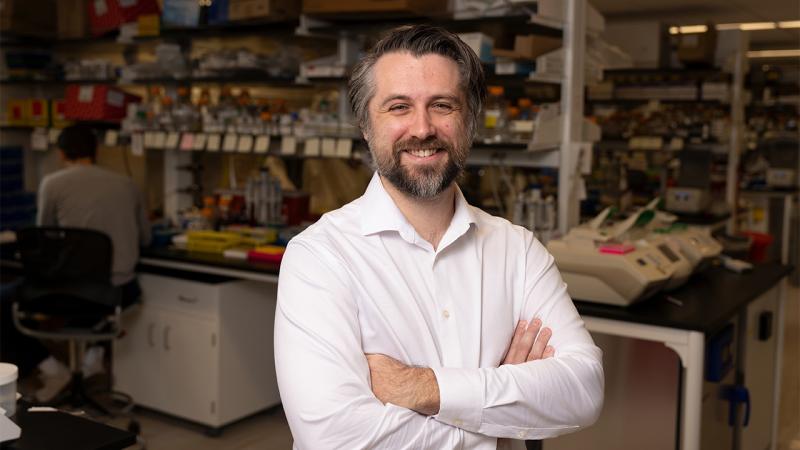
UChicago Pritzker School of Molecular Engineering and Biological Sciences Division Asst. Prof. Mark Mimee is the senior author of a new study that provides a genetic toolkit to engineer a common, but difficult to work with, family of bacteria with the ultimate goal of reprogramming the enhanced bacteria to improve health. (Photo by Jason Smith)
One of the goals of gut microbiome research is that scientists will be able to develop treatments for various diseases that add or restore microbes with health benefits that are missing from the gut. This isn’t as simple as just packing microbes into a probiotic capsule, though. Sometimes the most beneficial bacteria need a few tweaks before they can do their jobs.
A new study by researchers from the University of Chicago provides a genetic toolkit to engineer a common, but difficult to work with, family of bacteria in the human gut microbiome that produces metabolites that are linked to intestinal and metabolic health. Using this toolkit, they engineered bacteria to produce an additional immune protein that helps protect the lining of the gut. In a mouse model, the enhanced bacteria improved symptoms of metabolic liver disease, showing that this family of bacteria, and perhaps others, can be reprogrammed to improve health.
“We wanted to develop genetic tools to learn something about the biology of these microbes and why they might be so protective for health. Can we engineer additional features in them that might be used as a therapeutic?” said UChicago Pritzker School of Molecular Engineering and Biological Sciences Division Asst. Prof. Mark Mimee, PhD, senior author of the study. “This work is a proof of concept that opens the possibilities to engineer a whole family of microbes that has potential beneficial effects.”
Updating the canaries in the coal mine
Two former graduate students in Mimee’s lab, Jack Arnold and Sandra McClure, led the project and co-authored the new study, which was published in Nature Microbiology. They worked with a family of bacteria called Lachnospiraceae that help ferment dietary fiber and convert it into short-chain fatty acids like butyrate that are known to support gut health. These bacteria are also associated with protection against colon cancer, resistance to pathogens, and immune system regulation.
Despite their promising benefits, Lachnospiraceae are also difficult to work with. They are anaerobic, which means they are sensitive to oxygen, making them fragile under lab conditions. There are also few genetic tools for manipulating them, unlike other common model bacteria like E. coli.
“They’re kind of the canaries in the coal mine. They’re well-known, health-associated bacteria that produce a lot of metabolites and immunomodulatory molecules that maintain health and homeostasis in the gut. But when people get sick, these are the first types of bacteria to go away,” Mimee said. “So, this whole family of microbes was generally understudied because they’re difficult to grow and more or less impossible to use for any genetic studies.”
Some distant cousins of these bacteria have been engineered for industrial uses to break down biomass and agricultural waste into biofuels and chemicals. So, the team started with genetic tools built for those purposes and worked to adapt them for Lachnospiraceae.
Eventually, they were able to engineer a strain of Coprococcus comes, a common member of this family native to the human gut, so that it produced an immune protein, or cytokine, called IL-22 that triggers genetic activity to protect the epithelium, or the lining of the intestine. Scientists from Weill Cornell Medicine used a similar approach to engineer metabolic functions of other Lachnospiraceae species earlier this year.
When given to mice with a model of metabolic dysfunction-associated steatotic liver disease (MASLD), the engineered C. comes helped improve the balance of blood glucose, reduce levels of blood inflammatory markers, and lessen the overall effects of the disease.
“We wanted to demonstrate that you don’t necessarily need to use easy-to-engineer bacteria to do these sorts of things, so there was definitely an element of bravery there,” Mimee said. “We don’t have the solution to everything yet, but with a little elbow grease we were able to engineer these bugs to have additional health benefits.”
Giving beneficial bugs a better chance to survive
Mimee said this work helps them learn more about what makes these bacteria beneficial in the first place. And in addition to engineering them with new features, they could also do things to make them more robust and easier to work with in the lab.
“The fact that we developed these genetic tools opens entire realms of research into why these bugs are beneficial in the first place. How do they compete with other bacteria? How do they colonize the gut in the first place?” Mimee said.
“We’re trying to understand those systems better and also trying to engineer the more sensitive bugs that tend to be the most beneficial ones so that they’re easier to make, so that they can be delivered to the gut more readily, and so that if disease does happen, then they have a better chance to survive.”
The study, “Engineering commensal Lachnospiraceae for programmable therapeutic delivery in the gut,” was supported by the National Science Foundation, the National Institutes of Health, and the Arnold and Mabel Beckman Foundation. Additional authors include Joshua Glazier, Sadiksha Shakya, Zachary Jansen, David Villegas, Tracy Leidan Chen, Jay Fuerte-Stone, and Rory McGann from UChicago, and Recep E. Ahan from Bilkent University, Türkiye.
Related News
-
Dean’s Town Hall: Momentum and growth key to UChicago PME’s future
October 28, 2026The UChicago PME Fall 2026 Town Hall was the first for Interim Dean Stuart Rowan. -
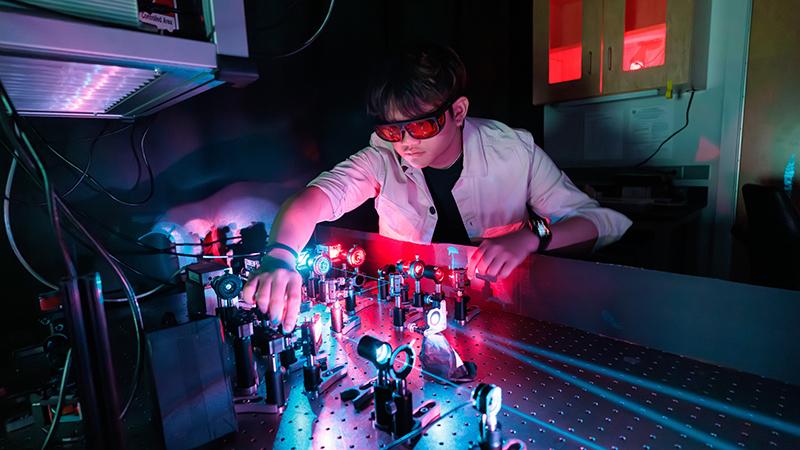
Working across fields to spark bigger and bolder questions in biology
October 27, 2026PhD student Ryan Febryanto is taking an interdisciplinary approach to research that could redefine how we detect many different biomarkers at once. -

Where the micro-scale meets the macro-scale at UChicago
October 15, 2026Master’s student Mel Zhou uses microfluidic platforms to learn how individual patients might respond to different therapies