
Remotely operated, robotic lab receives $20 million National Science Foundation grant
AI-powered PoLARIS Project will execute science experiments remotely, allowing underserved researchers across the nation access to create novel soft materials from afar
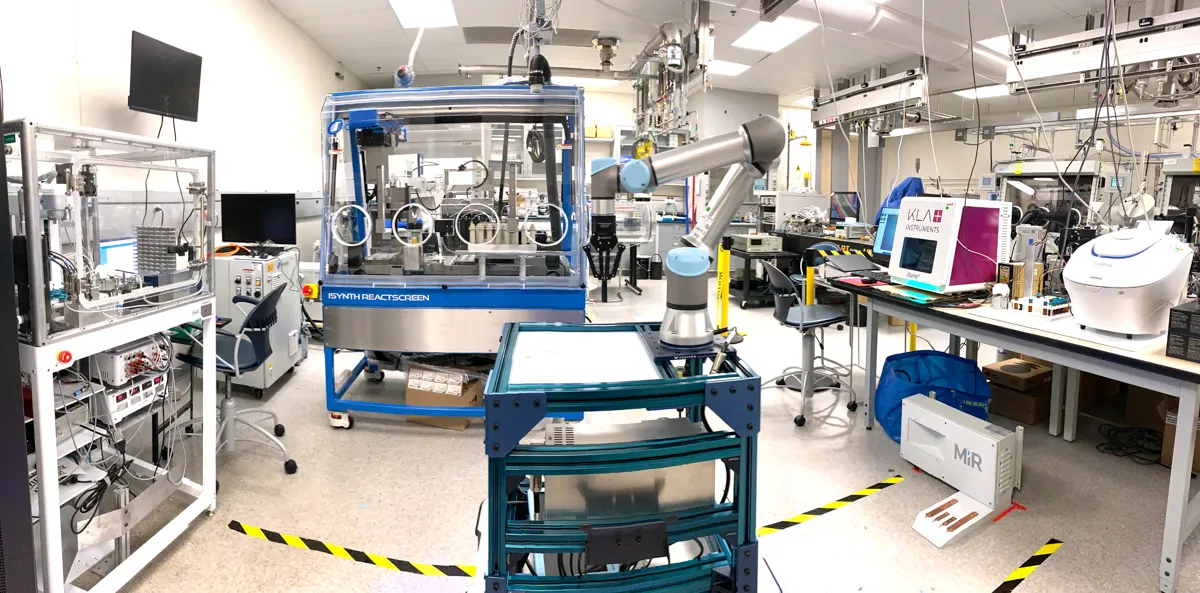
The AI-powered autonomous lab Polybot, located at Argonne National Laboratory, is one of five labs across Argonne and UChicago that will run remote experiments from researchers across the nation as part of the Polymer Laboratory for AI, Robotics, Informatics, and Standards (PoLARIS). PoLARIS will be created through a $20 million National Science Foundation grant announced today. (Photo courtesy Argonne National Laboratory)
Tomorrow’s clean energy, advanced manufacturing, healthcare, and national defense rely on developing novel, next-generation soft materials – things like liquids, polymers, gels, colloids, foams, and granular materials. But creating these new materials is slow, expensive, and largely manual.
A $20 million grant announced today will remove many of these barriers, developing a remotely accessible, robot-operated laboratory where researchers across the United States can design and run experiments without traveling.
Leveraging the expertise of the UChicago Pritzker School of Molecular Engineering, UChicago Department of Computer Science and Argonne National Laboratory, the Polymer Laboratory for AI, Robotics, Informatics, and Standards (PoLARIS) will strengthen domestic supply chains, reduce dependence on foreign materials, and help American companies compete globally in industries worth over $200 billion annually.
“PoLARIS is designed to make advanced polymer research faster, more accessible, and more reproducible. It will connect AI, robotics, specialized instruments, and data infrastructure into a cloud laboratory that researchers can access remotely,” said PoLARIS co-principal investigator Asst. Prof. Jie Xu, co-lead of Polybot Lab, a research group that spans the UChicago Pritzker School of Molecular Engineering and Argonne’s Nanoscience and Technology Division. “The goal is to allow strong scientific ideas to move forward even when the researchers do not have expensive equipment on their own campus.”
Through cloud interfaces, researchers from universities, industry, government laboratories, and under-resourced institutions will design and execute autonomous experiments that PoLARIS will execute at more than 20 autonomous stations spread across five labs at the University of Chicago and Argonne, supported by top-tier researchers from both institutions.
“We are combining robots and AI with deep expertise in soft material and polymer science,” said Xu, who has a joint appointment with Argonne.
Once fully operational, PoLARIS will be capable of running anywhere from 100–300 experiments a day.
“PoLARIS is essentially a distributed operating system for scientific discovery. We're connecting instruments across buildings and institutions so they function as a single intelligent laboratory, with AI agents coordinating when and how experiments run,” said co-principal investigator Prof. Ian Foster, co-head of Globus Labs, a research group that spans the UChicago Computer Science Department and Argonne's Data Science and Learning Division. “The same infrastructure principles that let millions of scientists move data seamlessly through Globus now let them orchestrate physical experiments from anywhere.”
Foster said the team expects to complete end-to-end autonomous experiments for our initial science drivers within 18 months. Full user-service launch, where external researchers can submit their own projects, is expected by the end of year two of the grant.
The five facilities running PoLARIS stations will be UChicago’s Hyde Park High-throughput Polymer lab, Soft Matter Characterization Facility, and Materials Preparation and Measurement Laboratory and Argonne’s Advanced Photon Source and Polybot.
“This democratizes access to frontier science and lets good ideas succeed regardless of where they originate,” said Foster, who is also the Arthur Holly Compton Distinguished Service Professor of Computer Science.
Xu and Foster will serve as co-principal investigators along with UChicago PME interim Dean Stuart Rowan and Computer Science Department Asst. Prof. Yuxin Chen.
Chen said the AI behind PoLARIS was designed to look beyond just single experiments, helping users plan longer-term strategies the way a seasoned researcher would.
“A skilled experimentalist plans a whole campaign, not just the next experiment – sometimes running one not for its immediate answer but because it sets up the decisive one later,” he said. “Teaching AI to reason that far ahead, for many users sharing the same instruments and adapting as every result arrives, is what separates a truly intelligent laboratory from a collection of robots.”
Rowan, who is also the Barry L. MacLean Professor for Molecular Engineering Innovation and Enterprise, a Professor of Chemistry and has a staff appointment at Argonne, said the impacts will go far beyond any one institution.
“This is a critical investment at a revolutionary time across all science and engineering,” Rowan said. “Within the rich research ecosystem UChicago PME and Argonne have built, a major focus is to reinvent how we access the next generation of materials that play such a role in our daily lives. This collaboration with UChicago researchers in Computer Science has gotten me very excited about the revolutionary advances that PoLARIS will enable not only here but across the US.”
Related News
-
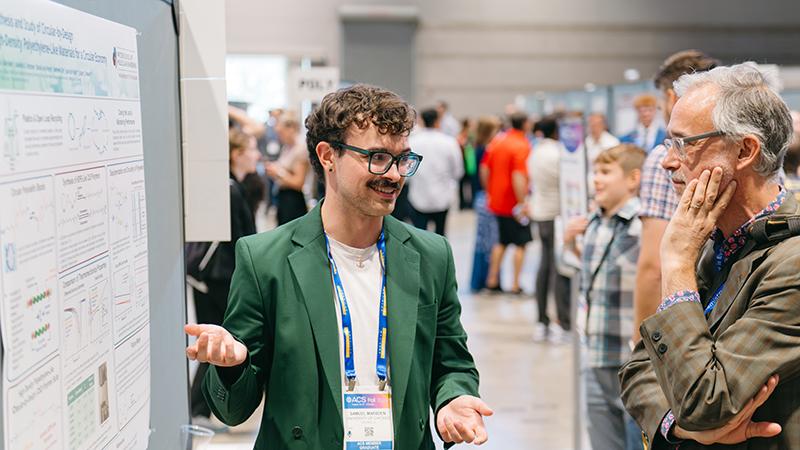
From undergrad to faculty, UChicago Pritzker Molecular Engineering represented at ACS
August 31, 2026Yearly American Chemical Society gathering brought the scientific world to Chicago for 2026. -

Laura Gagliardi awarded the 2027 Henry H. Storch Award in Energy Chemistry
August 31, 2026The American Chemical Society honor recognizes Gagliardi's pioneering work and its application to catalyst design, carbon capture, and the global energy transition. -

Machine learning smooths the road from idea to real-world climate impact
August 17, 2026Research outlines a new workflow for design and manufacturing, illustrated by two new methane-fighting materials.