UChicago PME startup K1 Semiconductor selected as Breakthrough Energy Fellow
Program provides funding, mentorship, and a global network to help bring climate tech to market
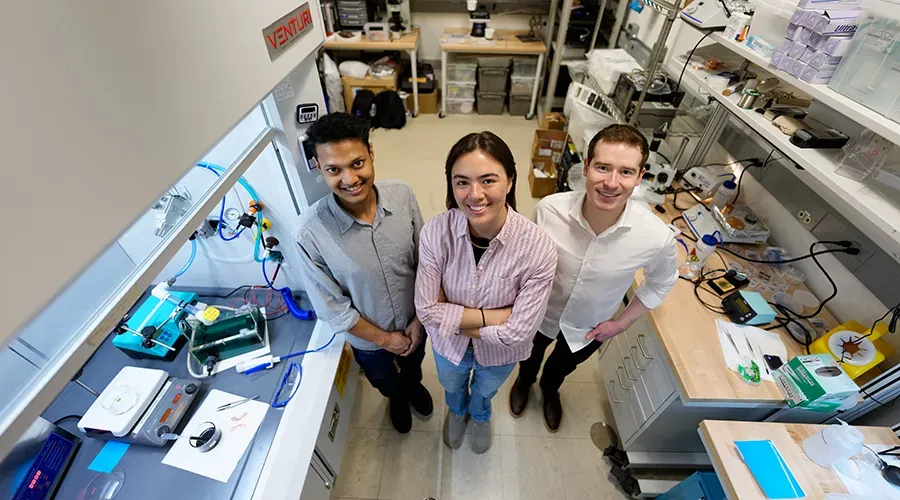
The startup K1 Semiconductor, founded by UChicago PME and Chicago Booth students and faculty, was selected for a yearlong program that helps scientific founders bridge the gap from lab to market. The team includes co-founder Sagar Kumar Seth, PhD'26 (left), CTO Xella Doi, PhD'25 (middle), and co-founder and CEO Connor Horn, PhD'25. Not pictured are COO Joseph McDonald and co-founder and advisor Prof. Supratik Guha. (Photo by Jason Smith)
The startup company K1 Semiconductor, founded at the University of Chicago Pritzker School of Molecular Engineering (UChicago PME), has been selected to participate in the prestigious Breakthrough Energy Fellows Program (BE Fellows).
The yearlong program helps scientific founders bridge the gap from lab to market, supporting early-stage innovators with capital, mentorship, education, and access to Breakthrough Energy’s global network.
K1 Semiconductor was founded in the lab of Prof. Supratik Guha by alumni Connor Horn, PhD’25, Sagar Kumar Seth, PhD’26, and Xella Doi, PhD’25. The startup is commercializing a semiconductor wafer-splitting process that could help make high-performance materials more feasible for use in chip manufacturing.
“The fellowship provides all the funding, coaching, and tools we need to guide us through the process of bringing deep tech to market,” said Horn, CEO of the company.
While most semiconductors today use silicon as the substrate for integrated circuits, more expensive materials like silicon carbide and diamond could help push the technology forward. K1 Semiconductor’s system for splitting material into wafers is much more efficient than current practices, making more expensive semiconductor materials more feasible for electronics.
BE Fellows supports early-stage innovators who are developing technologies with the potential to significantly reduce greenhouse gas emissions at scale. The K1 Semiconductor team found that if their technology is deployed at scale, the resulting efficiency gains could prevent hundreds of millions of tons in annual carbon dioxide emissions.
The fellowship provides all the funding, coaching, and tools we need to guide us through the process of bringing deep tech to market.
K1 Semiconductor co-founder and CEO Connor Horn, PhD'25
This year’s BE Fellows cohort includes 40 innovators across 21 companies. As part of the fellowship, the team is working with a business fellow to develop market maps and technoeconomic models to determine how to best generate revenue. Funding allowed the team to buy new tools to help slice wafers and measure the thickness variation of samples.
The tools are now in place at the team’s 2,000-square-foot facility in Chicago. “It’s important to have these new tools in house so we can rapidly develop our technology into an industry-ready product,” Seth said.
Through the Fellowship, team members have connected with other Fellows, including alumni of the program, and have gained new insights from their experiences. “Even though you are working on different technologies, there’s always overlap in how you think about solving a problem and bringing it into the world,” said Doi, CTO of the company.
K1 Semiconductor recently raised a pre-seed funding round of $2.7 million, and the team is exploring raising another round to help accelerate technology development. The company currently has partnerships with four global semiconductor companies to evaluate their technology.
“At the end of the Fellowship, we hope that global device manufacturers are using our wafers as a solution for near-term problems that they face, with the hope of getting our product into key devices in the semiconductor industry that are very important for today’s semiconductor boom,” Horn said.
The BE Fellows program sits within Breakthrough Energy Discovery, BE’s pre-venture innovation arm dedicated to advancing early-stage climate innovation. Discovery supports innovators, ecosystems, and new ideas that can unlock major decarbonization opportunities.
Related News
-

Five from UChicago PME among world’s most highly cited researchers
November 18, 2026Five scientists from the University of Chicago Pritzker School of Molecular Engineering (UChicago PME) have been honored as 2026 Clarivate Highly Cited Researchers. Every researcher who appears on the... -
New CQE report reveals the Quantum Prairie’s hidden talent pipeline
November 11, 2026Analysis finds Illinois, Indiana, and Wisconsin are producing quantum-relevant talent at above-average rates, with complementary strengths across the region. -
UChicago to collaborate with Tohoku University to bolster quantum research and education
November 09, 2026Agreement establishes joint research framework in Japan, with distinguished visiting professorships and shared access to leading facilities.