
“Carpet” growth method yields long-sought 2D quantum material
A new approach to growing a thin sheet of bismuth telluride let UChicago PME researchers confirm its ability to form a 2D topological insulator at ambient conditions.
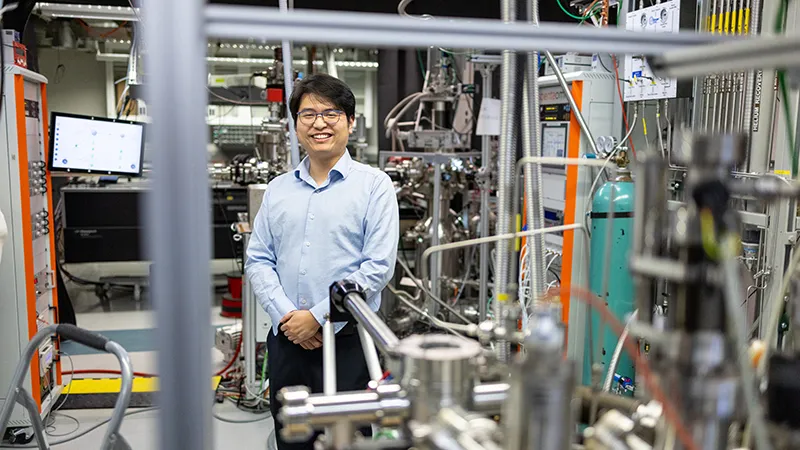
A breakthrough from the lab of Asst. Prof. Shuolong Yang at the UChicago Pritzker School of Molecular Engineering demonstrates used a new approach to produce a uniform-thickness bismuth telluride film and confirm theoretical predictions about the material’s properties. (Photo by John Zich)
For decades, physicists have sought a practical two-dimensional topological insulator: an ultrathin material whose interior blocks electricity but whose edges conduct it. In ordinary wires, electrons constantly bounce off imperfections, losing energy. But along the edges of a 2D topological insulator, electrons with opposite spins travel in opposite directions, like cars in one-way lanes, so they rarely scatter and lose energy.
Now, researchers at the University of Chicago Pritzker School of Molecular Engineering (UChicago PME) have shown that ultrathin films of bismuth telluride are such a material. The work, published in ACS Nano, used a new approach to produce a uniform-thickness bismuth telluride film and confirm theoretical predictions about the material’s properties.
“In a strict scientific sense, we are the first to demonstrate conclusive spectroscopic evidence that this is indeed a 2D topological insulator,” said Shuolong Yang, assistant professor of molecular engineering at UChicago PME and senior author of the new work. “When people created these films in the past, they were all mixed up with one, two, three, or four layers, and the topological electronic properties weren’t resolved.”
From three dimensions to two
Bismuth telluride has long been known as a three-dimensional topological insulator, which conducts electricity only on its surfaces. Theorists predicted that if it were cut down to just two of its quintuple layers—two nanometers thick in total—it would become a 2D topological insulator.
“When you go from 3D to 2D, suddenly all the physical principles have to be reconsidered,” Yang said.
In principle, such a system, sometimes called a quantum spin Hall system, could be nearly lossless.
“If we use this quantum spin Hall system, ideally we can achieve conducting edge channels with quantized conductance for sending energy or information without loss,” said Woojoo Lee, first author of the paper and a former postdoctoral scholar in Yang’s lab, now a professor at Gachon University in South Korea.
But making 2D bismuth telluride has proven difficult. Its electronic properties change dramatically depending on its thickness, so a film must have a consistent thickness throughout to draw firm conclusions. Previous attempts produced films that piled up into tiny pyramids of varying thickness.
To get something more uniform, Lee and Yang used molecular beam epitaxy, a technique that, in a vacuum, deposits atoms one layer at a time onto a crystal surface. After growing hundreds of samples and fine-tuning the growth conditions, the researchers found a way to make the films grow in what they call “carpet mode,” In which the film drapes continuously over tiny atomic steps in the underlying crystal.
“It is really like a carpet lying on a staircase,” Yang said.
Moreover, they were able to create a film that was millimeters across—thousands of times wider than the patches produced by earlier studies—and could be moved onto other surfaces. This carpet mode was experimentally verified using atomic-scale transmission electron microscopy by collaborators in Prof. Pinshane Huang’s group at the University of Illinois Urbana-Champaign, as well as Assoc. Prof. Chong Liu’s and Prof. Shirley Meng’s groups at UChicago.
Spectroscopic evidence
With the thin film produced, the team then turned to three different techniques to study its properties. First, they used angle-resolved photoemission spectroscopy to map its band structure—the energies and momenta its electrons can have. As layers were added one at a time, the band structure changed in close agreement with predictions.
“It fits almost perfectly with theory,” Yang said. “When we first started seeing these results, it was actually hard to believe.”
Second, they used ultrafast laser pulses to set the material’s atoms vibrating in unison and watched how the electrons’ energies shifted in response. The patterns resembled those expected for a topological state. Finally, collaborators in Prof. Mark Hersam’s lab at Northwestern University used scanning tunneling spectroscopy to study the edge states themselves—again pointing toward a 2D topological material.
Yang, Lee, and colleagues also showed that converting the top layer to manganese bismuth telluride widened the band gap—the range of energies at which the material’s edges can still conduct electricity. With that alternate top layer, the material could potentially work near room temperature, the team said.
Next, the researchers aim to measure the films' electrical resistance—a final confirmation of their topological properties.
“So far our study is spectroscopy, so we haven’t done that electrical resistance measurement, but we think that it should be there—the physics is there,” Yang said. “That’s clearly the next goal.”
Citation: "Millimeter-Scale, Atomically Controlled 2D Topological Insulators Revealed by Multimodal Spectroscopy," Lee et al., ACS Nano, October 9, 2026. DOI: 10.1021/acsnano.6c10210
Funding: U.S. Department of Energy, National Science Foundation.
The molecular beam epitaxy growth, angle-resolved photoemission spectroscopy (ARPES) characterization, and scanning transmission electron microscopy (STEM) on Bi2Te3 films were supported by DOE Basic Energy Sciences under Grant No. DE-SC0023317. The substrate preparation and atomic force microscopy were partially supported by National Science Foundation under Award No. DMR-2011854. The time-resolved ARPES work was supported by DOE Basic Energy Sciences under Grant No. DE-SC0022960.
Related News
-
Fermilab to lead two new Genesis Mission awards to accelerate development of microelectronics and quantum
October 08, 2026UChicago Pritzker School of Molecular Engineering Prof. Liang Jiang and Physics Prof. LianTao Wang are co-investigators on AI-guided quantum sensing project. -

Learning is a blast – and a bang – at the South Side Science Festival
October 08, 2026Dancing robots, mutant Legos and rocks that rock mark the fifth annual UChicago STEM community outreach event. -
NSF's eight Quantum Leap Challenge Institutes to hold first joint public discussion at Q2B x Chicago Quantum Summit
October 07, 2026For the first time since the U.S. National Science Foundation renewed and expanded the nation’s Quantum Leap Challenge Institutes, representatives from each Institute will convene at Q2B x Chicago...