
NSF's eight Quantum Leap Challenge Institutes to hold first joint public discussion at Q2B x Chicago Quantum Summit
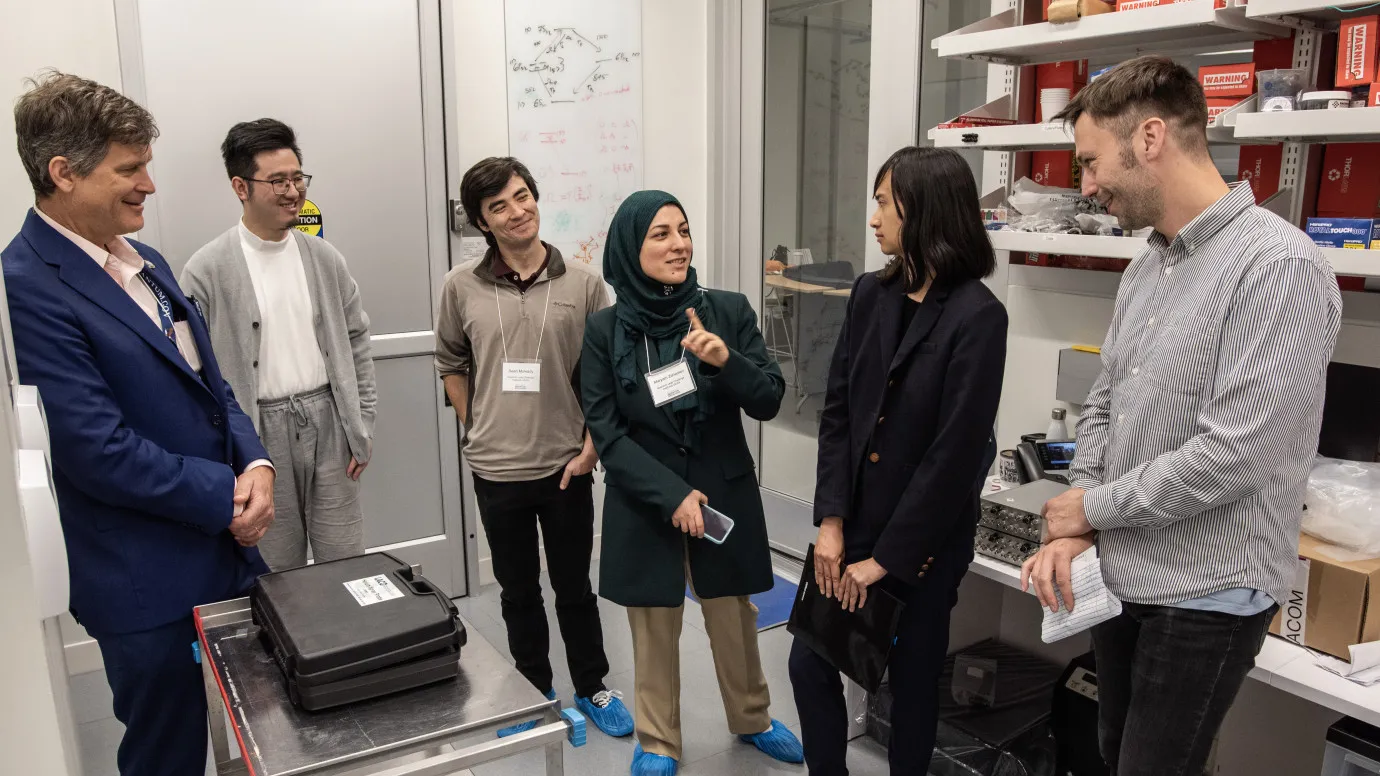
Students tour a quantum lab at the University of Chicago Pritzker School of Molecular Engineering as part of the National Science Foundation-sponsored Quantum Leap Challenge Institute Quantum Careers Workshop on April 12, 2024. Alex Cronin, who will moderate the NSF QLCI panel in December 2026, is shown at the far left. (Image by Lloyd DeGrane for the Chicago Quantum Exchange and the National Science Foundation.)
For the first time since the U.S. National Science Foundation renewed and expanded the nation’s Quantum Leap Challenge Institutes, representatives from each Institute will convene at Q2B x Chicago Quantum Summit to discuss their efforts to solve the complex hurdles facing the quantum technology sector as it nears utility-scale deployment.”
The eight NSF QLCIs, which include three new institutes and five that launched in 2020, support researchers from 36 institutions across 19 states. Each QLCI is tasked with confronting a specific challenge — from making quantum technologies more resilient to connecting different types of quantum computers to creating quantum sensors that measure biological processes. Two of the original QLCIs — the University of Illinois Urbana-Champaign–based Hybrid Quantum Architectures and Networks (NSF HQAN) and the University of Chicago–based Quantum Sensing for Biophysics and Bioengineering (NSF QuBBE) — are located in the Quantum Prairie. HQAN and QuBBE each received an additional $37.5 million in renewal funding in August.
“The NSF QLCIs, which represent important collaborations across academia, government, and industry, have been advancing quantum technology and training hundreds of students and early-career researchers since the program’s launch,” said David Awschalom, the University of Chicago Liew Family Professor of Quantum Engineering and Physics, co-principal investigator of QuBBE, director of the Chicago Quantum Exchange, and a senior scientist at Argonne National Laboratory. “The Q2B x Chicago Quantum Summit, an event that celebrates those who confront complex scientific hurdles, is an ideal setting for the first public discussion among this expanded group. This session will undoubtedly build upon last year’s insightful gathering of DOE quantum research center leaders at the Chicago Quantum Summit, and once again highlight the ways in which collaboration can enable us to accelerate advances in quantum technologies.”
Both the NSF QLCIs and the U.S. Department of Energy (DOE) National Quantum Information Science Research Centers were established under the 2018 National Quantum Initiative Act.
Getting leaders from each NSF Quantum Leap Challenge Institute together at the Q2B x Chicago Quantum Summit will provide a great platform to promote cooperation, disseminate research breakthroughs, and share notes on workforce development.
Alex Cronin, a QLCI Program Director in NSF’s Mathematical and Physical Sciences Directorate
Hosted by QC Ware and the CQE, Q2B x Chicago Quantum Summit brings Q2B's quantum business and commercialization expertise together with the CQE’s annual convening to advance quantum research, education, and economic innovation. The joint event will be held at the Marriott Marquis Chicago and McCormick Place December 8–10, 2026. Registration is open. (Use code CQE-20-CHI for a 20% discount).
The NSF QLCI panel will be moderated by Alex Cronin, a QLCI Program Director in NSF’s Mathematical and Physical Sciences Directorate.
“Getting leaders from each NSF Quantum Leap Challenge Institute together at the Q2B x Chicago Quantum Summit will provide a great platform to promote cooperation, disseminate research breakthroughs, and share notes on workforce development,” Cronin said. “Over 200 faculty, 300 postdoctoral researchers, and 1000 research students are participating in NSF Quantum Leap Challenge Institutes. At the Summit, I’m looking to hear from QLCI leaders how the Institutes provide connective tissue among these researchers, nurture a culture of discovery, and accelerate progress.”
Panelists will include:
Inese Berzina-Pitcher, executive director of the NSF Quantum Leap Challenge Institute for Quantum Systems through Entangled Science and Engineering (NSF Q-SEnSE). NSF Q-SEnSE focuses on fundamental science and technology development to achieve new precision sensing and measurement capabilities through experimental and theoretical research. Their work includes quantum simulations, solid-state systems, molecular sensors, new types of exceptionally precise atomic clocks and other innovations. NSF first invested in NSF Q-SEnSE in 2020.
Claire Cramer, executive director of Berkeley Quantum and executive director of the NSF Quantum Leap Challenge Institute for Quantum Computation (NSF CIQC). NSF CIQC discovers and demonstrates new quantum algorithms and hardware architectures and uses them to in turn discover new materials and methods that can enhance quantum computation. Their work spans a broad range of quantum computing techniques including neutral atoms, trapped ions and solid-state systems. NSF first invested in NSF CIQC in 2020.
Brian DeMarco, professor of physics at the University of Illinois Urbana-Champaign and director and principal investigator for the NSF Quantum Leap Challenge Institute for Hybrid Quantum Architectures and Networks (NSF HQAN). NSF HQAN tackles the science and engineering needed to create modular quantum computers that are interconnected and work together. Unlike a single quantum computer that uses a particular qubit technology, their modular approach will join different types of qubit technologies, each optimized for particular tasks to achieve enhanced performance. NSF first invested in NSF HQAN in 2020.
Greg Engel, chair of the University of Chicago department of chemistry, professor in the UChicago Pritzker School of Molecular Engineering, and director and principal investigator of the NSF Quantum Leap Challenge Institute for Quantum Sensing for Biophysics and Bioengineering (NSF QuBBE). NSF QuBBE uses quantum properties of nature, such as entanglement, to create sensors that can probe and measure biological processes with unprecedented sensitivity and accuracy. Their research includes the development of quantum nanoprobes, techniques to measure properties inside living cells and how such technologies can improve capabilities in biology and medicine. NSF first invested in NSF QuBBE in 2021.
Michael Gullans,adjunct assistant professor of physics with an adjunct appointment in the University of Maryland Institute for Advanced Computer Studies, a physicist at the National Institute of Standards and Technology, and co-principal investigator of the NSF Quantum Leap Challenge Institute for Robust Quantum Simulation (NSF RQS). NSF RQS targets the development and applications of quantum simulations that are valuable for scientific investigation of complex phenomena, industrial production of large-scale quantum technologies or both. Their work spans new algorithms, systems architecture, materials science and other areas. NSF first invested in NSF RQS in 2021.
Chris Laumann, an associate professor of physics at Boston University and an investigator of the NSF Quantum Leap Challenge Institute for Fault Tolerant Quantum Systems, Architectures and Applications (NSF FTQSAA). NSF FTQSAA investigates new methods to make quantum technologies more robust and resistant to the inherent fragility of quantum information. Their work will span experimentation with new software and hardware, including new materials that can be used to make quantum sensors and computers more reliable.
Christopher Palmstrøm, distinguished professor in the department of electrical and computer engineering at the University of California Santa Barbara and co-principal investigator of the NSF Quantum Leap Challenge Institute for Manufacturable and Resilient Superconducting Quantum Information Systems (NSF MARQUIS). NSF MARQUIS uses materials science, semiconductor fabrication techniques and other disciplines to develop Josephson junctions with improved abilities. Such junctions are key electronic components in quantum computers and other technologies that use superconducting qubits.
Robert J Schoelkopf, Sterling professor of applied physics at the Yale University School of Engineering and Applied Physics and director of the NSF Quantum Leap Challenge Institute for Physics and Engineering of Practical Quantum Error Correction (NSF PRACTIQAL). NSF PRACTIQAL creates new and more effective methods to correct errors commonly encountered in quantum computing systems, thus increasing the usefulness and scalability of quantum computers broadly. Their research will span experimentation with hardware, algorithms and other software, and theoretical methods that can enable better error correction techniques for large-scale quantum computers that have yet to be made.
To learn more about other confirmed speakers, please visit the Q2B x Chicago Quantum Summit website.
Related News
-
Developing quantum sensors for better health
October 05, 2026PhD student Antoni Wellisz is working at the forefront of quantum technology, developing biosensors that could actively monitor tiny molecules in the human body. -
Postdocs help power discovery at UChicago PME
October 01, 20262026 National Postdoc Appreciation Week honors postdocs, marks 150th anniversary of the first postdoctoral researcher in the U.S. -
South Side Science Festival returns Oct. 3
September 16, 2026Annual community gathering invites the South Side to the UChicago campus for a day of science and fun.