Postdocs help power discovery at UChicago PME
2026 National Postdoc Appreciation Week honors postdocs, marks 150th anniversary of the first postdoctoral researcher in the U.S.
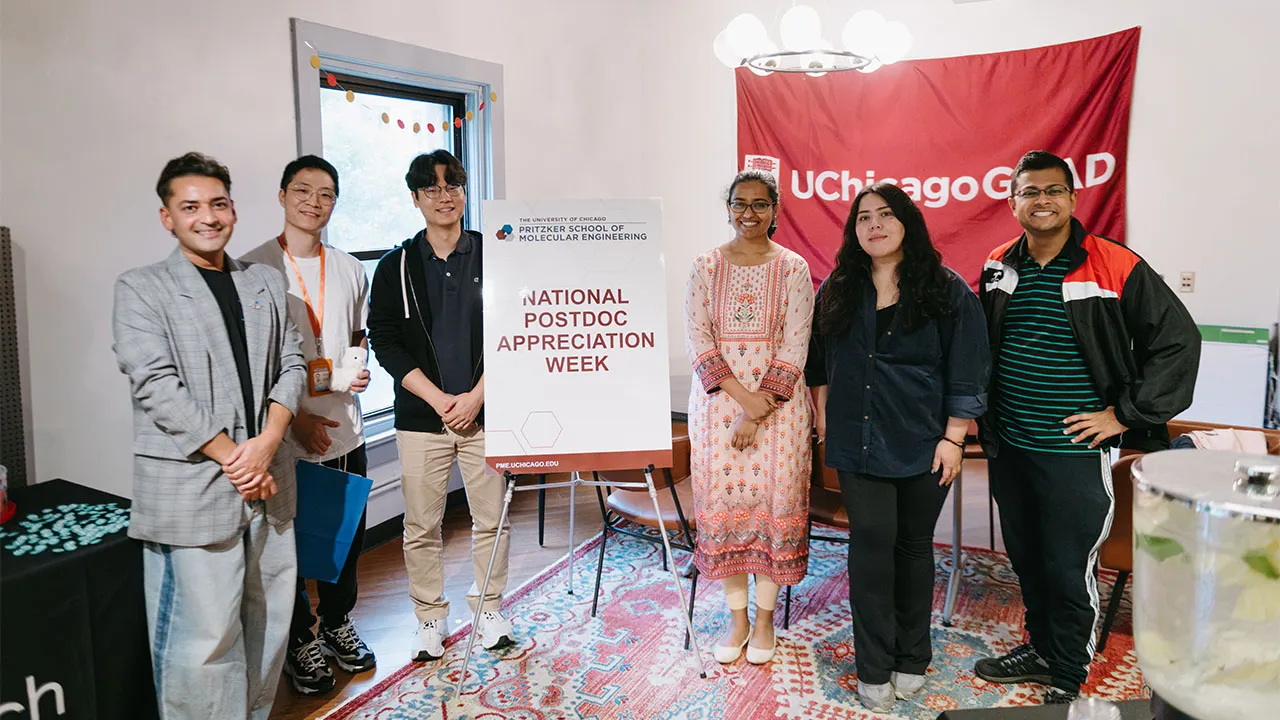
University of Chicago Pritzker School of Molecular Engineering Director of Postdoctoral Affairs Vipul Sharma, on left, stands with a group of postdoctoral researchers at one of the slate of events UChicago PME runs in honor of National Postdoc Appreciation Week. (Photo by Elaina Eichorn)
Immunoengineer Zhi Geng’s research aims to create vaccines that offer better protection with fewer side effects.
After he obtained his PhD, Geng decided to pursue his work and “make patients’ lives better” as a University of Chicago Pritzker School of Molecular Engineering postdoctoral researcher.
“UChicago PME has a truly interdisciplinary program. I love that very much,” said Geng, who works in the Esser-Kahn Lab. “I work on immunoengineering as well as a project in quantum engineering. I love contributing to translational research with the goal of making a contribution to humankind.”
Sept. 21-25 was National Postdoc Appreciation Week, a week to recognize the contributions postdoctoral researchers bring to university labs. These are researchers who have already obtained their PhDs, acting as leaders and connectors between faculty and students.
“Postdocs bring a unique combination of advanced research expertise, independence, and the ability to bridge ideas, techniques, and people within a research group,” Vipul Sharma, Director of Postdoctoral Affairs at UChicago PME and a member of the Board of Directors of the National Postdoctoral Association, said. “They often serve as scientific leaders and mentors while driving research forward in ways that complement the roles of both faculty and students.”
The UChicago PME Office of Postdoctoral Affairs supports postdocs across the full arc of their experience, from onboarding and research integrity to professional development, career preparation, mentoring, advocacy, and navigating challenges that arise during their appointment.
In addition, each year during postdoc appreciation week, Sharma’s office runs a slate of events to help recognize and support postdocs, running the gamut from research presentations to professional development to mental health breaks like playdates with rescue dogs.
The school currently has around 105 postdocs serving in labs across all three of UChicago PME’s core Institutes.
The year’s appreciation week is a special one, recognizing the hiring of the nation’s first postdocs at Johns Hopkins University in 1876.
“2026 marks 150 years since the first postdoctoral appointment in the United States, making this a historic milestone for the entire postdoctoral community,” Sharma said. “At UChicago PME, I wanted to honor that legacy by doing something never done before at UChicago – inviting postdocs from across every division of the University to share their research visually, creating an online research showcase that reflects both the depth and the breadth of what UChicago postdocs contribute every day.”
Bryan Andrews, a former postdoc in the lab of Rama Ranganathan, Joseph Regenstein Professor in the Department of Biochemistry and Molecular Biology, UChicago PME, and the College, said the postdoc position helps scientists develop leadership skills to match the laboratory acumen their PhD programs built.
“A big transition for me coming into my postdoc role was learning to advise more junior people in the lab, but also work collaboratively on projects with people who were in the lab and who had a secondary advisor, or those who were entirely outside of the lab,” said Andrews, who is now working for the Chicago-based biotech startup Natural Machine.
Andrews’ trajectory reflects a broader pattern of UChicago PME postdoc success across academia and industry. Of former UChicago PME postdocs in faculty positions, 58 percent hold appointments at top 50 engineering schools. Among those in industry, 35 percent are employed at Fortune 500 companies.
“In many ways, UChicago PME develops postdocs, and postdocs also hlp develop UChicago PME,” Sharma said.
Related News
-
Where the micro-scale meets the macro-scale at UChicago
October 15, 2026Master’s student Mel Zhou uses microfluidic platforms to learn how individual patients might respond to different therapies -
Learning is a blast – and a bang – at the South Side Science Festival
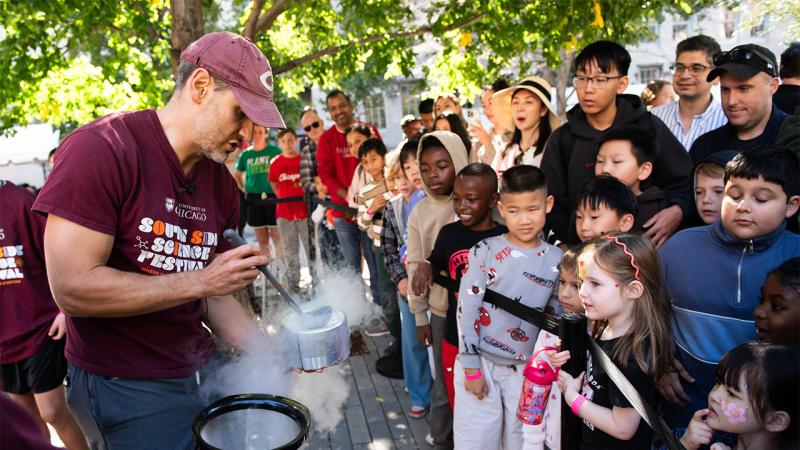
October 08, 2026Dancing robots, mutant Legos and rocks that rock mark the fifth annual UChicago STEM community outreach event. -
‘A place where anything is possible’
September 29, 2026PhD student Edward Ionescu prepared for a career in therapeutics by studying the effects of the gut microbiome.