
Learning is a blast – and a bang – at the South Side Science Festival
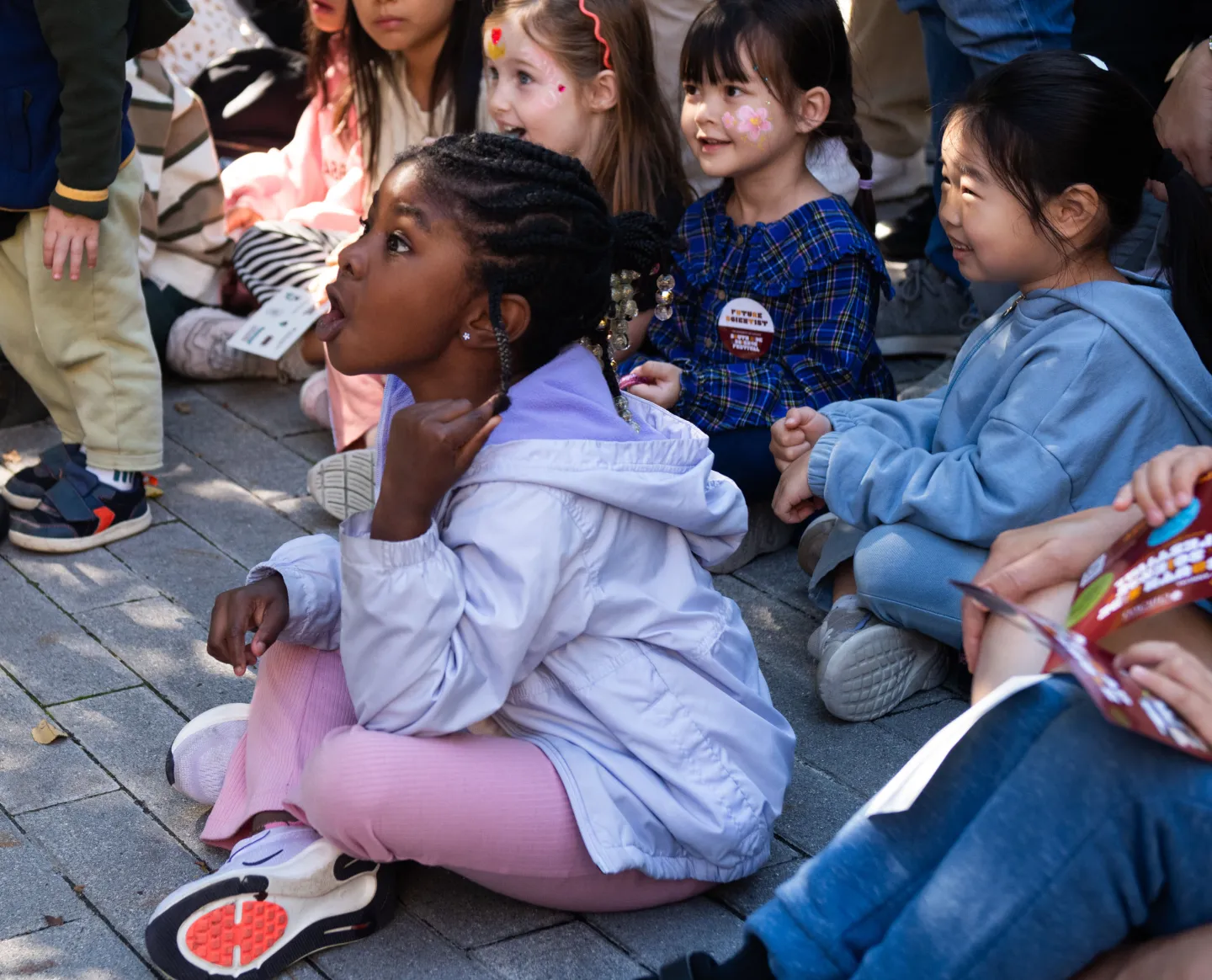
Dancing robots, mutant Legos and rocks that rock mark the fifth annual UChicago STEM community outreach event
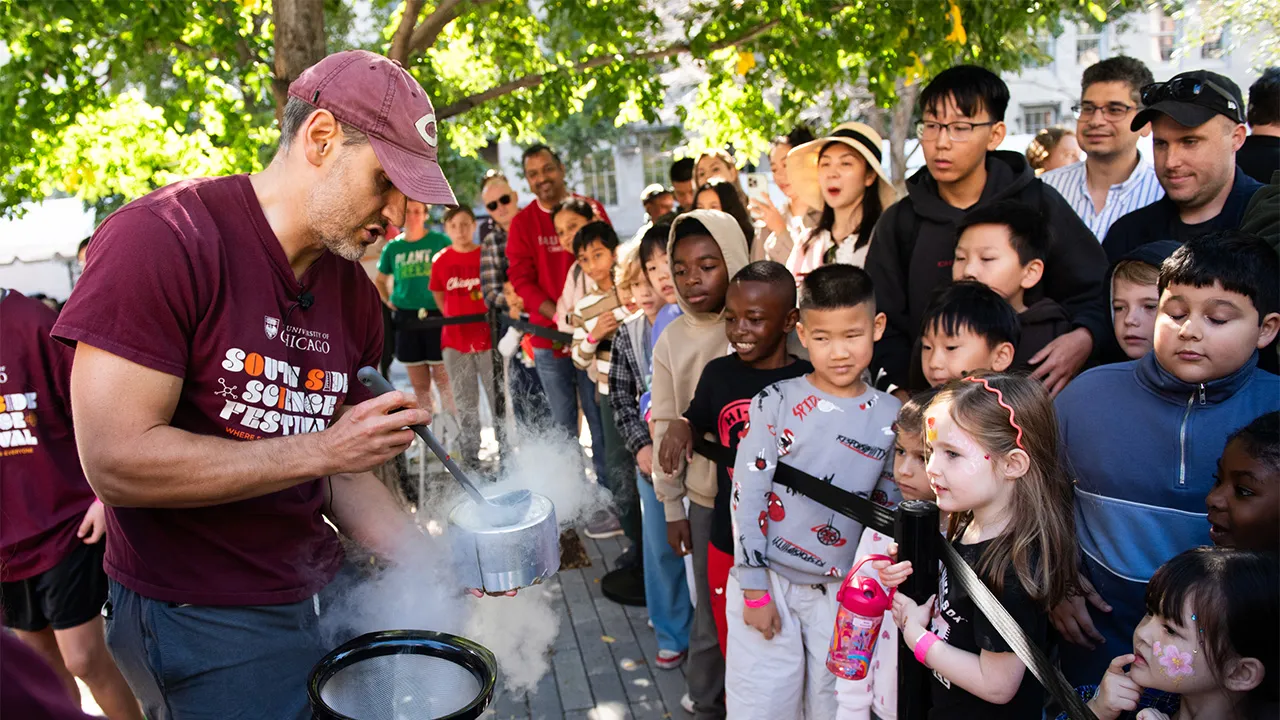
"Dr. DiNitrogen," aka University of Chicago Chemistry Prof. John Anderson, demonstrates his frozen craft at the 2026 University of Chicago South Side Science Festival, which drew around 4,600 attendees to the UChicago campus for a day of learning and fun. (Photo by Jean Lachat)
“It’s very important to throw away trash,” Dr. DiNitrogen said, capping the suspiciously billowing pop bottle and tossing it in a bin.
He sealed the plastic lid on the recycling bin and took a few steps toward the crowd of wide-eyed children and families.
“You see, you have to properly dispose of-”
BA-BOOM!
The bin’s lid blew a few inches in the air. The blast briefly echoed across the University of Chicago Crerar Science Quadrangle, only outdone by the children’s delighted screams. And “Dr. DiNitrogen,” aka UChicago Chemistry Prof. John Anderson, launched into an explanation of the science behind the liquid nitrogen explosion.
Dr. DiNitrogen’s liquid nitrogen show was just one of the attractions at the fifth annual South Side Science Festival on Saturday. “S3F,” as it’s called on campus, brings thousands of visitors to the University of Chicago each year for dancing robots, oozy chemicals, quantum card tricks, live jellyfish, a giant inflatable colon named Coco and an inside view of the science found in everyday life.
“S3F brings people from the South Side and across Chicago onto campus to see it and get a taste of inquiry-based learning,” said UChicago Pritzker School of Molecular Engineering (UChicago PME) Prof. Aaron Esser-Kahn, who, like Anderson, is one of the event’s faculty organizers. “We want kids to see not just the campus but the people on it: what it looks like to be an undergrad, a grad student, a researcher. The kids who get the most out of it are ages 5 to 15. That includes my own, who have come every year since the start.”
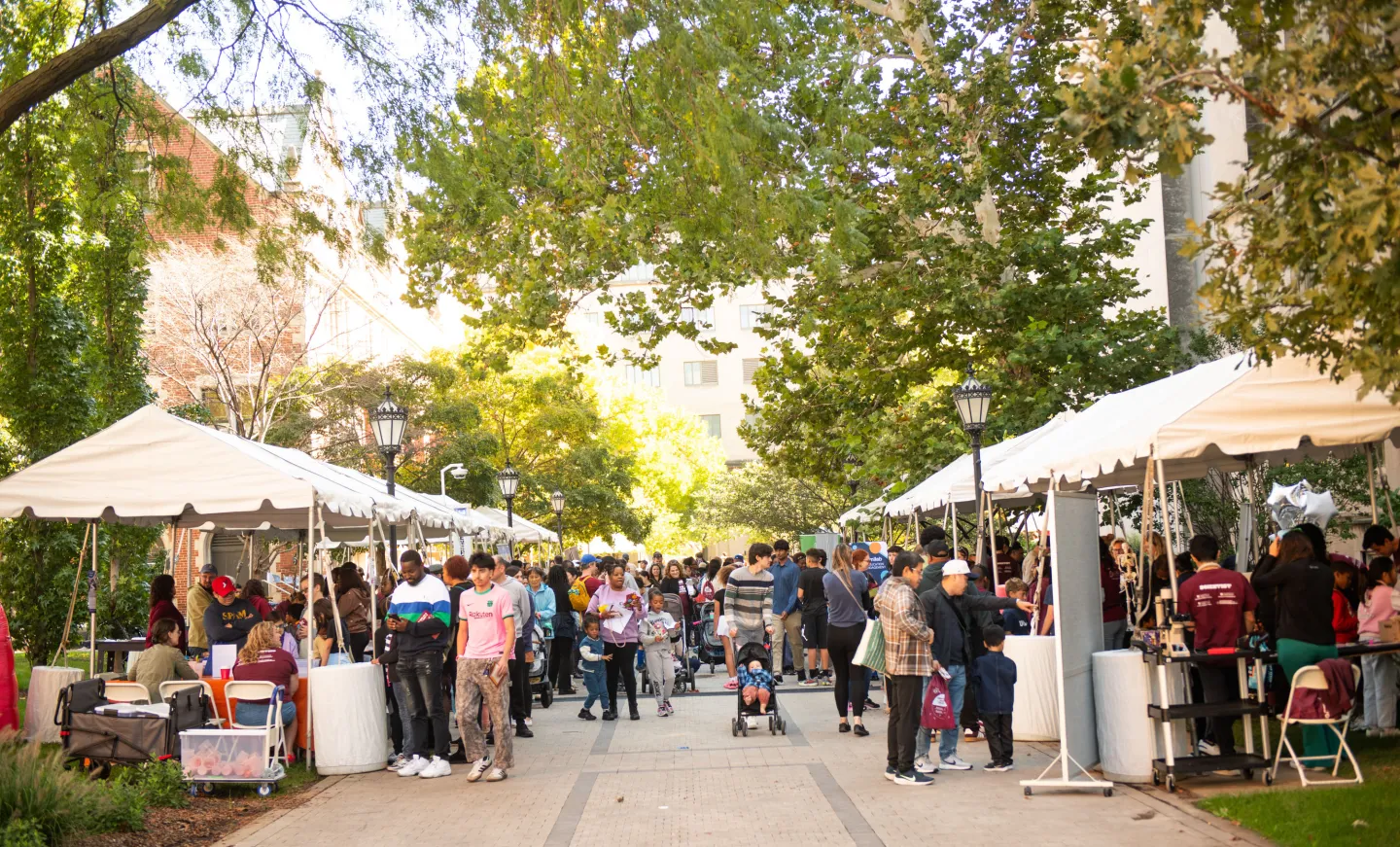
Run by the Office of Civic Engagement, the Physical Sciences Division, UChicago PME and the Biological Sciences Division, the event showcases STEM programs from across campus, with more than 600 students, postdoctoral researchers, staff and faculty presenting 130 demonstrations, and an additional 150 general event volunteers.
The event drew around 4,600 attendees, more than 60% of whom came from neighborhoods on Chicago’s South or Southwest sides.
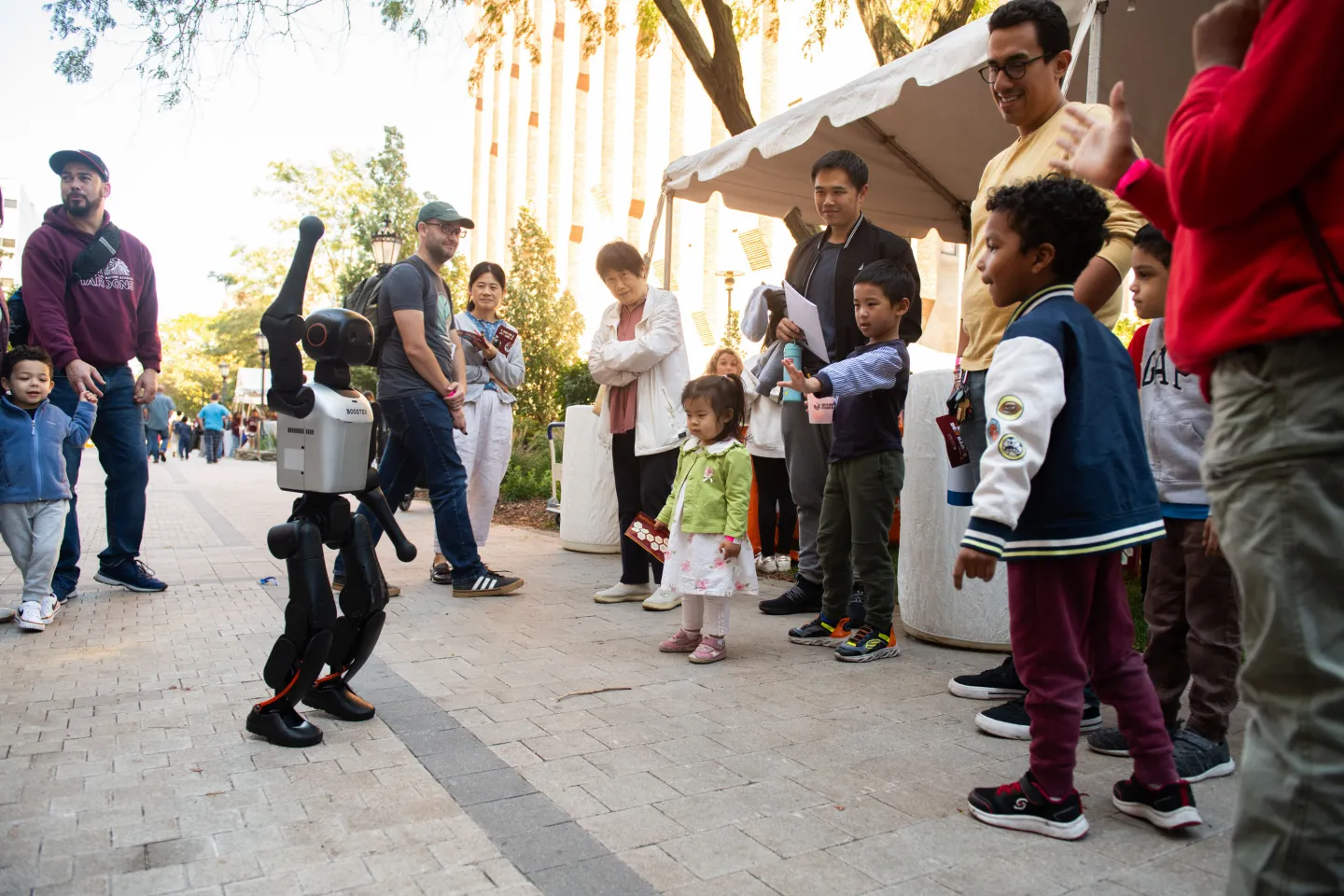
Outside Abbott Memorial Hall, three members of a local Brownies troop danced alongside a breakin’ robot from local STEM education company RoboThink Chicago. One member, Stevie, 7, said she knew robots could talk, “but not good stuff” like dancing.
Despite also boogieing with the ‘bot, troopmate Ellie, 7, said her favorite part of the festival was “the thing that you put on your head and then everything gets so different,” i.e., the virtual reality headset demonstration led by the Chemistry Department’s Mazziotti Group.
Kid-friendly methods can teach serious subjects. Committee on Cancer Biology PhD student Sara Woessner helped explain mutation – and possibly tumor growth – using Lego blocks. If the DNA is like the Lego instruction set for cell growth, mutation happens when the wrong instructions are followed.
“Mutation might look like if you took a random instruction from a Lego set to build a tiger and used it in a Lego set to build an alligator,” Woessner said. “You might end up with something kind of functional, but you probably are going to end up with a broken protein that doesn't work super well.”
The preparation for the 130 demos offered to the community can be intense. Annabel King, a Cell and Molecular Biology PhD student, for example, spent two and a half hours the previous day just portioning water laden with living algae from a big tankard into 300 tiny vials.
It was worth it, she said, when the attendees peered into the lightless cardboard box on the demonstration table and she gave one of those vials a little shake, filling the box with an eerie, living glow.
“In Chicago, there are no bioluminescent algae just hanging out. I guess that's something only kids in California and various little tropical pockets get to witness,” King said, laughing. “A lot of people don't know bioluminescence is a thing that happens outside of fireflies.”
While many of the events eased toward the oozy, glowing, colorful, spinning or explosive, all facets of STEM were represented. Attendee Ollie, 11, got a grounding in statistical distribution and “wisdom-of-the-crowd" analysis snuck into a Statistics Department display of balls in a jar.
“We were trying to estimate how many balls were in the jar,” Ollie said. “I guessed 407, and I was 14% off.”
Kyle Kwok, a rising second-year Chemistry major, was helping run a demonstration using herbal tea, honey and lemon juice to show the impact of changes in pH balance. The kids’ eyes widened when a squirt of lemon juice turned the purple tea pink. But the biggest surprise came when they were told they could drink their experiment.
"It’s a really good opportunity to draw kids into learning the foundational tenets of chemistry,” Kwok said. “This demo itself is very, very simple. It's just doing some acid-based chemistry. But it’s a good gateway for them, if science is something that interests them later down the line.”
Anderson said sharing the human side of science helps both the community and the University.
“Science is mysterious to some people and boring to a lot of people. Some people ask whether it’s worth it,” Anderson said. “I think it’s important for the public to see some of the cutting-edge science that people are doing, but also see this is something that you do with your hands. This is a craft that people do every day, and it can be really fun and exciting.”
Sometimes those lessons come in surprising ways. At the Geophysical Sciences display, PhD student Alya Al-Kibbi expected kids to be drawn in watching rocks that glowed under UV light. Instead, kid after kid was enthralled just by the chance to touch different rock specimens – a simple thing she gets to do every day at the University of Chicago.
“Something like this teaches kids that science is interesting and accessible, something that they could do, something that they could be a part of,” Al-Kibbi said. “It doesn't have to be complicated. It doesn't have to be expensive. It doesn't have to be hard to understand. Science is just what the world around us is.”
Related News
-
Fermilab to lead two new Genesis Mission awards to accelerate development of microelectronics and quantum
October 08, 2026UChicago Pritzker School of Molecular Engineering Prof. Liang Jiang and Physics Prof. LianTao Wang are co-investigators on AI-guided quantum sensing project. -
NSF's eight Quantum Leap Challenge Institutes to hold first joint public discussion at Q2B x Chicago Quantum Summit
October 07, 2026For the first time since the U.S. National Science Foundation renewed and expanded the nation’s Quantum Leap Challenge Institutes, representatives from each Institute will convene at Q2B x Chicago... -
Developing quantum sensors for better health
October 05, 2026PhD student Antoni Wellisz is working at the forefront of quantum technology, developing biosensors that could actively monitor tiny molecules in the human body.