
Discovery of ‘slow’ electrons in 2D material could lead to new memory device
A research team found a quantum phenomenon in a two-dimensional magnet that could be relevant for memory storage
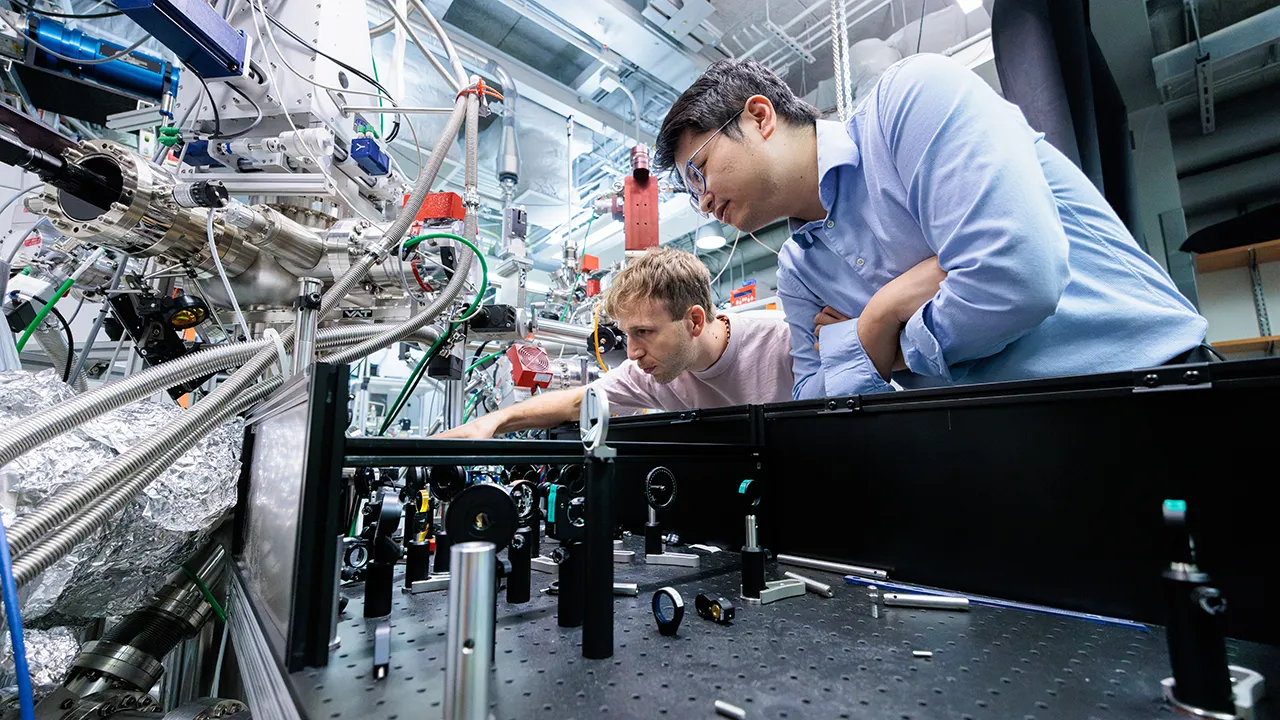
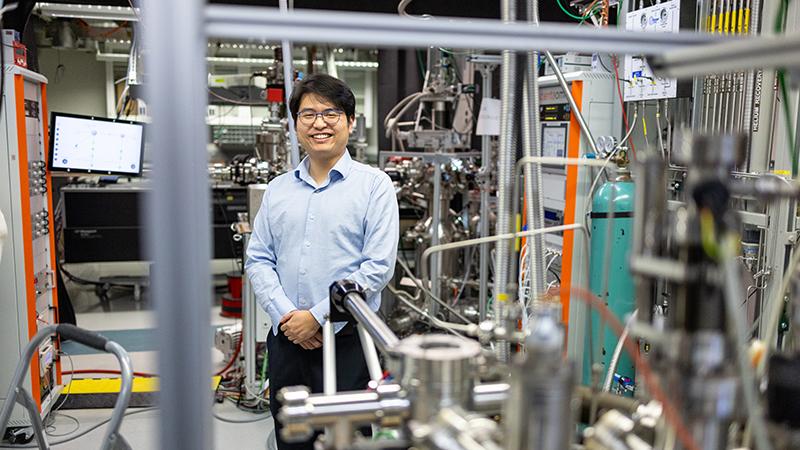
UChicago PME researchers discovered that a material exhibits a charge-ordered state where electrons move collectively and unusually slowly while remaining quantum coherent. (Photo by John Zich)
Over the last decade, researchers have developed two-dimensional materials with fascinating quantum effects that could be harnessed for next-generation technologies.
Such materials have shown superconductivity—conducting electricity without energy loss—and charge orders, where electrons arrange in some frozen patterns rather than moving freely in the material.
At the University of Chicago Pritzker School of Molecular Engineering (UChicago PME), a research team discovered that one such new material, Fe5GeTe2, exhibits a charge-ordered state in which electrons move collectively and unusually slowly while remaining quantum coherent.
The research, published in Science Advances and conducted in the lab of Asst. Prof. Shuolong Yang, rewrites current knowledge of the material and unlocks new technological applications.
“This is a fundamental discovery that deviates from theoretical predictions,” Yang said. “We now have to go back and think about the magnetic interactions of this material from scratch, but it also leads to new possibilities in using this material for new kinds of memory devices.”
A many-body phenomenon
Discovered seven years ago, Fe5GeTe2 is part of a class of materials known as van der Waals magnets. Their atomically thin layers could enable new kinds of memory technologies, with advantages over those based on conventional magnetic materials.
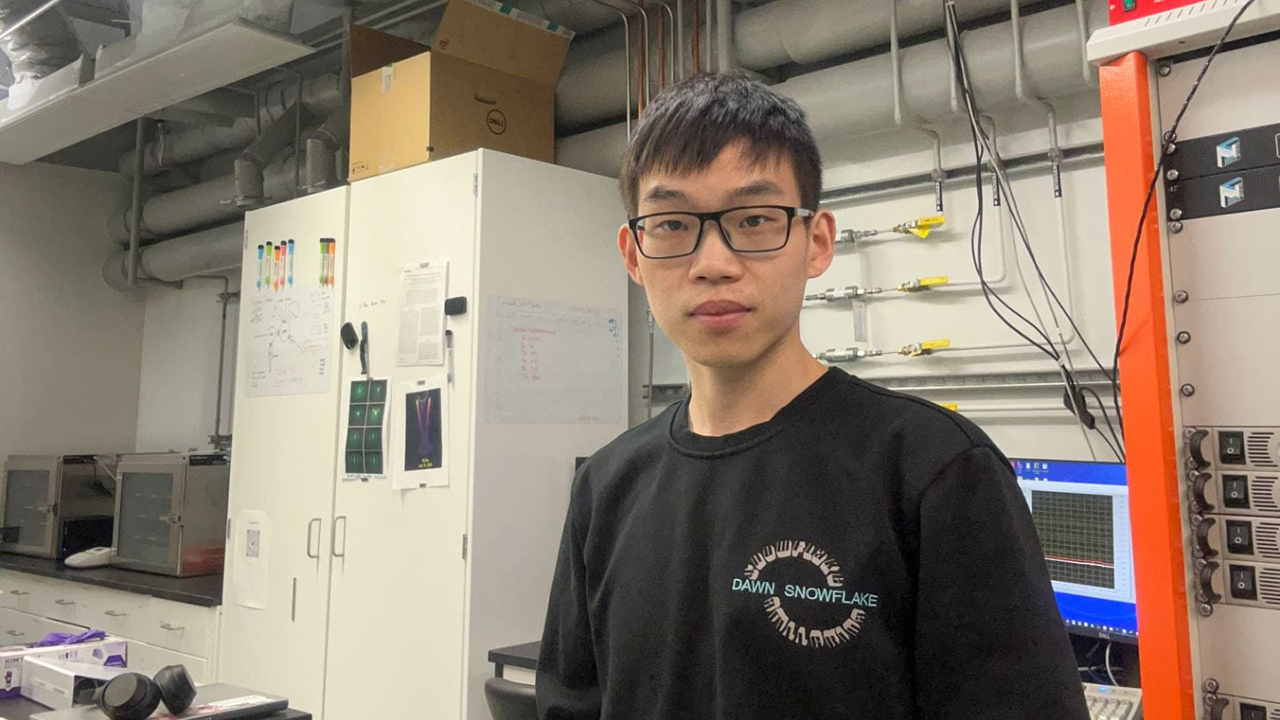
Yang and his team, including postdoctoral scholars Gabriele Berruto and Qiang Gao, studied the material with angle-resolved photoemission spectroscopy (ARPES), which uses photons to eject electrons from a material’s surface. That gives scientists the ability to observe the material’s electronic structure and magnetic states.
By focusing down an ultraviolet laser to 10 micrometers, the team was surprised by what they observed. The electronic band—the range of energies that electrons can have within a material that determines whether it conducts electricity—was flat.
A flat band is a strange phenomenon where the electrons within a material don’t move as fast as they should. In fact, they move very slowly, all together.
“We’re not measuring one electron,” Yang said. “We’re measuring the interaction of thousands or millions of electrons, and they are all moving together in a coherent way. That’s a quantum many-body phenomenon, and it’s actually a very weird thing.”
Yang likens it to a waterfall: when the slope is steep, the water flows faster. But when the slope is shallow, the water flows slower. The finding of these very slow electrons changes how scientists and engineers view the material, which has many different structural arrangements of atoms within it.
“From a scientific perspective, it suggests that the magnetic interactions within the material are totally different from what theory predicts,” Berruto said.
From a technological point of view, the phenomenon shows that the material’s different magnetic states could be used to encode information in a memory storage system. In fact, Yang and the team are currently working to switch between this quantum many-body phase and other phases using a microfocused laser, showing that this switching is possible and could be used in a memory device.
Moving toward room temperature
And while most of these quantum phenomena can only be observed and harnessed at extremely cold temperatures, the team found this response to be coherent up to 100 degrees above absolute zero. Still below room temperature, but very promising compared to analogous materials.
“If we eventually want to use it in a memory device, it needs to work at room temperature,” said Gao, who is now a research scientist at Lawrence Berkeley National Laboratory.
Next, the team will continue working to see if they can find the same properties if they exfoliate the material down to a single atomic layer.
This paper was one of the final research publications of Peter Littlewood, a distinguished physicist at UChicago who died on June 15.
“He was a great theoretical physicist and a leader of quantum materials research at UChicago,” Yang said. “We dedicate this paper to him.”
Other authors on the paper include Khanh Duy Nguyen, Chaowei Hu, Paul Malinowski, Haoran Lin, Beomjoon Goh, Bo Gyu Jang, Xiaodong Xu, and Jiun-Haw Chu.
Citation: “Interaction-driven flat band and charge order in Fe5GeTe2,” Gao et al. Science Advances. August 7, 2026. DOI: 10.1126/sciadv.aeg5930
Funding: This work at the University of Chicago was supported by the U.S. Department of Energy, Grant No. DE-SC0022960, and partially supported by the Gordon and Betty Moore Foundation, Grant No. GBMF12763.
Related News
-
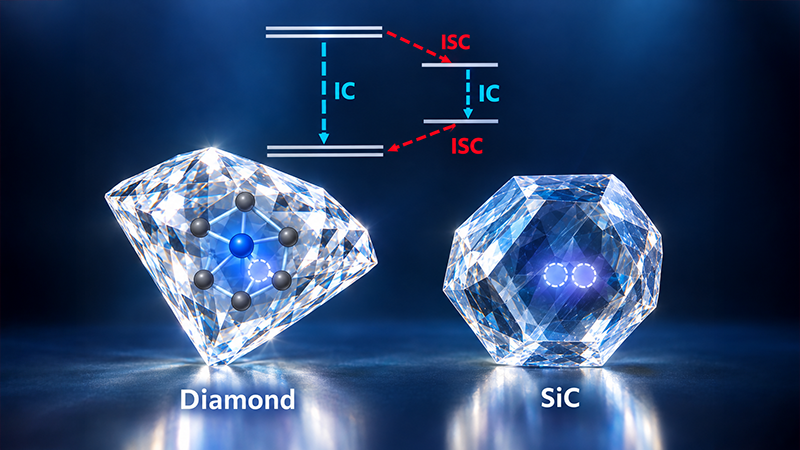
Quantum calculations reveal how quantum defects lose energy
October 14, 2026A first-principles framework from UChicago PME researchers sheds light on the utility of spin defects as qubits and could help design materials for energy conversion and storage. -
“Carpet” growth method yields long-sought 2D quantum material
October 12, 2026A new approach to growing a thin sheet of bismuth telluride let UChicago PME researchers confirm its ability to form a 2D topological insulator at ambient conditions. -

Fermilab to lead two new Genesis Mission awards to accelerate development of microelectronics and quantum
October 08, 2026UChicago Pritzker School of Molecular Engineering Prof. Liang Jiang and Physics Prof. LianTao Wang are co-investigators on AI-guided quantum sensing project.