Finding the quantum advantage in Chicago
PhD student Su-un Lee is working to understand how quantum devices can provide a computational advantage in the near term
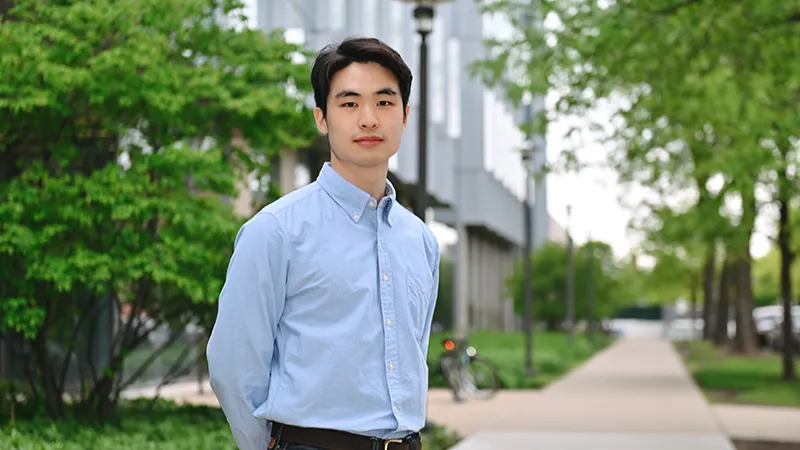
PhD student Su-un Lee's research focuses on determining the opportunities and limitations of current quantum devices.. (Photo by Elaina Eichorn)
Fascinated by how the movement of planets could be anticipated through an understanding of gravity, Su-un Lee was originally drawn to physics through its grand-scale logic.
But as an undergraduate at Seoul National University in Korea, his attention turned to the universe’s smallest scales. Quantum information science could harness the strange powers of the universe at the quantum level, he learned. But quantum computers were still years away from having an advantage over classical computers.
Lee decided that he wanted to be part of that journey toward finding opportunities for quantum devices.
So he applied to the PhD program at the University of Chicago Pritzker School of Molecular Engineering (UChicago PME) to work with one of the world’s premier quantum information science theorists: Prof. Liang Jiang.
“I was particularly interested in his group’s broad range of research across quantum information science, from fundamental theory to practical applications, so UChicago PME was my first choice,” Lee said.
Since arriving at UChicago in 2022, Lee has focused on determining the opportunities and limitations of current quantum devices. Because quantum computers involve particles that are easily perturbed by outside forces, they produce computational “noise” and imperfections.
Lee has focused on how these near-term quantum devices might still provide some computational advantage and solve problems that are difficult to solve on classical computers. To do so, he developed both classical and quantum algorithms to study their boundaries. That allowed him to show the limitations of these circuits and conclude that scientists need highly structured quantum circuits to achieve any quantum advantage.
I was particularly interested in his group’s broad range of research across quantum information science, from fundamental theory to practical applications, so UChicago PME was my first choice.
PhD student Su-un Lee
Within the Jiang group, he has found a supportive cohort. “It’s a relatively large group, so there are always people with different perspectives to discuss ideas with,” he said. “Liang gives us a lot of freedom to pursue our own research directions. He’s curious about a wide range of topics and has a great sense of which people and perspectives to bring together for a discussion.”
In the summer of 2025, Lee interned at IBM in Yorktown Heights, New York, studying quantum advantage for near-term quantum devices as part of a large-scale project. As part of the quantum algorithms team, he spoke with experimental researchers to understand bottlenecks in current quantum devices. “Being part of such a large collaboration for such an ambitious goal was something I had never experienced before,” he said. He liked the experience so much that he returned for another summer internship in 2026.
Outside of his research, Lee connects with other UChicago PME students at graduate student socials and coffee hours. He also finds time to play tennis, watch movies, and go to classical music concerts.
“I enjoy the contrast Chicago offers. I can go downtown and enjoy the cultural life of a major city, and then come back to Hyde Park, which feels more relaxed and peaceful.”
After he receives his PhD, he hopes to find a position in industry or academia that will allow him to continue his research on quantum information science.
“I believe there are practical problems where quantum computers can make a real difference,” he said. “The capabilities of quantum hardware have advanced significantly, and we’re getting closer to demonstrating quantum advantage on practically meaningful problems.”
Related News
-
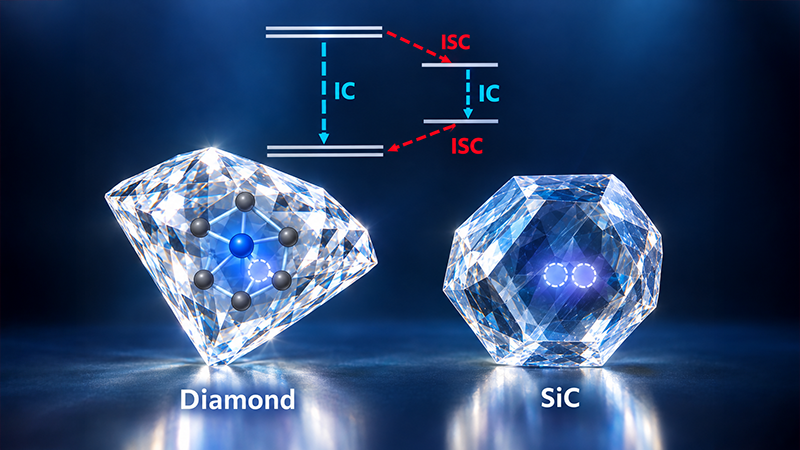
Quantum calculations reveal how quantum defects lose energy
October 14, 2026A first-principles framework from UChicago PME researchers sheds light on the utility of spin defects as qubits and could help design materials for energy conversion and storage. -
“Carpet” growth method yields long-sought 2D quantum material
October 12, 2026A new approach to growing a thin sheet of bismuth telluride let UChicago PME researchers confirm its ability to form a 2D topological insulator at ambient conditions. -
Fermilab to lead two new Genesis Mission awards to accelerate development of microelectronics and quantum
October 08, 2026UChicago Pritzker School of Molecular Engineering Prof. Liang Jiang and Physics Prof. LianTao Wang are co-investigators on AI-guided quantum sensing project.