
New open-source software predicts energy transfer between tiny defects in solid materials
Connecting atomic-scale behavior to larger-scale material properties to predict the performance of real optical devices
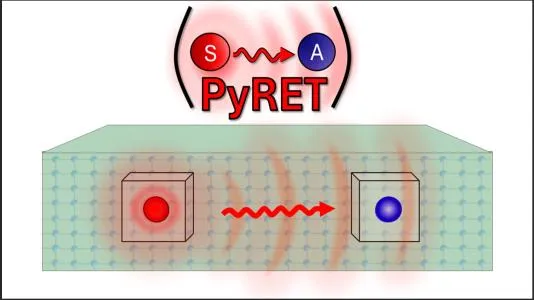
Scientific illustration of energy transfer between atomic-scale defects in a solid, as modeled by the open-source PyRET software developed by Argonne and UChicago researchers. (Image by Argonne National Laboratory)
The performance of many next-generation devices depends on controlling how energy flows at extremely small scales. In the field of microelectronics — where devices continue to shrink and new materials are introduced — small imperfections in solids can strongly influence how a material stores, transfers or loses energy. Those processes can either be used to improve device performance or create problems such as energy loss, information loss, signal disruption or reduced reliability.
Researchers at the U.S. Department of Energy’s (DOE) Argonne National Laboratory and the University of Chicago have developed PyRET, an open-source software tool that helps scientists understand and predict how energy is transferred between tiny defects in solid materials. These defects can behave like small, light-responsive centers. Scientists are studying them for use in optical memory devices, quantum information systems and advanced microelectronics.
PyRET, short for Python package for Resonance Energy Transfer, was created to address a basic challenge in materials science: linking the behavior of electrons near a defect with the behavior of light, which interacts with a material over much larger distances in a device. Addressing processes that happen over such different scales is challenging.
Energy transfer between defects is important because it can influence how well a device works. In some systems, the transfer is useful. It could be used, for example, to build new forms of optical memory that store far more data in the same amount of space than current technologies allow. In other systems, the same transfer process can lead to problems by causing energy leaks near the very defect researchers want to control.
“For many advanced devices, it is important to know how one defect interacts with another,” said Swarnabha Chattaraj, an Argonne postdoctoral appointee who developed this software. “PyRET gives us a way to calculate the energy transfer rates between defects from first principles — starting from the atomic structure of the material and the known laws of physics — rather than relying on fitted experimental data or rough approximations.”
UChicago Pritzker School of Molecular Engineering Prof. Supratik Guha and Prof. Giulia Galli contributed to the work. Guha is senior advisor to Argonne’s Physical Sciences and Engineering directorate; Galli is a Senior Scientist at Argonne and group leader and the director of the Midwest Integrated Center for Computational Materials.
PyRET models what happens when one defect is excited, releases energy as light and a nearby defect absorbs that energy. The code combines information about the electronic structure of each defect with a detailed, quantum-level description of how they absorb or emit light. This allows researchers to study interactions that are difficult to capture with existing methods alone.
The software is designed for a problem that spans very different length scales. The electronic behavior near a defect takes place on the scale of less than a nanometer, while light can travel across tens or even hundreds of nanometers inside a material or device. Chattaraj said PyRET helps connect those small-scale calculations to the larger scales that matter for device design.
“If we want to design real devices, we have to understand both the atom-scale behavior of the defects and the longer-range movement of light,” Chattaraj said. “PyRET brings those two pieces together.”
The modeling that PyRET enables is important because real devices are much larger than the small system sizes many first-principles methods can handle directly. PyRET helps close that gap, giving researchers a way to study energy transfer in settings that are closer to how real devices operate.
Using PyRET, Chattaraj and collaborators predicted how a photonic cavity — a tiny structure that traps and shapes light at specific colors or frequencies, known as its cavity modes — can sharply increase or decrease the rate of energy transfer between defects. By tuning the cavity mode, the researchers found they could change the energy transfer rate by nearly two orders of magnitude. That level of control could help enable key operational functions, such as read and write, in future ultra dense optical memory devices.
In the long term, PyRET could help scientists better understand unwanted energy loss in quantum systems and support the design of new materials and devices that store and control information more efficiently.
PyRET is open-source software, allowing the scientific community to use, test and improve it. Making the software public helps to speed progress in both basic research and device design.
The project also benefited from the broader efforts of Argonne-based Midwest Integrated Center for Computational Materials, which develops open-source computational tools and data to help researchers predict the properties of functional materials.
“Open access helps build a community around the problem and is an important part of doing open science,” Chattaraj said.
PyRET is publicly available on GitHub, and additional information and documentation is available on the project website.
The scientific development of PyRET is outlined in two publications in the journal Physical Review Research.
This study was funded by the Extreme Lithography & Materials Innovation Center, a DOE Office of Science Microelectronics Science Research Center.
Related News
-
Engineering the Summer: A real-world eye on materials
July 29, 2026Engineering the Summer is an annual series following UChicago Pritzker School of Molecular Engineering students as they embark on summer internships and career experiences. Suin Choi is excited. The... -
To design better energy devices, researchers investigate membranes
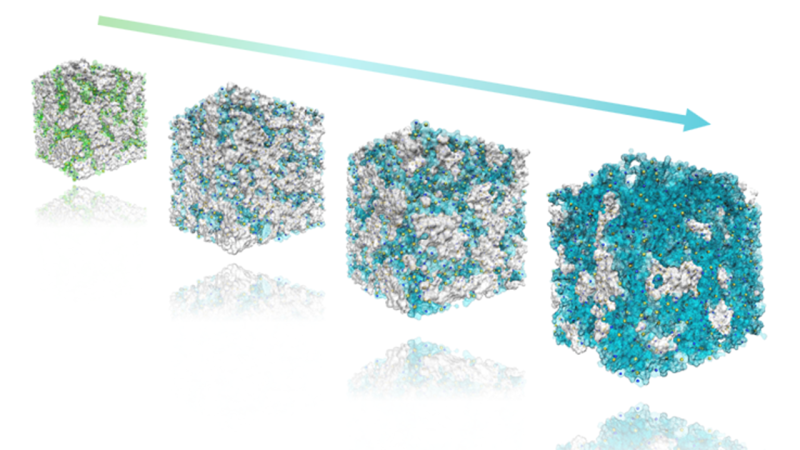
July 27, 2026A research team at the University of Chicago and NYU used experiments and molecular simulations to better understand how polymer backbone design affects the performance of ion-exchange membranes. -
Remotely operated, robotic lab receives $20 million National Science Foundation grant
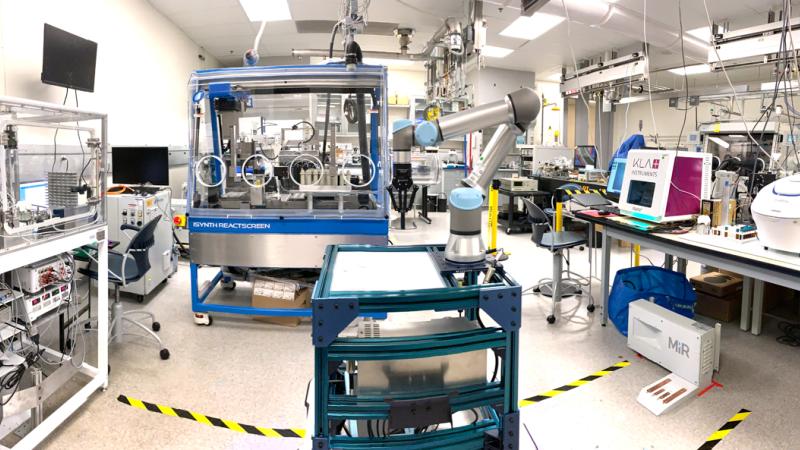
July 22, 2026Tomorrow’s clean energy, advanced manufacturing, healthcare, and national defense rely on developing novel, next-generation soft materials – things like liquids, polymers, gels, colloids, foams, and...