
NSF CAREER award to bring biological qubits to the single-molecule realm
The $400,000 grant hopes to tackle photobleaching and readout fidelity to improve protein-based biosensors
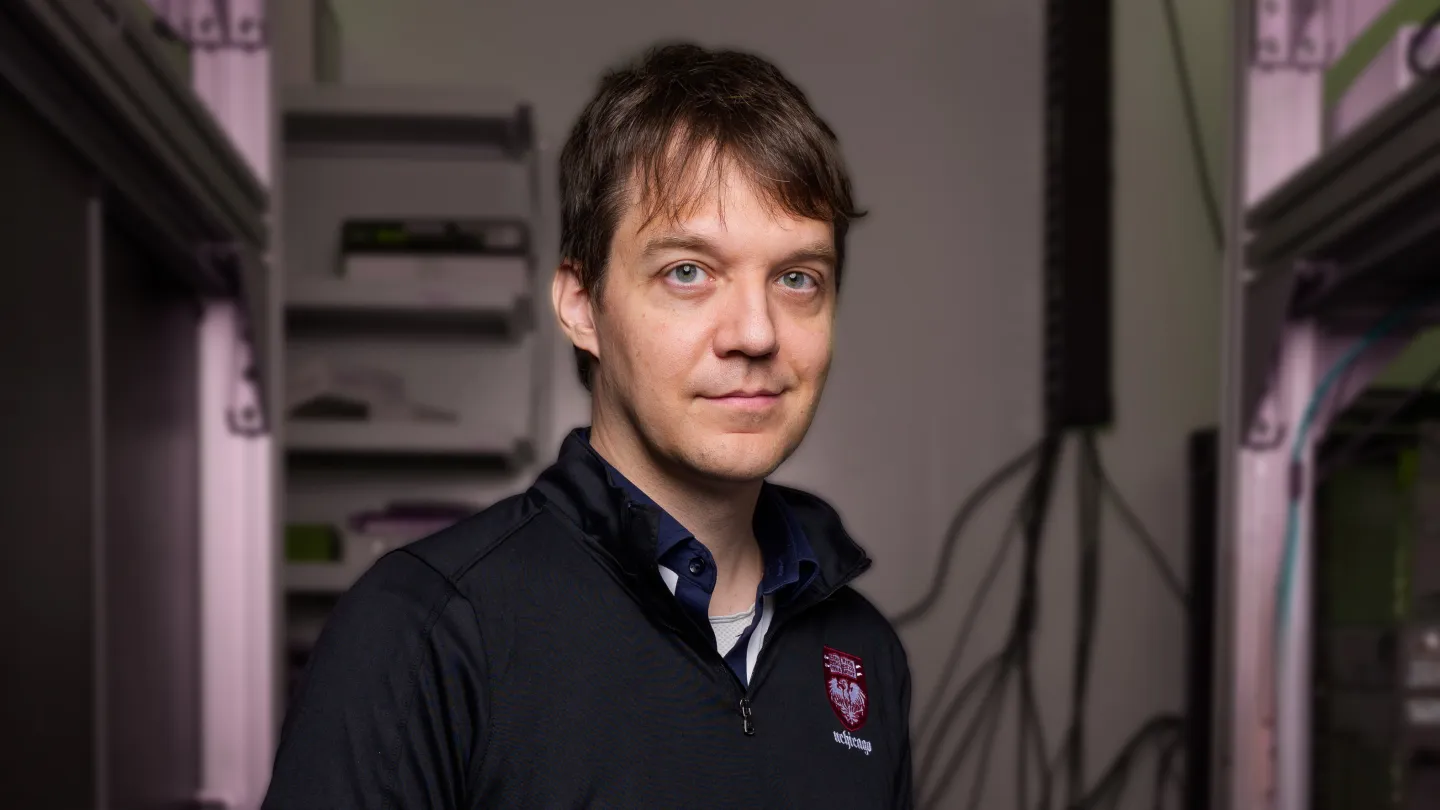
A new NSF CAREER award will advance Assoc. Prof. Peter Maurer's research on improving biological qubits’ use as sensors. (Photo by Jason Smith)
When University of Chicago Pritzker School of Molecular Engineering researchers turned a protein found in living cells into a functioning quantum bit, or qubit, in 2025, it was a first-of-its-kind breakthrough – a protein quantum qubit or sensor capable of detecting minute changes and ultimately offering unprecedented insight into biological processes.
A new $400,000 grant from the U.S. National Science Foundation’s Faculty Early Career Development Program (CAREER) will help advance that work, tackling photobleaching and readout fidelity issues to better explore how cells function down to the single molecule.
“Improving biological qubits’ use as sensors will enable biologists to study fundamental mechanisms of disease at an atomic resolution, providing critical insights into conditions ranging from cancer to neurodegenerative disorders,” said grant recipient Assoc. Prof. Peter Maurer. “Educationally, this will support the creation of a multidisciplinary quantum workforce, actively engaging chemists, physicists and biophysicists.”
Quantum biosensors work by taking advantage of the very problem that complicates quantum computing. Qubits - the building block of quantum computers - are incredibly finicky; the slightest environmental perturbation results in a collapse of the qubit state.
It is an exciting time for a technology that unites the worlds of quantum research and life sciences.
Assoc. Prof. Peter Maurer
While researchers building next-generation quantum computers fight this excessive sensitivity, quantum biosensor researchers embrace it, using it to measure the functions of living cells on the smallest of scales in clarity never before seen. This interdisciplinary combination of quantum technology and bioengineering is a rapid growth area at UChicago PME and one of the technologies underpinning UChicago PME’s Berggren Center for Quantum Biology and Medicine.
But many of the best qubits for biosensors are found in nitrogen vacancies in small pieces of diamond.
“Bringing a diamond sensor inside a living cell and keeping that cell's function unperturbed still remains an outstanding challenge. Having a sensitive probe that cannot be targeted to the right location will not help anything,” Maurer said. “Our qubits overcome this challenge. However, their sensitivity remains limited. Here we are working towards overcoming sensitivity challenges.”
Much of the current research, including Maurer’s own, is devoted to making diamond-based quantum biosensors more biocompatible. When Maurer and UChicago PME Prof. David Awschalom created a functional biological qubit encoded in a yellow fluorescent protein, they created a material that promised complete biocompatibility. Protein qubits can also be genetically encoded, able to be positioned at exact, predetermined sites within the cell with atomic precision.
Physics World named the feat one of its top ten physics breakthroughs of 2025.
The new NSF CAREER grant hopes to build on that breakthrough. Maurer and his team will use the funds to: create a detailed understanding of how photobleaching impacts the fluorescent protein; develop novel readout methods at the single-molecule level; and engineer molecular spin coherence and advance sensitivity benchmarks significantly beyond current standards.
“It is an exciting time for a technology that unites the worlds of quantum research and life sciences,” Maurer said. “We thank the NSF for this powerful investment in the future of quantum technology and human health.”
Related News
-
Discovery of ‘slow’ electrons in 2D material could lead to new memory device
August 07, 2026A research team found a quantum phenomenon in a two-dimensional magnet that could be relevant for memory storage. -
Engineering the Summer: Building interdisciplinary expertise
August 05, 2026Engineering the Summer is an annual series following UChicago Pritzker School of Molecular Engineering students as they embark on summer internships and career experiences. While many researchers talk... -
Finding a hidden culprit in quantum biosensors
August 03, 2026Research indicates surface effects, not temperature, are responsible for a longtime hurdle in using quantum tech to explore living cells.