
To teach quantum to teens, teachers reach for ice cream and cell phones
Now in its sixth year, TeachQuantum helps teachers make quantum concepts accessible and engaging
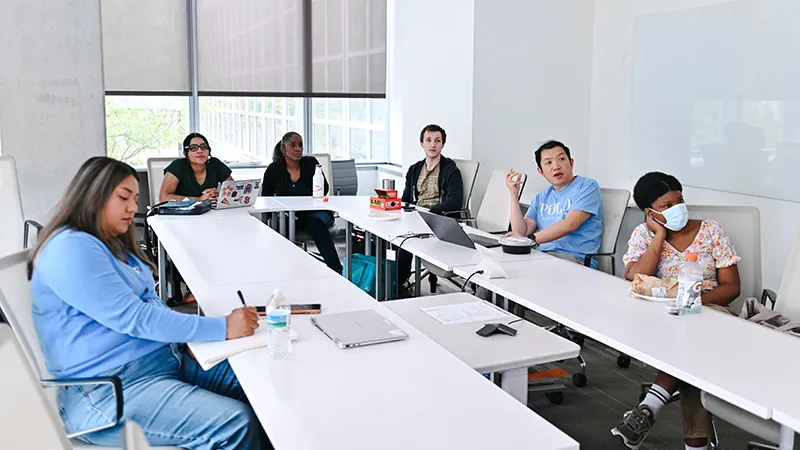
UChicago PME faculty members and local high school teachers work together to make to make quantum concepts accessible and engaging for high school students. (Photo by Elaina Eichorn)
The teachers at James H. Bowen High School know how to get their students interested in abstract concepts like quantum science.
The first step: use the right tools. That means lessons that incorporate ice cream, cell phones, and card games to explain complex concepts like quantum decoherence and light polarization.
“When you’re a public-school science teacher on the South Side of Chicago, you need to make lessons as relevant and as practical as you can,” said Evelyn Alfred, who teaches biology and chemistry at the school. “So, you say, ‘Here’s what’s going on behind your phone screens.’”
The second step: tie it into their neighborhood. The Illinois Quantum and Microelectronics Park, a campus for quantum technology innovation, is currently under construction only a mile from the high school.
“It’s happening in our backyard,” said Adam Davenport, who teaches physics and chemistry at the school. “Our students need to know what’s coming down the pipeline for computer science and communications. They need an understanding of these concepts if they want to be a part of the quantum industry.”
While quantum mechanics hasn’t traditionally been taught in high school, that’s changing thanks to programs like TeachQuantum at the University of Chicago Pritzker School of Molecular Engineering (UChicago PME).
TeachQuantum brings in high school teachers from around the Midwest for a six-week summer program that helps them design and refine lessons that will inspire the next generation of the quantum workforce. A collaboration between UChicago PME and the University of Wisconsin-Madison, it is funded by the NSF Quantum Leap Challenge Institute for Hybrid Quantum Architectures and Networks (NSF HQAN).
Within the program, teachers are immersed in quantum science laboratories with a collaborative cohort of educators. They then use what they learned in the lab and in curriculum development sessions to create lessons for the upcoming year. That’s where Alfred and Davenport came up with their innovative new ideas. After the program is over, the cohort of teachers meets quarterly to share updates on how their lessons worked in their classrooms, refining their work and supporting each other.
“That’s one of the best parts of the program,” Davenport said, “listening to people with diverse backgrounds and educations attack these concepts in their own way. I love that.”
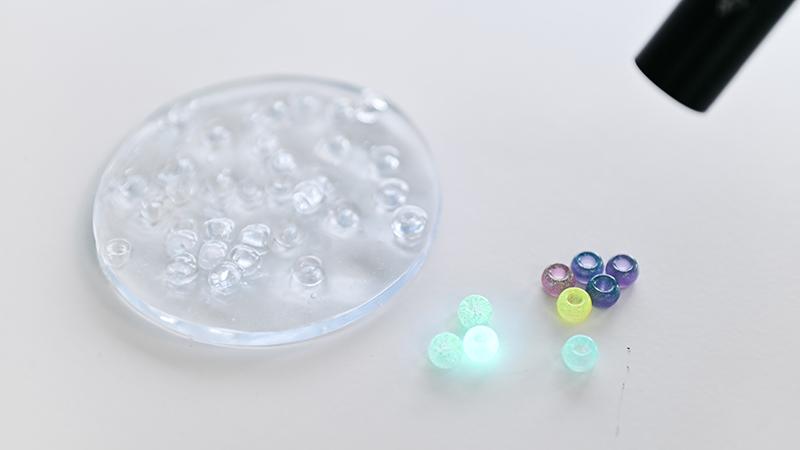
Teaching quantum decoherence with ice cream
Davenport has been part of the program since its inception in 2021. As a physics teacher, he understood quantum mechanics but knew it would be difficult to teach, since its abstract concepts aren’t readily observable in our world and rely on math and equations that are beyond many high school students’ abilities.
But participating in TeachQuantum showed him that quantum science “can be made less weird and completely accessible,” he said. “The barrier to entry is a lot lower than people think it is.”
Over the years, Davenport has worked with his cohort and faculty at UChicago PME to develop quantum-themed lessons, including having students act out the process of encryption by moving envelopes around the classroom. Another lesson challenged students to use flashlights to transfer information across the room. Another year, Davenport used a card game to teach quantum spectroscopy.
But perhaps his most successful lesson used ice cream sandwiches to demonstrate the idea of quantum decoherence. Davenport writes “data” on the side of the ice cream sandwich, then explains that when the ice cream melts, the data doesn’t go away—it’s just unreadable.
Students are then charged with making a list of supplies that can be purchased cheaply to make their own “quantum refrigerator” that will keep the sandwich frozen and therefore maintain quantum coherence.
“It’s really impressive what they put together, and it gives them the idea that what they are doing is protecting something fragile from ambient energy, which is exactly what scientists do in a lab with qubits,” Davenport said.
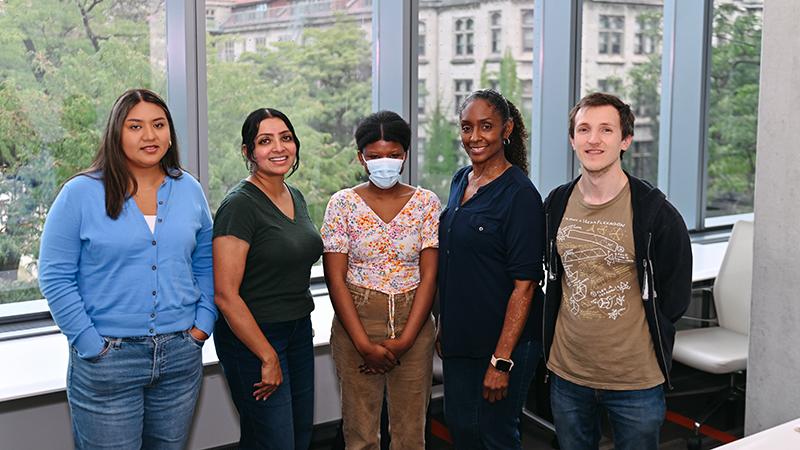
Helping students understand how their phones work
For Alfred, teaching students quantum science is especially important in the age of AI and data centers. “I want them to understand the theories behind these technologies in a way that’s accessible for them,” she said. “I want them to understand that they can take part in this world.”
During her first year in the program, Alfred developed a lesson about quantum sensors for biology. Students were interested, but the lesson ultimately didn’t land. “I don’t think it was relevant enough for them,” she said.
This summer, she developed a new lesson that’s much closer to home: teaching students about the technology behind their phone screens. This coming year, her students will use handheld polarizers to learn how light is directed to make images appear.
“It’s much more physical and is something students can apply to their everyday world,” she said. “The program gave me the time and space to come up with this prototype, and I’m so glad I made it as practical as I could.”
Davenport has now become a mentor in the program, helping teachers workshop and revise their ideas, and guiding them as they work to tie it into national teaching standards—an important step to being able to teach quantum science in high schools.
“That helps eliminate another barrier to teaching quantum in high schools,” he said. “So, students will be ready to both join this industry and understand that this is the fundamental nature of the universe in which they exist.”
Related News
-
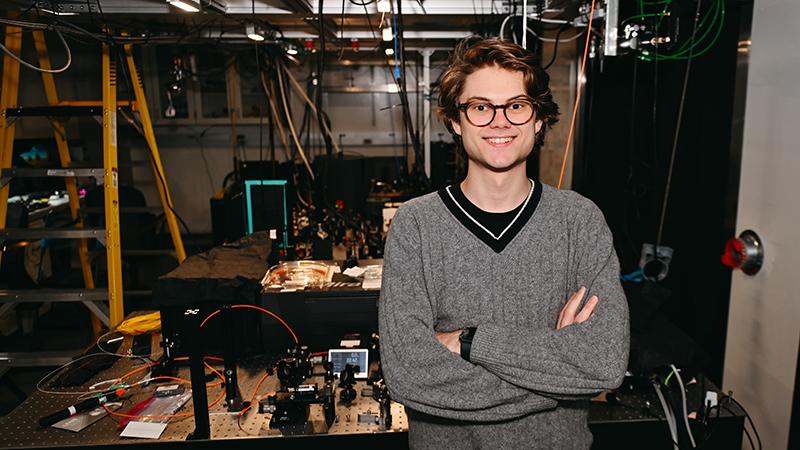
Developing quantum sensors for better health
October 05, 2026PhD student Antoni Wellisz is working at the forefront of quantum technology, developing biosensors that could actively monitor tiny molecules in the human body. -
Postdocs help power discovery at UChicago PME
October 01, 20262026 National Postdoc Appreciation Week honors postdocs, marks 150th anniversary of the first postdoctoral researcher in the U.S. -
South Side Science Festival returns Oct. 3
September 16, 2026Annual community gathering invites the South Side to the UChicago campus for a day of science and fun.