Transitioning from quality control to the cutting edge of immunoengineering
After four years in pharmaceutical quality control, master’s student Akasha Ashraf came to UChicago PME to understand how therapies are built from the ground up — and discovered a passion for engineering the immune system itself
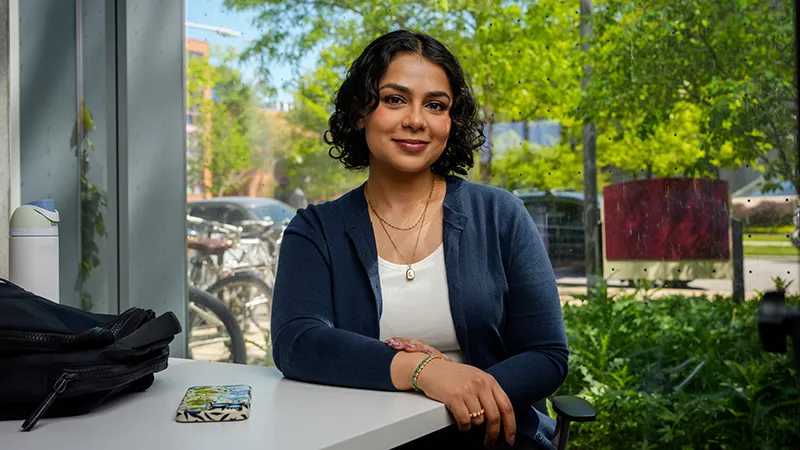
Master of Engineering student Akasha Ashraf. (Photo by Jason Smith)
For Akasha Ashraf, the journey to the University of Chicago Pritzker School of Molecular Engineering (UChicago PME) began over two thousand miles away and in the midst of a lockdown.
As an undergraduate student at UC Merced in California’s Central Valley, Ashraf received her bachelor’s degree in bioengineering during the height of the COVID-19 pandemic, an event that heightened public attention on new ways of combating illness and promoting health.
A role at BioMarin, a biotechnology company that specializes in treating rare diseases, allowed Ashraf to experience the quality-control side of drug development, testing the raw materials that go into therapeutic products, but it also gave her a desire to learn more about how a therapy comes together, from early research all the way to the patient. After four years with the company, she decided that she needed a change.
“I was only seeing one small part of the whole process,” Ashraf said, explaining her desire to pivot to a more interdisciplinary path within her field of study. She was looking for a way to understand not only the research and development that went into creating therapies, but the industry as a whole.
That’s when she found the Master of Engineering program at UChicago PME.
“First of all, I’ve always wanted to come to Chicago,” she said, explaining what first caught her eye about the program. She saw the Bio- and Immunoengineering Track, which seemed to present an opportunity to leverage her undergraduate degree and experience while still branching out.
“I had a good background in bioengineering, which is why I felt like this program would help me take the next step in my career.”
In the Bio- and Immunoengineering Track, Ashraf became more acquainted with immunology and how medical engineering works at the cellular and molecular levels. During a nanomedicine course led by Senior Instructional Professor Mustafa Guler, she became fascinated by the way in which particles can be engineered to work with the immune system to promote healing.
I had a good background in bioengineering, which is why I felt like this program would help me take the next step in my career.
MEng student Akasha Ashraf
An externship on campus interviewing ICU nurses to brainstorm possible innovations also gave Ashraf greater insight into the hands-on applications of medical devices and helped instill a desire to keep working in this area.
Throughout it all, Ashraf has enjoyed the spirit of openness and rigor within the program and on campus in general.
“I just love that people are so welcoming. People are constantly wanting to do something new.”
Driven by the experiences of her externship, Ashraf looks forward to finding new ways to innovate medicine and clinical practice beyond the program. In the short term, she is working as a student research intern at Signl, a startup spun out of UChicago PME’s Esser-Khan Lab that is developing ways to tune the immune system.
“I’m really excited to be getting more hands-on experience with immunology.”
--Learn more about the Master of Engineering program at UChicago PME
Related News
-

Where the micro-scale meets the macro-scale at UChicago
October 15, 2026Master’s student Mel Zhou uses microfluidic platforms to learn how individual patients might respond to different therapies -

Learning is a blast – and a bang – at the South Side Science Festival
October 08, 2026Dancing robots, mutant Legos and rocks that rock mark the fifth annual UChicago STEM community outreach event. -
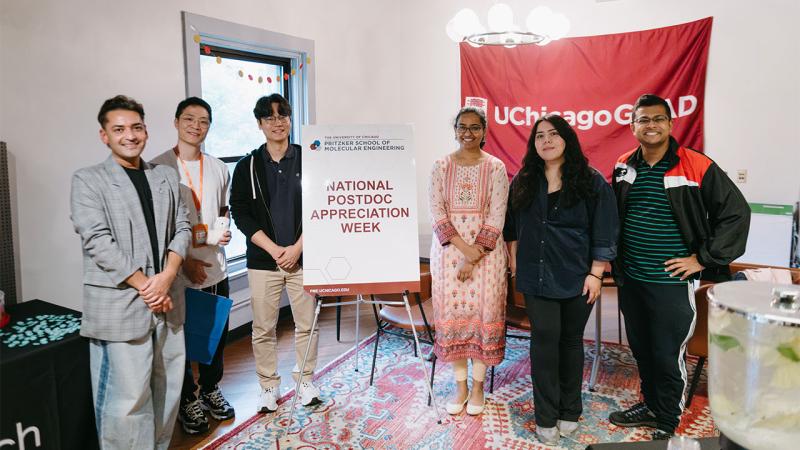
Postdocs help power discovery at UChicago PME
October 01, 20262026 National Postdoc Appreciation Week honors postdocs, marks 150th anniversary of the first postdoctoral researcher in the U.S.