Unlocking new quantum architectures
A less-explored form of quantum code could be more powerful – and more stable – than its popular alternative in error correction
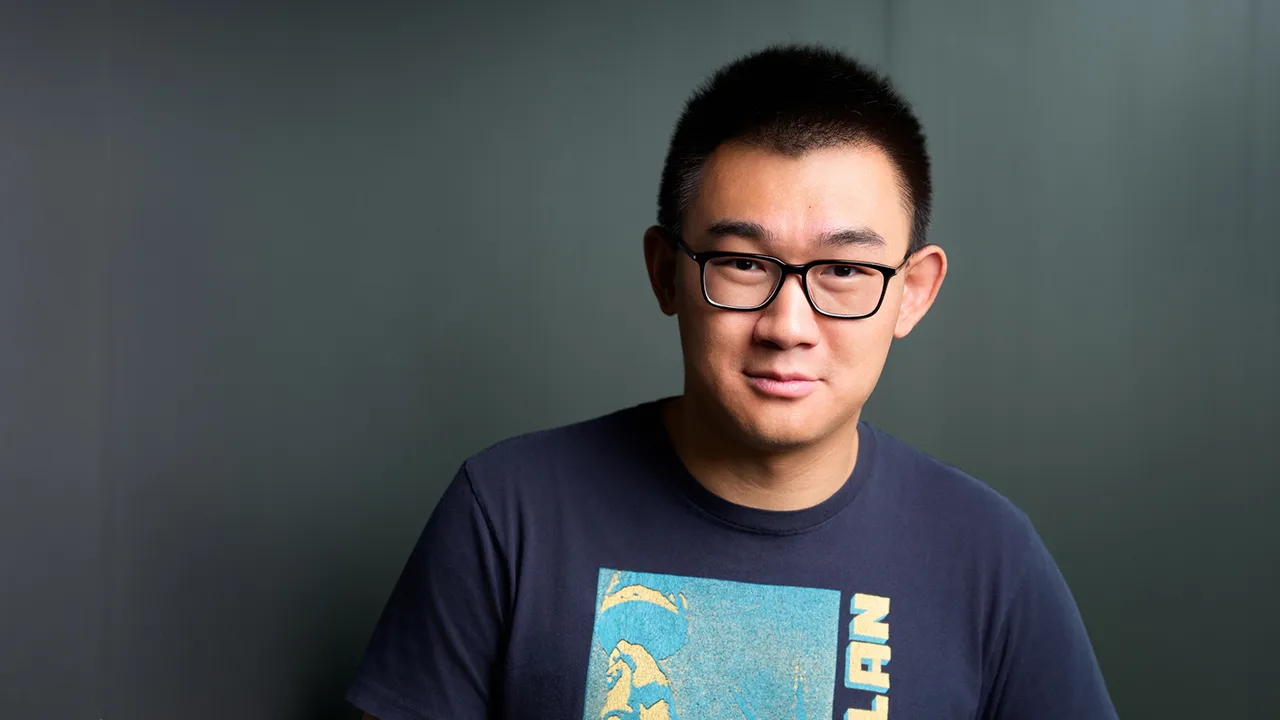
University of Chicago Pritzker School of Molecular Engineering PhD student Rossoneri Jing is the first author of a paper that explores the potential benefits - and headaches - of an underdeveloped area of quantum code. (Photo by Jason Smith)
In mathematics and getting dressed, some processes are commutative, while others are noncommutative. Commutative means the order doesn’t matter (3+2 is the same as 2+3 and it doesn’t matter which sock goes on first). Noncommutative means the order does matter.
“If you first put on your sock and then your shoe, it’s not the same as putting on your shoe and then your sock,” said UChicago Pritzker School of Molecular Engineering (UChicago PME) Asst. Prof. Ruben Verresen. “That’s noncommutativity.”
Applying this rule of socks to the world of qubits, new theoretical research from UChicago PME indicates that noncommutative or “non-Abelian” quantum code where the order matters could create quantum computers that are not only more powerful than ones based on Abelian code, but more stable.
In a paper published in Physical Review Letters, the team found that non-Abelian systems could have a noise threshold – an ability to tolerate quantum-scale interference – that is about 38% higher than comparable Abelian systems for a particular type of noise.
“It’s more difficult to work with than the Abelian code, but on the other hand, we know it also gives us a lot of benefits,” said UChicago PME PhD student Rossoneri Jing, first author of the work. “The entire non-Abelian architecture is very underdeveloped right now. So we know there are benefits, but we don’t yet know the full extent of how powerful – or how much of a headache – non-Abelian could be.”
Jing said quantum theorists have previously eyed non-Abelian quantum codes as a powerful option for computing, but their complexity has left the field relatively unexplored. It’s hard enough to create these complicated quantum architectures when you don’t have to do everything in exactly the right order.
“Most of the quantum companies and many research groups have focused on a very particular architecture, a particular type of code called surface code or toric code,” said Verresen, co-corresponding author. “But it turns out in the bigger landscape of possible entangled states it is a very special corner. There are more exotic or interesting types of entangled states that, in principle, could serve as more powerful types of codes.”
In addition to being more powerful, non-Abelian codes could also be more stable, intrinsically giving off information that can help researchers correct errors in a way that doesn’t risk the delicate quantum states. Because in quantum error correction, a little information is a dangerous thing.
Observer effects
The code that stores information in a quantum computer has built-in redundancies to make sure the information is correct. “Checks” correspond to the redundancies. The checks, like the redundancies themselves, should be identical. If they’re different, something went wrong.
“We measure these checks, and they will tell us whether an error has occurred,” Jing said.
But the action of checking provides information, which can risk destroying everything.
We don’t yet know the full extent of how powerful – or how much of a headache – non-Abelian [code] could be.
UChicago Pritzker School of Molecular Engineering PhD student Rossoneri Jing
Quantum superposition is a delicate dance where things exist in multiple states simultaneously. The answer to a question isn’t “yes” or “no,” but “yes/no.” Observing – the very act of measuring the system – interrupts the dance, in quantum terms “causing the wave function to collapse” down to a single state. The answer becomes a definitive yes or no, Schrödinger’s cat is either dead or alive.
In error correction, researchers want to learn enough to find the problem, but not so much they collapse the wave function.
“We don’t want to learn too much, the idea being if you try to learn everything about the state, you end up collapsing it, because quantum entanglement is kind of finicky,” Verresen said. “There’s a delicate balance of how much you want to learn, or how much you can learn, without hurting it.”
Intrinsic heralding
Error correction in Abelian systems often involves creating “flag qubits” to help identify suspects responsible for violating the checks. It’s more work – Verresen called them “extra bells and whistles.”
But in non-Abelian systems, noisy interactions with the environment give rise to emergent, particle-like check violations called non-Abelian anyons. They are often seen as an added complication – another headache of non-Abelian systems.
The UChicago PME team, together with coauthor Pablo Sala de Torres-Solanot of the University of California, Berkeley, realized the anyons themselves can be used as flags. By using information left behind by imperfect anyon strings, the team developed an approach it calls “intrinsic heralding.”
“We didn't have to put in extra bells and whistles to learn that extra information. It just comes from the very nature of the non-Abelian code,” Verresen said.
This provides information that researchers can study without risking waveform collapse, making non-Abelian systems theoretically more stable, at least for certain types of noise.
“There is a threshold of noise the system can tolerate before you irreparably lose the information that was stored,” said UChicago PME Prof. Liang Jiang, co-corresponding author. “We found this intrinsic heralding increased that threshold. It shows that non-Abelian properties do not reduce, as long assumed, but actually enhance stability.”
Jing said this theory must still be validated experimentally, but could open a new world for quantum computing and technologies.
Citation: “Intrinsic Heralding and Optimal Decoders for Non-Abelian Topological Order,” Jing et al., Physical Review Letters, March 26, 2026. DOI: 10.1103/ccj7-ctd8
Related News
-
Quantum calculations reveal how quantum defects lose energy
October 14, 2026A first-principles framework from UChicago PME researchers sheds light on the utility of spin defects as qubits and could help design materials for energy conversion and storage. -
“Carpet” growth method yields long-sought 2D quantum material
October 12, 2026A new approach to growing a thin sheet of bismuth telluride let UChicago PME researchers confirm its ability to form a 2D topological insulator at ambient conditions. -

Fermilab to lead two new Genesis Mission awards to accelerate development of microelectronics and quantum
October 08, 2026UChicago Pritzker School of Molecular Engineering Prof. Liang Jiang and Physics Prof. LianTao Wang are co-investigators on AI-guided quantum sensing project.