
Engineering the Summer: Advancing quantum computing with IBM
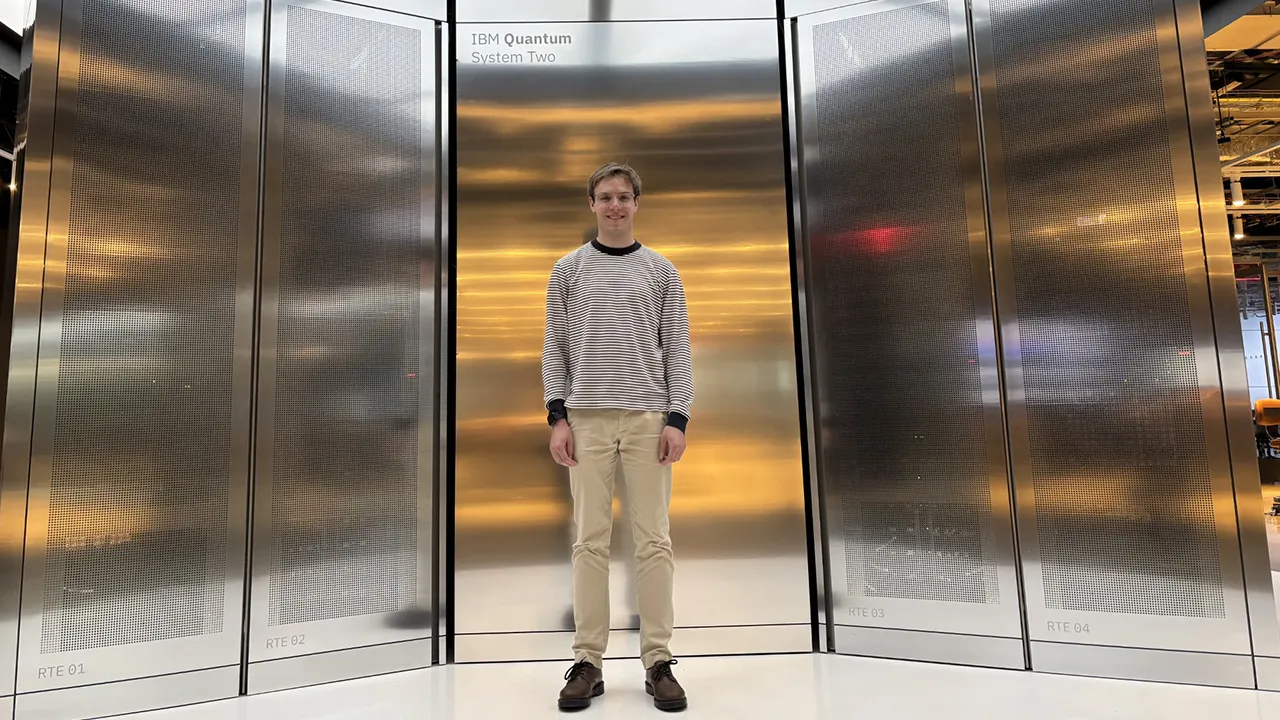
UChicago Pritzker School of Molecular Engineering PhD student Antoine Brillant stands in front of the IBM Quantum System Two quantum computer. Brillant spent the summer interning with IBM’s quantum demonstration and capabilities team in Yorktown Heights.
Engineering the Summer is an annual series following UChicago Pritzker School of Molecular Engineering students as they embark on summer internships and career experiences.
The quantum revolution is already changing everything from computing and telecommunications to healthcare and cryptography.
But for University of Chicago Pritzker School of Molecular Engineering quantum PhD student Antoine Brillant, the most exciting part is not what has already happened, but what’s coming next.
“A few very powerful quantum algorithms already exist, but I like to think that the best applications have not yet been discovered,” Brillant said.
The fourth-year student in the Clerk Group spent the summer helping bring that future closer through an internship with IBM’s quantum demonstration and capabilities team in Yorktown Heights.
Brillant shared his experience for UChicago PME’s Engineering the Summer series:
This interview has been edited for length and clarity.
What has been your experience so far this summer at your internship?
My experience has been great so far. I am working on the quantum demonstration and capabilities team. I have been working on finding techniques to efficiently mitigate noise on IBM quantum devices. My team is very interested in similar questions as I am, which allowed for engaging discussion. That has been great.
How does your internship connect with your field of study at UChicago PME?
The work that I have been doing this summer can be seen as a practical application of questions and results that I have been working on during my PhD. I see my internship as a direct continuation of my PhD work and as a perfect occasion to directly learn about practical considerations that come with the implementation of my results.
What role do you hope to play in the future of quantum computing?
I think that large-scale fault tolerant quantum computations will be possible by the end of the decade – with IBM Starling – and continue to improve over the next 10 to 20 years. It is still unclear what the wider impact on the world of these quantum computers will have, but we know they have the potential to change many areas of modern life. I hope in my career to bring solutions and ideas to the many challenges that will come with the development of fault-tolerant quantum computers.
Related News
-

Welcome to the Neighborhood: UChicago Pritzker Molecular Engineering in focus as ACS Fall 2026 brings the world to Chicago
August 11, 2026As the global research community gathers in Chicago for the American Chemical Society’s yearly conference, UChicago PME faculty and leadership share insights and innovations. -
NSF CAREER award to bring biological qubits to the single-molecule realm
August 10, 2026The $400,000 grant hopes to tackle photobleaching and readout fidelity to improve protein-based biosensors. -
Discovery of ‘slow’ electrons in 2D material could lead to new memory device
August 07, 2026A research team found a quantum phenomenon in a two-dimensional magnet that could be relevant for memory storage.