Making the Midwest a biotech hub
UChicago Pritzker Molecular Engineering researchers advance healthcare solutions at the Midwest BioBuilders Summit
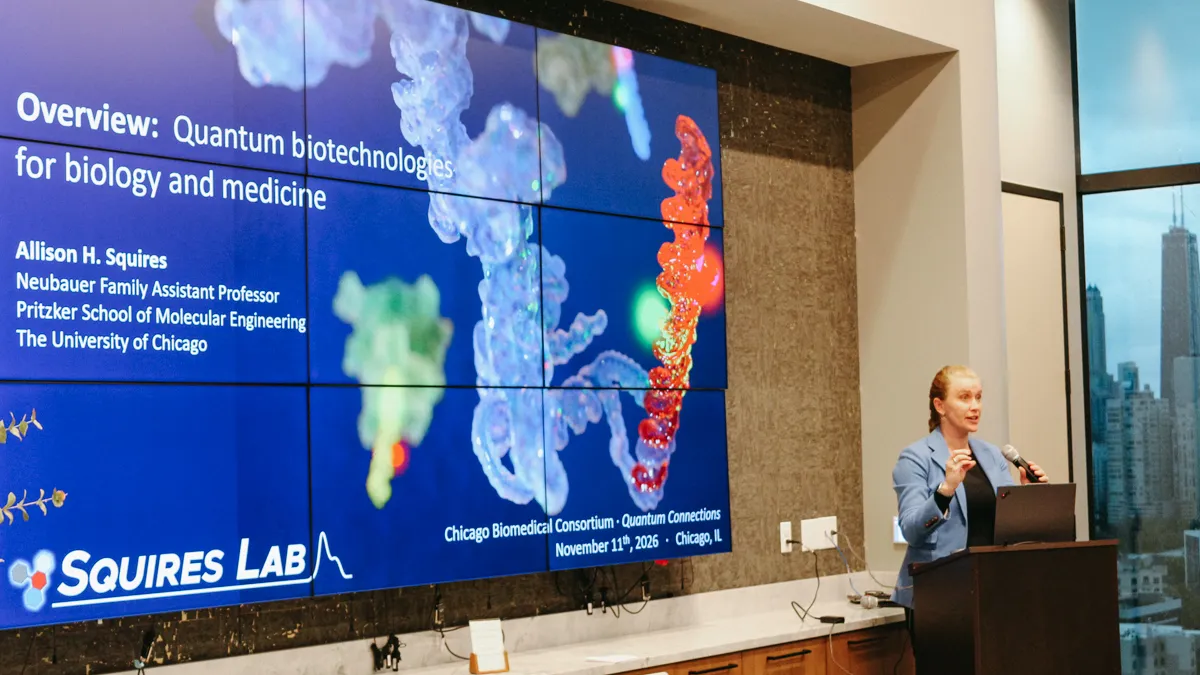
Neubauer Family Assistant Professor Allison Squires speaks at the Midwest BioBuilders Summit. (Photo provided by The Greenhouse at the Chicago Biomedical Consortium)
The Midwest region has top-tier engineers and doctors, peerless healthcare systems and a network of research universities, but it’s still growing into a major biotech hub.
A yearly conference is looking to accelerate that growth. And the UChicago Pritzker School of Molecular Engineering Immunoengineering and Bioengineering Institute researchers are helping to lead the way.
Last week, The Greenhouse at the Chicago Biomedical Consortium hosted the third Midwest BioBuilders Summit, formerly the Chicago BioCapital Summit. The event connects researchers and startups with pharma, venture capitalists, angel investors and other business leaders who can bring lifesaving medical technology from lab to hospital.
“We work with researchers across nine Illinois universities to identify discoveries with commercial potential before a company exists,” said Greenhouse Executive Director Michelle Hoffman. “Our goal is to build fewer but stronger biotech companies with solid scientific and commercial foundations in the Midwest while developing the next generation of translational talent.”
UChicago PME Immunoengineering and Bioengineering Institute Co-Director Prof. Aaron Esser-Kahn said the region is ready to lead on biotech.
“Science isn't the bottleneck here,” he said. “Chicago and the Midwest already have the universities, hospitals and talent to start great companies. The gap is early capital and experienced company builders, and a day that puts young companies in one room with investors and pharma is how that gap closes.”
At the event, Esser-Kahn participated in the Hall of Inventions, discussing Signl, a startup he and UChicago PME graduate student Jeremiah Kim created. Signl makes small molecules that separate a vaccine's inflammatory side effects from the protection it gives, helping create vaccines that protect better, last longer and cause fewer side effects.
Kim has watched the summit – and the Midwest market – grow each year.
“The conference has been growing steadily and has been getting more impactful strategic and VC attendees every year,” Kim said. “It is really great to see the development of the ecosystem and the surge in the number of startups every year.”
One hot topic at the 2026 summit was quantum medicine, which unites physicists and physicians to envision and create cutting edge healthcare solutions, including “biological qubits” and sensors that can provide real-time readings from living cells at smaller scales than previously possible.
“It definitely seems that when people hear ‘quantum,’ they often imagine the cold, isolated environments of quantum computing, far removed from the complexity of biology,” said UChicago PME postdoctoral fellow Uri Zvi, co-founder and CTO of quantum biotech startup Qualla Labs. “Yet some of quantum technology’s most exciting opportunities lie in healthcare, from modeling and sensing to therapeutics, enabling us to interact with biological processes in entirely new ways and potentially transforming how we understand and treat disease.”
UChicago PME is pioneering the field through leadership roles in the Berggren Center for Quantum Biology and Medicine and the U.S. National Science Foundation Quantum Leap Challenge Institute for Quantum Sensing for Biophysics and Bioengineering (NSF QuBBE).
The goal is training the next generation of “bilingual” researchers, scientists who are equally comfortable culturing cells or calculating quantum equations, said QuBBE Deputy Director Allison Squires, Neubauer Family Assistant Professor at UChicago PME.
“Pairing researchers who are inventing and figuring out the details of how you can manipulate quantum systems with physicians who actually understand the frontier challenges of biology and medicine is more than half the battle,” Squires said at a summit session organized by UChicago PME Assoc. Prof. Peter Maurer. “Because they don't speak the same language.”
Whether probing quantum horizons or advancing cellular solutions, UChicago PME is working across boundaries to improve human health, one venture at a time.
Related News
-
Five from UChicago PME among world’s most highly cited researchers
November 18, 2026Five scientists from the University of Chicago Pritzker School of Molecular Engineering (UChicago PME) have been honored as 2026 Clarivate Highly Cited Researchers. Every researcher who appears on the... -
Getting to the root of the problem through research
November 10, 2026From screening children's vision to ocular regeneration research, master’s student Amirhossein Moghtader wants to treat disease at its source. -
New genetic toolkit lets scientists engineer hard-to-study gut bacteria
November 04, 2026UChicago researchers programmed a beneficial gut bacterium to deliver a protective immune protein, improving symptoms of metabolic liver disease in mice.