
Investigations into the mechanism of ferromagnetic imprinting of nuclear spins have revealed that conduction electrons in n-GaAs can be spontaneously polarized along the magnetization of and adjacent ferromagnetic layer. Such spontaneous spin coherence is observed most clearly in the geometry below, where the magnetic layer's anisotropy is used to keep its magnetization at a large angle to the applied magnetic field. In this case, electron spins that become polarized along the magnetization will precess around the applied field and can be detected by time-resolved Faraday rotation (TRFR).
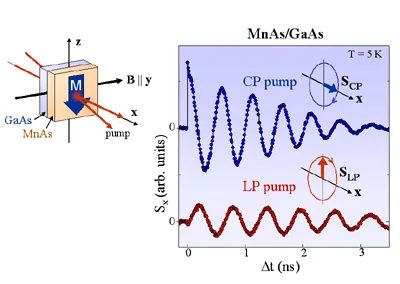
The figure above shows two TRFR curves for circularly polarized (CP) and linearly polarized (LP) pump pulses. For CP pulses, spins are polarized both by the laser and by the ferromagnet but the laser signal dominates the data. However, for LP pulses, spins are not polarized optically so the TRFR signal must be caused by the ferromagnet. The -90 degrees phase shift of the LP data relative to the CP data suggests that the spontaneously polarized spins are oriented antiparallel to the ferromagnet's magnetization.
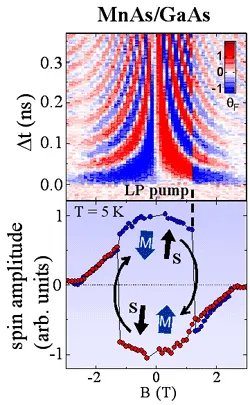
The figure below shows that the spontaneous spin coherence mimics the hysteresis of the ferromagnetic layer. The LP data in the preceding figure is a vertical linecut of this dataset.
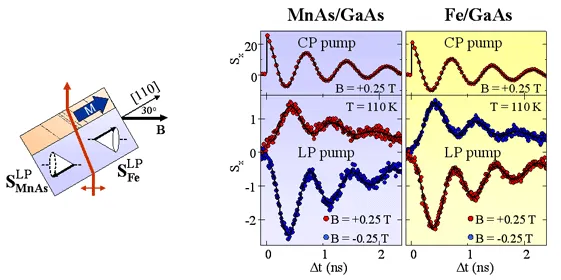
Insights into the mechanism underlying the spontaneous spin coherence are obtained by comparing different ferromagnetic materials. For example, the figure below has data for MnAs/n-GaAs and Fe/n-GaAs structures. The data show that Fe polarizes spins in GaAs parallel to its magnetization while for MnAs they are polarized antiparallel.
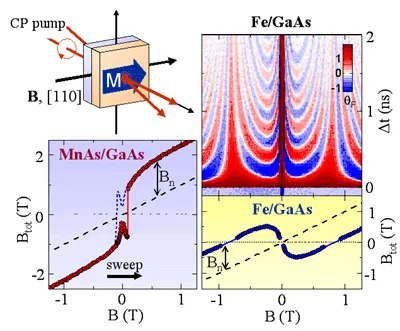
The opposite polarization for the two ferromagnetic materials is also manifest in nuclear imprinting. By obtaining the spin precession frequency from fits to the TRFR oscillations, one can convert the frequency into an effective magnetic field. After taking data at many magnetic fields, we see that the nuclear field adds to the applied field for MnAs/GaAs, whereas it opposes the applied field for Fe/GaAs. This is most noticeable at ~0.8T where the nuclear and applied fields cancel and spin precession stops.
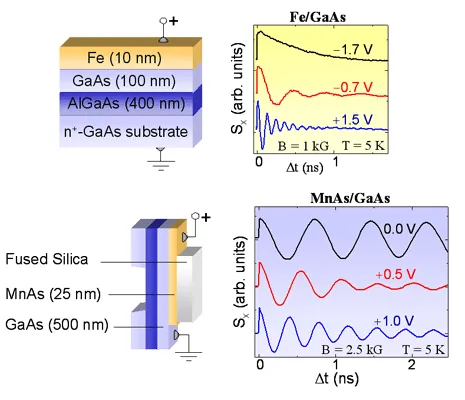
By processing these structures into Schottky diodes, one finds that the bias voltage has a strong impact on the nuclear polarization and the electron spin dynamics. For the Fe/GaAs device, the nuclear field can be tuned over many orders of magnitude with a few volts bias. At -1.7 V, the nuclear and applied fields cancel, halting spin precession. At +1.5 V the nuclear field is about 16 times larger than the applied field. The MnAs device shows similar behavior but the nuclear and applied fields are parallel.
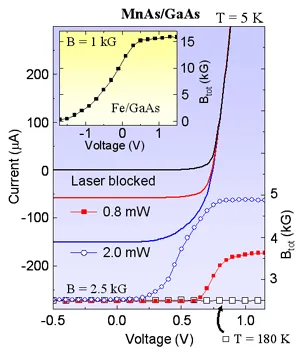
Comparison of the electrical characteristics of the MnAs/n-GaAs device reveals a connection between the diode turn-on and the onset of nuclear spin polarization. Below we plot the diode's current-voltage curves and the total magnetic field obtained from TRFR data at each voltage. The diode turns on at nearly the same voltage as the nuclear polarization, suggesting that band bending near the MnAs/GaAs interface strongly influences this spin polarization mechanism.
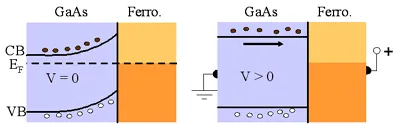
Recalling that it is spontaneously polarized electrons that cause the nuclear polarization, the diagrams below depict how the Schottky barrier could influence the degree of electron spin polarization. At zero bias, electrons are swept away from the ferromagnet, which would reduce their interaction with it. At positive voltages, the band flattens allowing carriers to access the interface and interact with the ferromagnet.
For more information on these experiments please see the following publications.
- "Ferromagnetic Imprinting of Nuclear Spins in Semiconductors", R. K. Kawakami, Y. Kato, M. Hanson, I. Malajovich, J. M. Stephens, E. Johnston-Halperin, G. Salis, A. C. Gossard, and D. D. Awschalom, Science 294, 131 (2001).
- 'Spontaneous spin coherence in n-GaAs produced by ferromagnetic proximity polarization", R. J. Epstein, I. Malajovich, R. K. Kawakami, Y. Chye, M. Hanson, P. M. Petroff, A. C. Gossard, and D. D. Awschalom, Phys. Rev. B 65, 121202(R) (2002).
- "Voltage control of nuclear spins in ferromagnetic Schottky diodes", R. J. Epstein, J. Stephens, M. Hanson, Y. Chye, A. C. Gossard, P. M. Petroff, and D. D. Awschalom, Phys. Rev. B 68, 41305(R) (2003).
- Research Index