
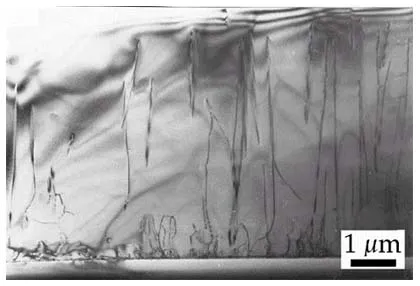
The III-V compound semiconductor GaN provides an interesting testbed for studying spin coherence in that it combines high optical quality with a large number of structural defects. This unusual coincidence of characteristics allows the optical creation and monitoring of spin coherence (using the technique of time-resolved Faraday rotation (TRFR) ) in a system with strong momentum scattering. In the cross-sectional transmission electron microscopy (XTEM) image seen below, the dark vertical lines represent charged threading dislocations that typically thread the entire thickness of MOCVD grown GaN epilayers. These dislocations serve as strong momentum scattering centers as seen in the carrier mobility.
Despite this strong momentum scattering however, we observe spin coherence which persists to longer than 3 ns in samples with a variety of carrier concentrations, as can be seen below. Also visible is data taken at room temperature, demonstrating the remarkable robustness of spin coherence in this material system.
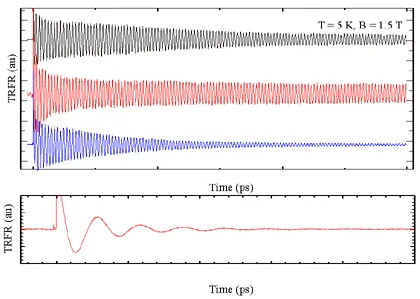
Our ability to measure the spin coherence over such long time scales allows us to obtain precise fits to the data which yield both the electron g factor (g = 1.94 ( 0.01) and the various spin decoherence and scattering times (the decay envelope of the TRFR is multi-exponential, indicating several different spin scattering/dephasing processes). While there are both very short and long lived components to the spin coherence, the component which dominates the behavior in the regime considered here varies from ~ 500 ps to ~ 10 000 ps. In the figure below we can see the variation of this parameter, τ2, as a function of temperature and magnetic field. This data is striking in its qualitative similarity to data obtained in GaAs.
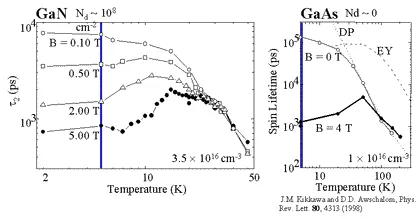
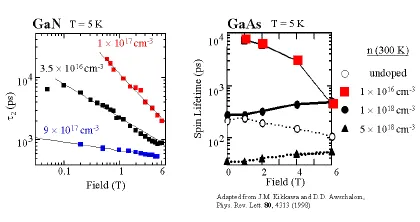
The qualitative similarities continue when we consider cuts at constant temperature and variable magnetic field (indicated by the blue lines in the figure above). This data (shown below) reveals that in both GaAs and GaN the samples exhibiting both the longest spin lifetime and strongest lifetime suppression in applied magnetic field have carrier concentrations in the vicinity of the metal-insulator transition (MIT). This result is still somewhat of a mystery, but it is interesting to note that the carrier localization length is thought to diverge near the MIT, so if one supposes a spin-scattering mechanism which is localization length dependent then one might anticipate this trend in the spin lifetime.
To learn more about our studies in GaN please refer to: "Spin Coherence and Dephasing in GaN", B. Beschoten, E. Johnston-Halperin, D.K. Young, M. Poggio, J. E. Grimaldi, S. Keller, S.P. DenBaars, U.K. Mishra, E.L. Hu, and D.D. Awschalom, Phys. Rev. B, vol. 63, p.R121202 (2001)