
Using the all-optical approach, all three mechanisms of initial polarization, detection and excitation of nuclear magnetic resonance have been focused onto a 7.5 nm wide GaAs quantum well. Thereby, as few as 1010 nuclei can be detected. The used quantum well is grown on (110) GaAs, which has longer spin life-time than conventional (100) samples, and exhibits a strongly anisotropic g-factor.
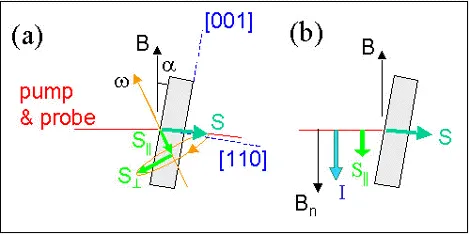
Measurement geometry: (a) pump and probe beams are both perpendicular to the applied field, B. The sample normal can be tilted by an angle a with respect to the laser beams. The pump beam generates an electron spin S in the quantum well. This spin can be divided into two components along and perpendicular to the precession axis. The non-precessing component is enhanced due to an anisotropic g-factor in the quantum well, which tilts the precession axis ω away from B. (b) The non-precessing electron spin hyperpolarizes the nuclear spin I. This leads to a strong nuclear field Bn acting onto the electron spin.
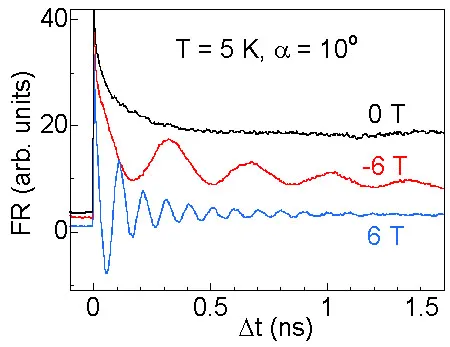
Measured electron spin dynamics at 0 T, -6 T and 6 T for α = 10. The Faraday rotation (FR) shows different precession frequencies at -6T and 6 T. This strong asymmetry is due to nuclear polarization along the non-precessing electron-spin component. The resulting nuclear field Bn enhanced or reduced the total field, depending on the sign of the applied field.
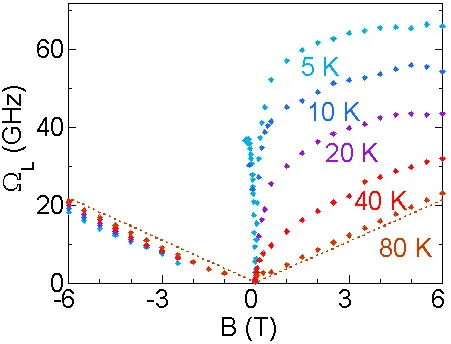
Measured precession frequency ΩL as a function of field and temperature. The nonlinear increase of ΩL with B is attributed to dynamic nuclear polarization. The dashed line corresponds to the Zeeman frequency ΩZ. The difference between ΩL and ΩZ is due to the polarized nuclear spin.
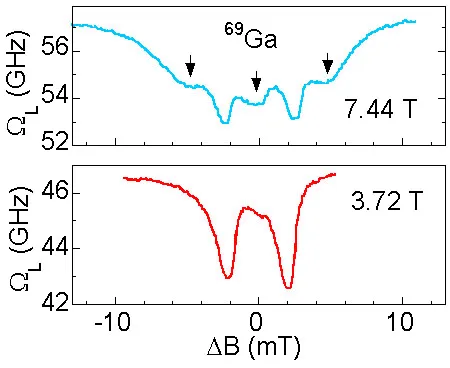
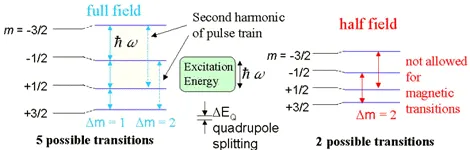
Nuclear resonances induced by laser pulses at a repetition rate of 76 MHz. At 7.44 T, the nuclear precession frequency of 69Ga matches the repetition rate, leading to depolarization of the nuclear spin. This is reflected in the observed decrease of the electron spin precession frequency ΩL. The resonance displays a triplet structure originating from the three Δm = 1 transitions within the quadrupolar split levels of the spin-3/2 nuclei (arrows). Another resonance occurs at 3.72 T. Here, the precession frequency of 69Ga is exactly half the laser repetition rate. This corresponds to an excitation of a Δm = 2 transitions. Because there are only two such transitions possible within the spin-3/2 levels, we observe a doublet structure.
To learn more about our studies, please refer to "Origin of enhanced dynamic nuclear polarization and all-optical nuclear magnetic resonance in GaAs quantum wells", G. Salis, D. D. Awschalom, Y. Ohno and H. Ohno, Phys. Rev. B, vol. 64, R195304 (2001)