
Stationary electron spins have been extensively studied in many diverse environments including bulk semiconductors, quantum wells, quantum dots, and defect centers in diamond. Their capacity to be externally controlled by electric or magnetic fields along with long spin coherence times make these particles viable qubit candidates for quantum information processing. Transporting spins as information carriers from one location to another in various materials is another challenge that has been heavily studied. Externally manipulating the quantum information during transport would provide an additional level of control with potential applications for quantum metrology and computational spin-based protocols. We demonstrate on-chip control of an ensemble of moving electron spins by driving the carriers through a spatially-isolated magnetic field created by polarized nuclear spins at T = 8 K.
A 10 μm wide channel of doped GaAs (n = 1x1017 cm-3) is patterned using photolithography. Centered along the channel is a 30 μm long ferromagnetic island of MnAs.
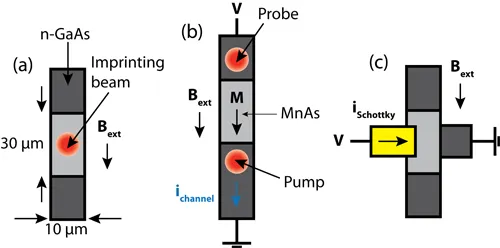
In the presence of an external magnetic field, spins are injected into the GaAs using a circularly-polarized pump laser on one side of the MnAs. The spins are driven under the MnAs island by applying a voltage along the channel and are detected (via Kerr rotation) as they emerge on the other side by a linearly-polarized probe beam.
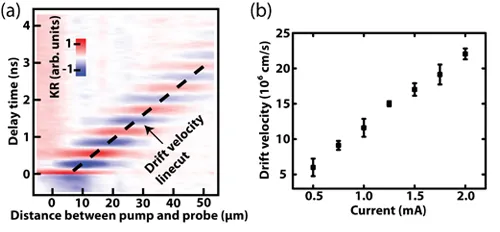
The previous plots demonstrate spin rotation and drift along the channel (on a sample with no MnAs island). If we apply stronger voltages in the channel we can drive the spins faster under the MnAs. Below we measure the time of detection at the probe spot (on the opposite side of the MnAs island from the pump) for increasing channel voltages (currents) and can control the time of arrival between 2 and 7 ns.
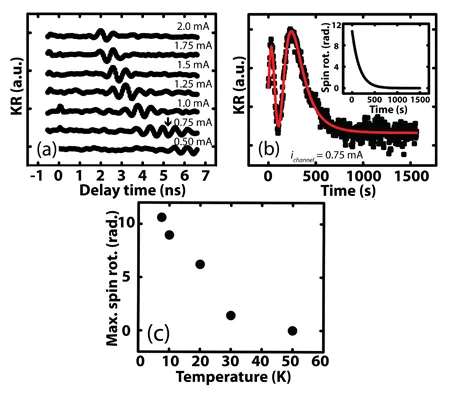
The MnAs island is fabricated to act as a electromagnetic gate. At the interface of a ferromagnet and semiconductor under optical excitation or an electrical Schottky current, nuclear spins in the semiconductor will become polarized by the ferromagnetic proximity polarization (FPP) effect. The polarized nuclear spins act as an effective magnetic field which is spatially-isolated under the MnAs island. We direct a third laser beam onto the MnAs to initialize the polarization process. After saturation, optically-injected electron spins are driven through this magnetic region. As they arrive on the other side their spin orientation is rotated due to the nuclear field. When the imprinting laser is turned off the nuclear spins begin to depolarize over the next 20 minutes.
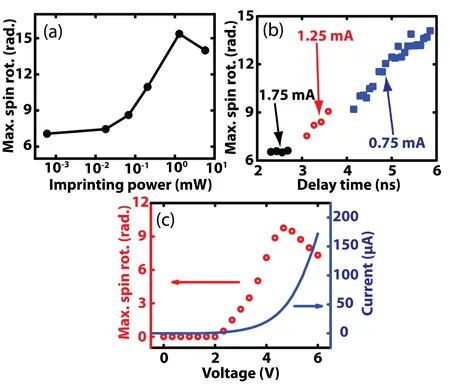
The nuclear field can be controlled by changing the power of the imprinting laser. Moreover, as previously stated, the nuclear spins can be polarized by spin-dependent reflections at the Schottky interface. Spin rotation is detected at the probe after polarizing the nuclear spins electrically with different Schottky currents. Eventually, heating limits the maximum achievable rotation. Finally, for a fixed nuclear field, the spins can be rotated by controlling the amount of time it takes to traverse the MnAs island. We find that more rotation is achieved for longer traverse times.
To learn more please refer to "Spin Control of Drifting Electrons Using Local Nuclear Polarization in Ferromagnet-Semiconductor Heterostructures", M. E. Nowakowski, G. D. Fuchs, S. Mack, N. Samarth, and D. D. Awschalom, Phys. Rev. Lett. 105, 137206 (2010).