
The processing of quantum information based on the electron spin degree of freedom requires fast and coherent manipulation of local spins. Using magnetic fields to provide spatially selective tuning of the spin splitting will require their precise control at reduced length scales. Alternatively, there are proposals that employ electrical gating and spin engineering in semiconductor heterostructures involving materials with different g-factors. In these "spin engineered" nanostructures, the electron g-factor can be continuously tuned by displacing an electron wave function. A specially designed AlxGa1-xAs quantum well with parabolically graded Al concentration is used for this purpose. Using time-resolved optical techniques, we demonstrate gate-voltage mediated control of coherent spin precession over a 13 GHz frequency range in a fixed magnetic field of 6 T, including complete suppression of precession, reversal of the sign of g, and operation up to room temperature.
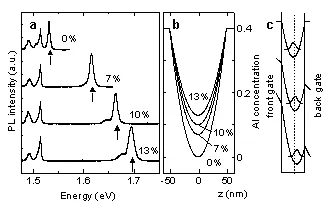
Samples are grown by molecular beam epitaxy, and photoluminescence (PL) spectra of unprocessed samples are shown above. Four samples, with different minimum Al concentrations, are prepared. Each sample is grown with a buried back gate, and a front gate consisting of Ti/Au is evaporated on. The samples are nominally undoped.
Using time resolved Kerr rotation (TRKR), we observed that the spin dynamics are strongly modified by an application of gate bias.
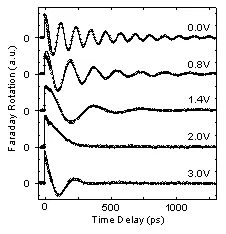
This figure shows TRKR scans at 5K with an applied field of 6T for different biases, for a 7% sample. In this sample, g-factor tunes through zero, allowing the change in sign.
The figure on the right shows the g-factor as a function of gate voltage for all four samples. These data can be fit with a simple model which averages the g-factor over the wave function.
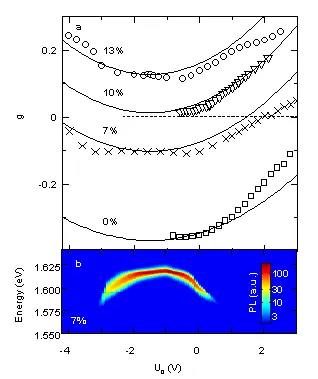
The symmetric point in voltage is shifted from zero due to built-in potential.
The right bottom figure is a series of PL spectra as a function of gate voltage for the 7% sample at 5K. The PL peak shifts as a bias is applied, due to quantum confined Stark effect. At higher biases, PL diminishes because excitons are dissociated. In the region where PL intensity is high, g-factor remains roughly constant, suggestive of exciton effects in this region.
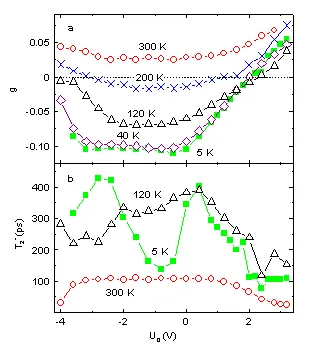
The device operates up to room temperature. On the 7% sample, temperature dependence is investigated. g-factor is tunable in all temperatures up to 300K.
Figure below shows the spin lifetime as a function of gate voltage. Dip around -1V at 5K is attributed to enhanced recombination, as it disappears at higher temperatures, consistent with time-resolved PL measurements.
To learn more about our studies, please refer to "Electrical Control of Spin Coherence in Semiconductor Nanostructures", G. Salis, Y. Kato, K. Ensslin, D. Driscol, A. C. Gossard, and D. D. Awschalom, Nature, vol. 414, p.619 (2001)