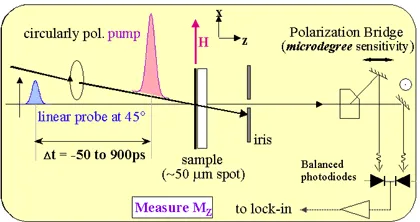
Using a pump-probe optical arrangement, a ~100 femtosecond circularly-polarized optical pump pulse selectively excites either spin-up or spin-down excitons in the magnetic heterostructure sample. These excitons spin-scatter and perturb the magnetization of the embedded Mn moments. This perturbation to the sample magnetization is measured by the Faraday rotation imparted to a time-delayed linearly-polarized probe pulse. The evolution and eventual relaxation of the magnetic perturbation can persist long after the excitons have recombined, and even longer than the normal repetition rate of the laser, necessitating its reduction with the use of an acousto-optic pulsepicker.
Faraday Rotation Basics
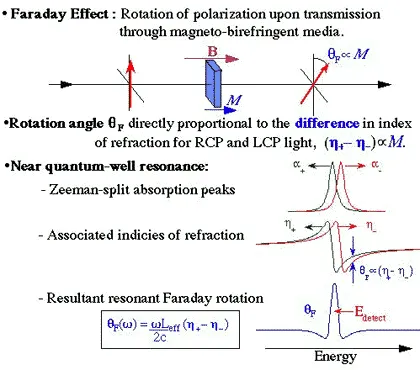
Most materials in longitudinal magnetic fields will cause linearly polarized light to rotate some amount per unit length of material. This phenomena is called the Faraday effect, and the magnitude of this effect depends on the sample magnetization and the wavelength of light used. We exploit this property, and the fact that the effect is enhanced near a quantum well resonance, to measure the very small magnetizations arising from these ~10 nanometer-thick magnetic heterostructures.