
The chromium defect in SiC has well-isolated transition at 1070 nm between its ground and excited state, and is expected to have long spin T1 times, long spin coherence times, and very high Debye-Waller factor of at least 75%. In this result, we create Cr defects in SiC using implantation and annealing, as opposed to using as-grown samples. After implantation at temperatures of up to 700 degrees Celsius, we believe that the chromium ions sit at interstitial positions in the SiC lattice. Once the samples are annealed, the chromium ions move to two possible Si lattice sites, replacing the Si atoms and forming the bonds with the surrounding C atoms that create our desired energy level structure. The lattice and energy level structures are shown below.
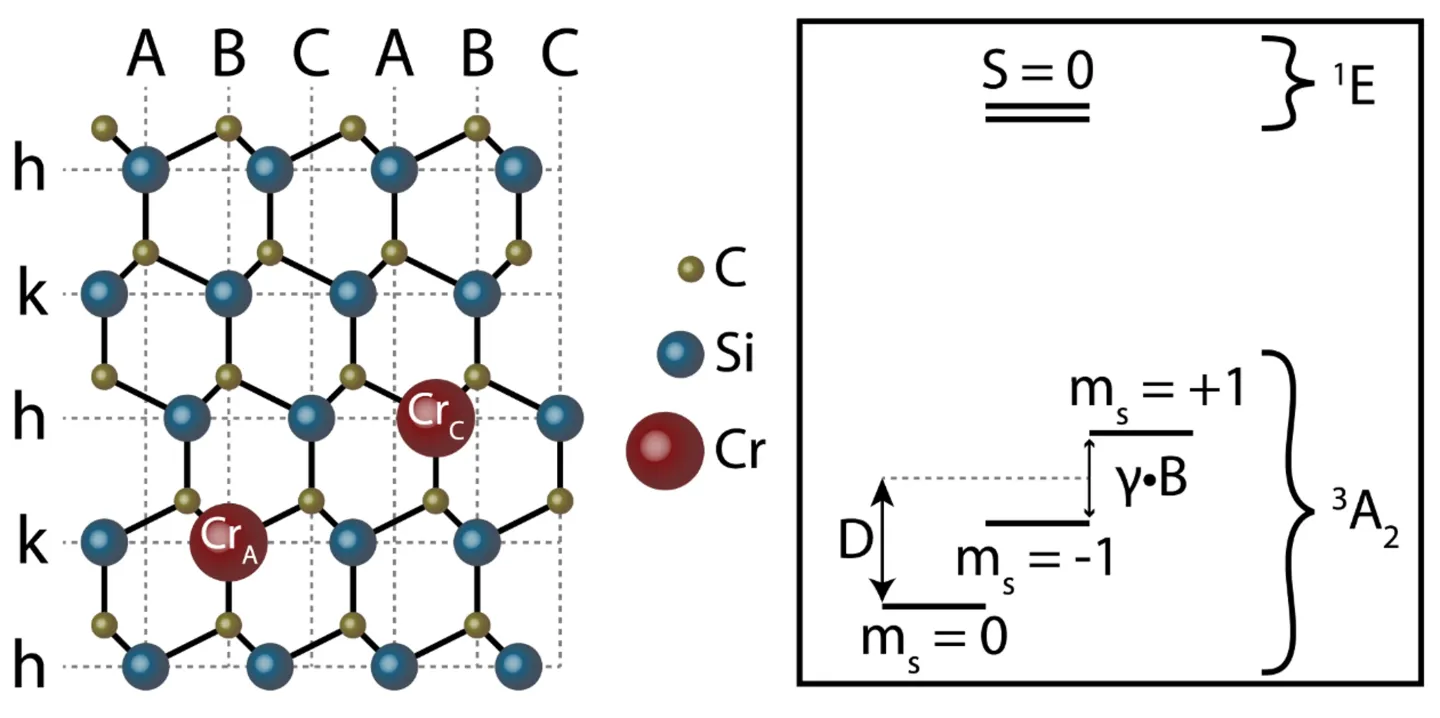
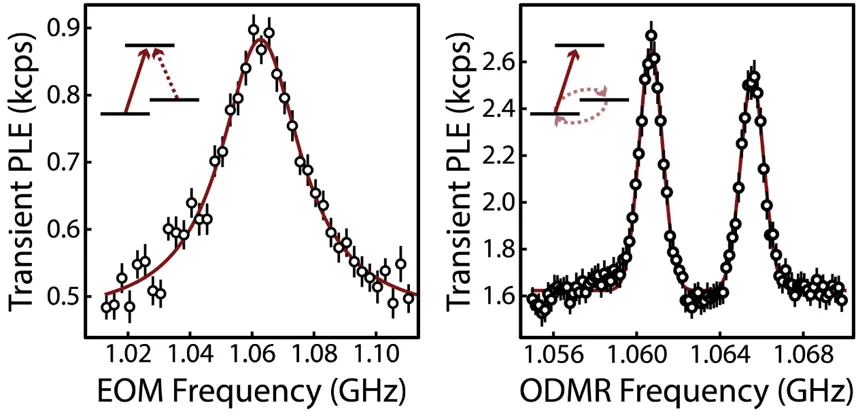
We obtain a photoluminescence spectrum that shows the zero phonon lines and phonon sidebands of the two defect sites. We obtain another, higher resolution spectrum of the CrA site that we can fit to the signals from the different spin states of the defect. Performing hole burning and ODMR experiments confirm the D splitting of our system to be approximately 1063 MHz, where the particular defect we are looking at has split ms=+-1 states due to stray magnetic fields.
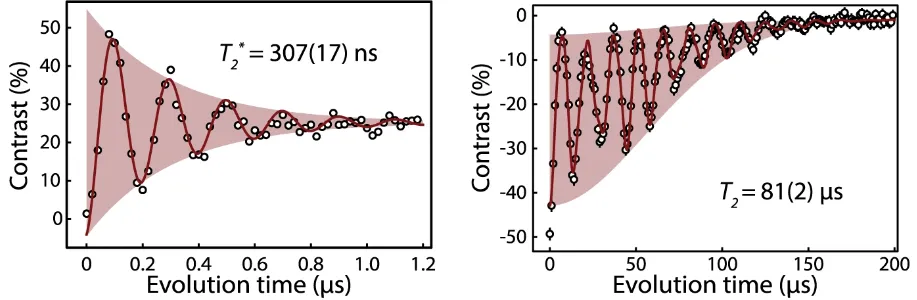
To characterize the ground state spin coherence times, we perform Ramsey interferometry and Hahn echo measurements. We measure a T2* of 307 ns and a T2 of 81 us.
We measure an optical lifetime of 156 us and the longest T1 time we measure is 1.6 s when the sample is at a temperature of 1.5 K.
Details can be found in our manuscript: