
In previous work, we observed spin precession at zero magnetic field due to spin-orbit coupling in strained semiconductors. Such behavior can be thought of as an internal magnetic field acting on electron spins, when the electrons are dragged with an applied electric field. Here, we show that it is possible to use this internal magnetic field to polarize electron spins.
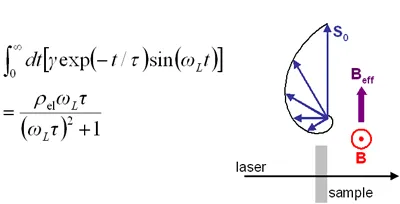
Faraday rotation is measured with electric field parallel to the external magnetic field as shown above. The spins polarize in response to the internal field, and the external field makes them precess. This results in out-of-plane spin polarization that grows symmetrically with the external field, until spins precess a significant number of times within their lifetime so that the time-averaged spin diminishes (Hanle effect).
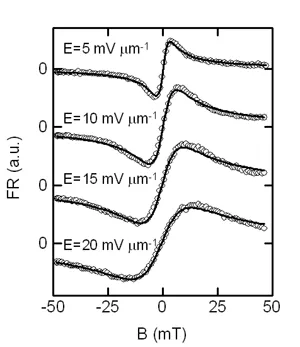
The figure above shows experimental data (circles) and fits (lines). The amplitude grows with electric field, and we can also determine the spin lifetime from the width of the curve.
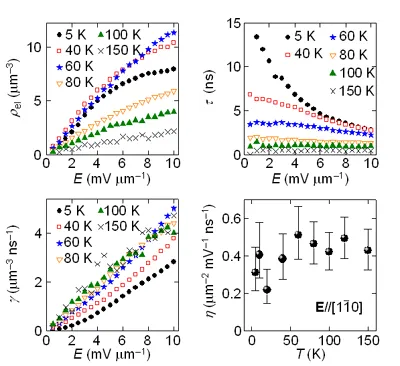
It is also possible to obtain quantitative values of the spin density. The plots above show the spin density, spin lifetime, and the spin generation rate, for various temperatures. The spin orientation efficiency is defined as a slope of spin generation rate with respect to electric field, and does not show a large temperature dependence up to 150 K.
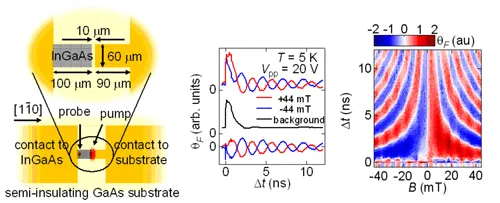
In the final figure, above, we show time-resolved studies of the effect. A photoconductive switch (Auston switch) consisting of a gap between a strained n-InGaAs layer and Au contact on semi-insulating substrate is used to generate electrical pulses. The switch is biased, and a linearly polarized pump pulse tuned above the bandgap of GaAs is focused at the switch. The photoexcited carriers results in electrical pulses with the duration limited by the carrier lifetime. The probe beam is focused on the n-InGaAs layer, and we observe oscillations in the Faraday rotation at the electron Larmor frequency. The signal is antisymmetric with magnetic field, consistent with initial in-plane polarization of spins. The ripples in the magnetic field axis are due to Resonant Spin Amplification (RSA).
To learn more about our studies, please refer to "Current-induced spin polarization in strained semiconductors", Y. K. Kato, R. C. Myers, A. C. Gossard, and D. D. Awschalom, Phys. Rev. Lett. 93, 176601 (2004).