
The following figure shows Time Resolved Faraday Rotation singal obtained in GaAs bulk samples with different doping concentrations:
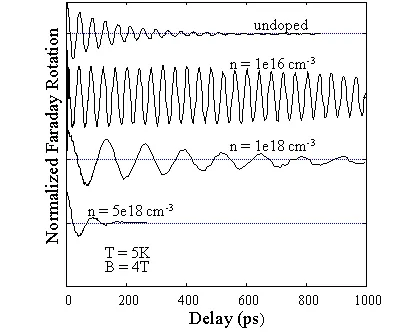
Typically, spin lifetimes are obtained from pump-probe Faraday rotation measurements by varying the pump-probe temporal delay. However, when the observed Faraday rotation experiences little decay over the accessible range of the delay line spin lifetimes are difficult to obtain. This is the case for n-GaAs with n = 1e16 cm-3.
To address this problem, we utilize a technique called Resonant Spin Amplification which drives the spin precession into resonance with the exciting laser cavity. By scanning the magnetic field at a fixed pump-probe delay, we obtain a periodic series of resonances which are shown below:
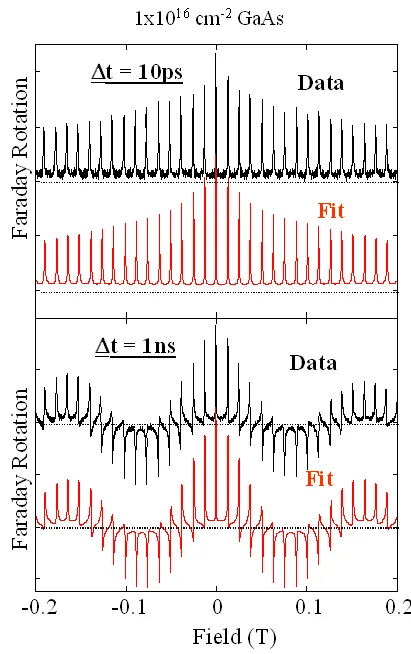
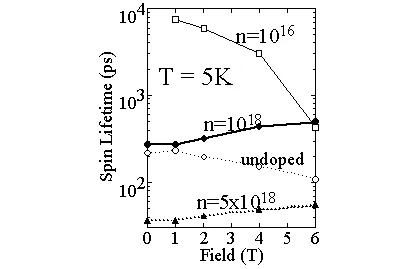
By analyzing the width of the resonant peaks at different fields, a measure of the spin lifetime is obtained. For the case of bulk GaAs the extracted lifetimes are shown below:
To learn more about these measurements, go to the Resonant Spin Amplification page or look in:
"Resonant spin amplification in n-type GaAs", J.M. Kikkawa, D.D. Awschalom, Phys. Rev. Lett., vol. 80, p. 4313 (1998).