
Optically active semiconductor defects with associated spin qubits are a promising class of systems for implementing quantum network nodes due to their intrinsic spin-photon interfaces and the ability to fabricate electrical and photonic devices out of their semiconductor hosts. Well-studied defects, such as the NV and group-IV centers in diamond, have been used in cutting edge demonstrations of entanglement distribution, but non-ideal properties of these systems have limited their performance. One of the efforts in the Awschalom group is to study promising novel defect systems that may excel at certain applications, such as quantum networking. One such system is the neutrally charged vanadium defect in silicon carbide which is known to emit photons in the telecom O-band (1260-1360nm) enabling significantly longer distance transmission in optical fibers. We have studied the optical and spin properties of this defect to further evaluate its suitability for quantum communication.
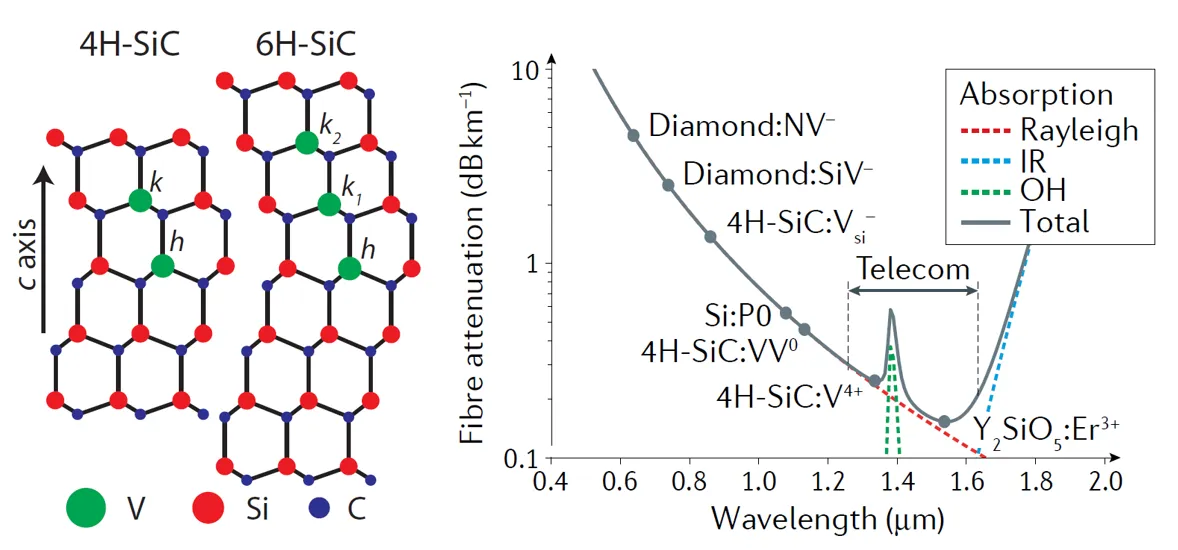
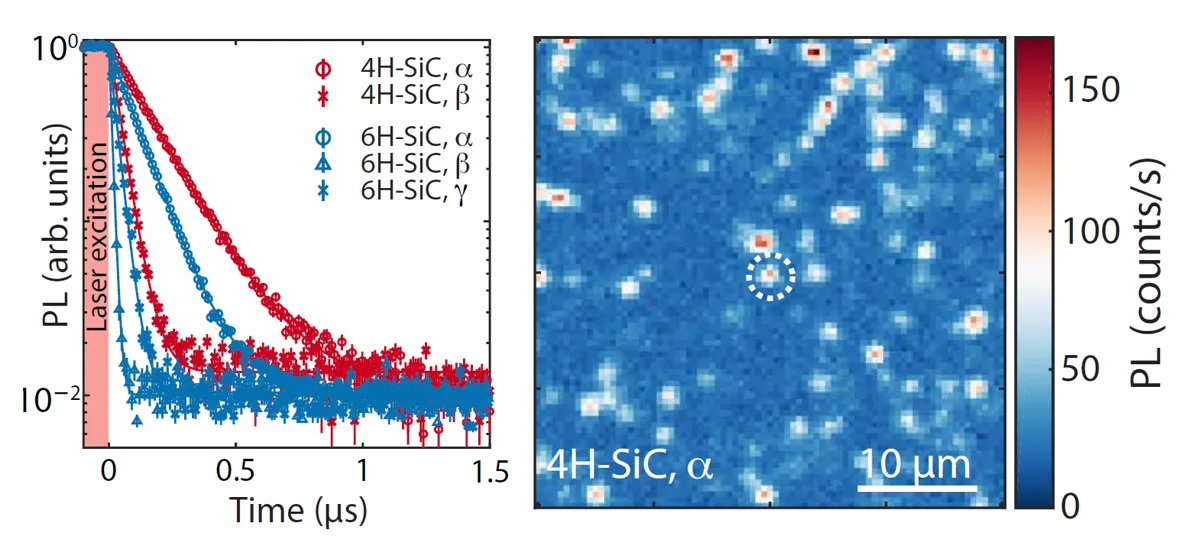
We measured important optical parameters including the Debye-Waller factor (fraction of photons emitted at the optimal wavelength) and the optical lifetime (inverse of emission rate) using photoluminescence (PL) and photoluminescence excitation (PLE) spectroscopy. We find Debye-Waller factors as high as 50% and short optical lifetimes in the 10-100 ns range. These short optical lifetimes further enabled us to observe single defects even without the enhancement granted by photonic devices.
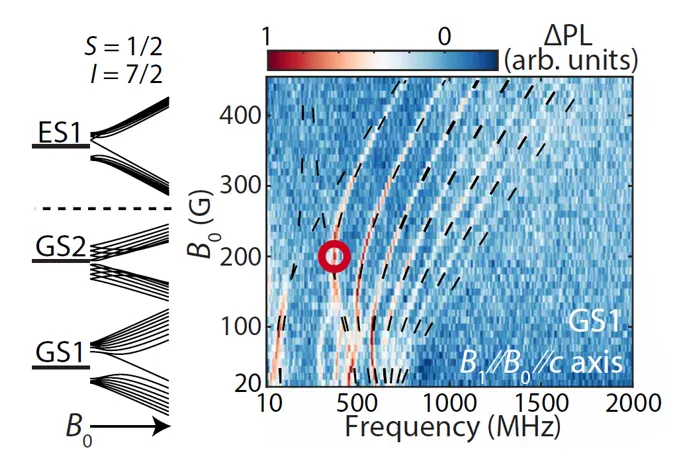
In addition to its favorable optical properties, the vanadium defect also has spin levels provided by its spin-1/2 electron and spin-7/2 nucleus which can be used as a qubit to store and manipulate quantum information. We utilized optically detected magnetic resonance (ODMR) to learn the parameters of the joint Hamiltonian of the vanadium spin system and identify clock transitions which confer reduced susceptibility to decoherence from magnetic noise.
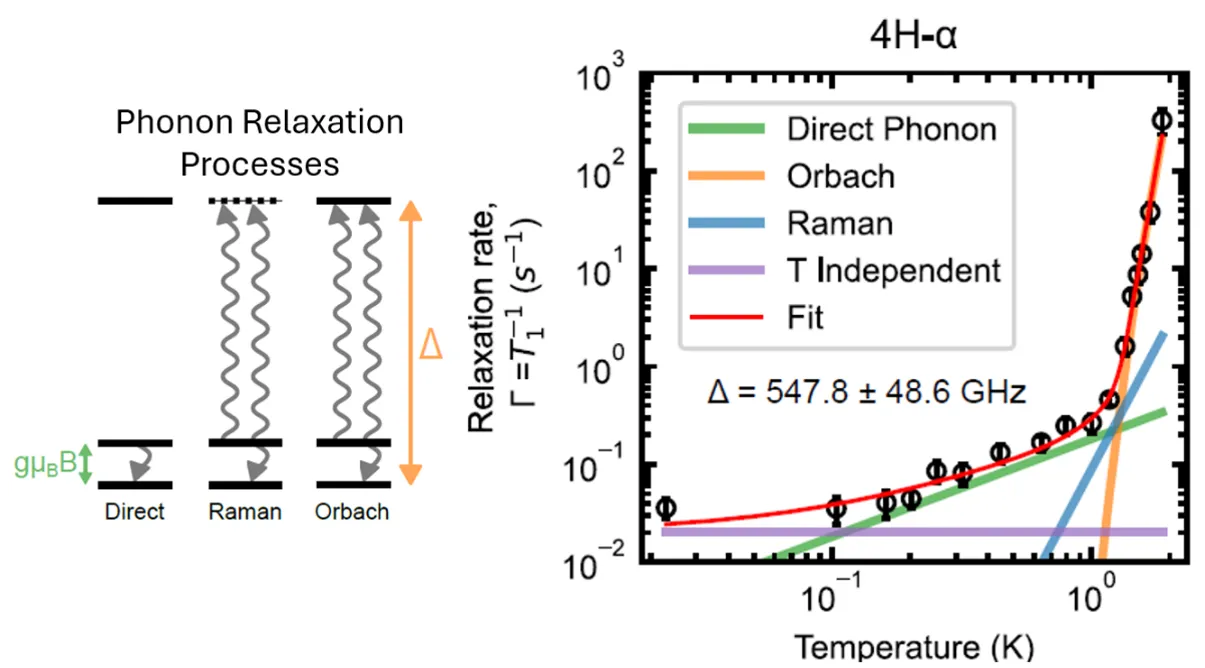
Next, we explore the spin relaxation dynamics by using laser light to drive the system out of equilibrium and observe the recovery. By reducing the temperature of the system to 23 mK we find exceptionally long T1 spin lifetimes of up to 27.9 seconds. The dependence of the T1 time on the sample temperature enabled us to identify the exact spin-lattice interactions that were limiting the T1 at different temperatures. In particular, above 1 K the main decay channel is a 2-phonon Orbach process which can be mitigated through strain engineering, enabling long lifetimes at higher temperatures.
These results all continue to suggest that the vanadium defect in silicon carbide is a promising platform to utilize in quantum networking. Our work also enables further work on this defect system including photonic device integration, strain coupling, and studies of spin control and coherence.
Details can be found in our manuscripts: