
Manipulating charge carrier spins electrically, rather than magnetically, has posed a long-standing challenge for the spintronics community. Electric fields offer high-speed modulation and spatially localized application, both very difficult to achieve with magnetic fields. Considerable progress has been made in traditional II-VI and III-V semiconductors, such as ZnSe and GaAs, by exploiting the spin orbit (SO) coupling of the valence band. Most approaches involve engineering complex nanostructures to control spin phenomena. Here we present a simple device geometry that affords the capability to control the spin coherence time in a bulk semiconductor, ZnO.
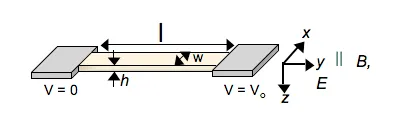
Above is a schematic of the processed structure used in our time-resolved Kerr rotation measurements with spatial coordinates for reference. In this simple wire geometry, we can drive a current in the ZnO channel and simultaneously observe optically pumped spins decohere in the presence of a small magnetic field at low temperature.
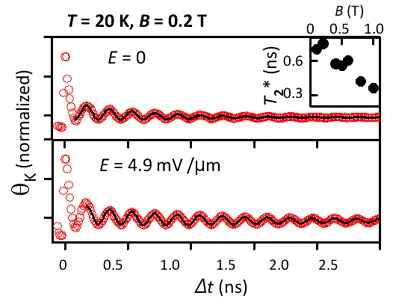
The time-resolved Kerr rotation traces above show the coherent beating of spins in a transverse magnetic field at the picosecond timescale. By fitting the top trace, we extract a spin coherence time of 0.7 ns. However, as can be seen in the lower trace, when an electric field is applied, the spin coherence persists approximately a factor of two longer. The inset shows that the transverse spin lifetime decreases with increasing magnetic field. Further characterization of the device response to an electric field can be seen below.
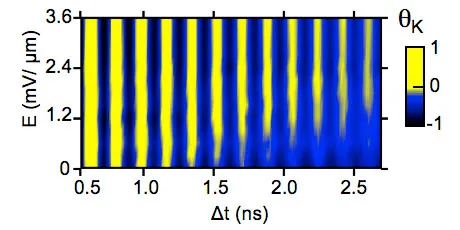
Kerr rotation θK is plotted at B = 0.2 T as a function of electric field E and delay time t at 20 K. The amplitudes of all θK values are normalized to their respective t = 0 values. In order to better understand the increase in spin coherence as a function of electric field, additional dynamical optical spectroscopies were used, specifically time-resolved transmission and time-resolved photoluminescence. Combining these temporal techniques, a qualitative mechanistic picture has emerged. We speculate that application of the in-plane electric field has a two-fold effect: it enhances the initial absorption cross-section, while preferentially increasing the decay rate of long-lived carriers without affecting the fast carrier relaxation rate. It is clear that there is a pathway for enhanced carrier relaxation with applied electric field. The faster depopulation of carriers with increasing E results in both reduced initial magnetization seen in the Kerr rotation measurements, as well as steady decrease in transmission amplitude. Also, while the decreased density of photo-generated carriers leads to smaller initial magnetization, it enhances spin coherence time by decreasing electron-electron interactions.
To learn more about our studies, please refer to "Electrical control of spin coherence in ZnO", S. Ghosh, D. W. Steuerman, B. Maertz, K. Ohtani, Huaizhe Xu, H. Ohno, and D. D. Awschalom, Appl. Phys. Lett. 92, 162109 (2008).