
Spins in defects in solid state systems provide a versatile platform for quantum information, with applications such as quantum computing, sensing and communication. Defects in silicon carbide (SiC) in particular have been found to combine long-lived, controllable quantum defects with mature growth technology developed by the SiC high power electronics industry.
In any given defect, multiple charge state configurations are possible, but only one of those offers the correct spin properties needed for quantum information. Being able to control the charge state is therefore a pre-requirement to experiments in this system.
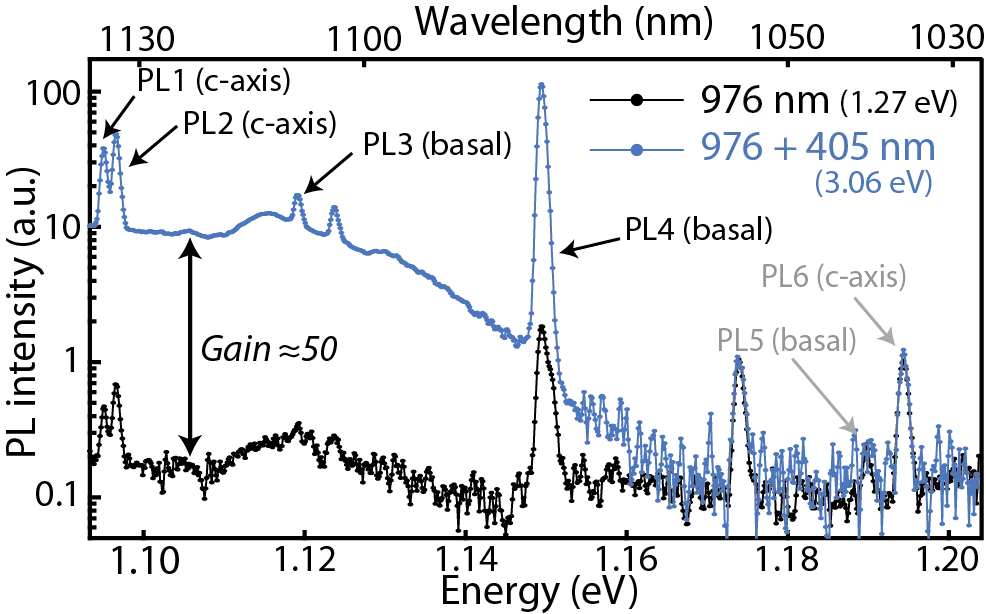
In this study, we demonstrate control over the charge state of divacancies defects in 4H-SiC, where the neutral charge state provides the correct spin state and is optically bright (photoluminescent), enabling spin experiments. Using combinations of near-infrared and near-ultraviolet excitation from two light sources, we are able to convert the defect from this bright to another dark (non-photoluminescent) charge state.
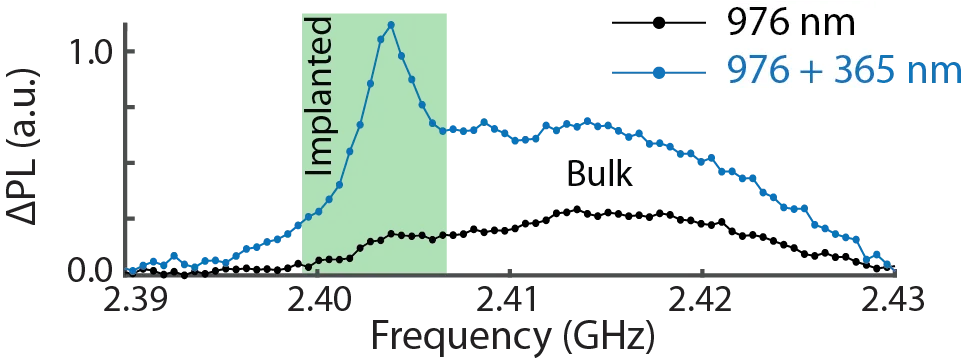
We measure enhancements of up to three orders of magnitude in the optical signal depending on the sample, facilitating the realization of any future experimental demonstration. For example, it is typical to implant defects in a sample to obtain spin qubits with a given concentration. Implantation however can locally damage the sample or change its Fermi level, resulting in defects being in the wrong (dark) charge state which cannot be observed. The application of the near-ultraviolet light in this case fully converted this implanted layer of defects, showing a narrow spin signal with millisecond coherence times, even under the illumination.
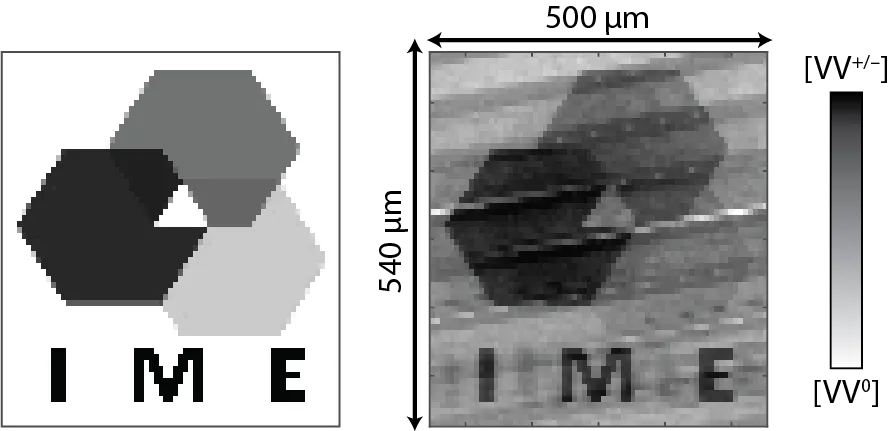
Finally, we demonstrated patterning of the defect charge state over large area of the sample. The charge conversion is persistent at cryogenic temperatures (5 K), therefore defects can locally be changed to either bright or dark, and then measured later. This may provide high-density storage of information.
Overall, these results provide a strong basis for all future quantum experiments using divacancy defects in SiC, as well as the possibility to use the charge state of these defects for alternative applications.
---
To learn more about our studies, please refer to:
“Optical charge state control of spin defects in 4H-SiC”, Gary Wolfowicz, Christopher P. Anderson, Andrew L. Yeats, Samuel J. Whiteley, Jens Niklas, Oleg G. Poluektov, F. Joseph Heremans and David D. Awschalom. Nature Communications, 8:1876 (2017).