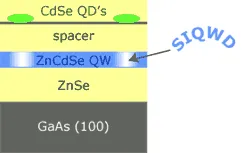
In this semiconductor heterostructure, lattice mismatch strain between the CdSe quantum dots (QDs) and the ZnCdSe quantum well (QW) produces a three dimensional confinement potential in the QW itself, effectively confining carriers to small regions in the sample termed strain induced quantum well dots, or SIQWD's.
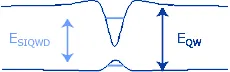
Schematic picture of the changes in the conduction and valence bands of the ZnCdSe QW due to the strain fields of the CdSe QDs.
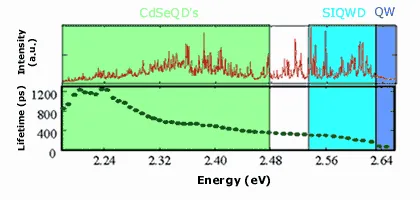
Shown below are a photoluminescence (PL) spectra and carrier lifetimes extracted from time-resolved PL measurements. The PL spectra shows that the confinement of carriers is nearly zero-dimensional in both the ordinary CdSe QDs as well as in regions energetically attributed to dots produced in the ZnCdSe QW itself. The intermediate carrier lifetimes in the SIQWD region reflect both shallower confinement relative to CdSe dots, as well as thermally activated detrapping of carriers into the QW host.
In the two structures below, carriers confined to quantum dots interact with a local magnetic environment provided by paramagnetic Mn2+ ions (spin 5/2). In the left, a layer of MnSe is grown sufficiently close to the CdSe QDs so that there is significant overlap of the carrier’s wavefunction with that of the Mn ions. The right structure is a variant of the SIQWD samples in which the dot-like regions produced by strain are present in a Digital Magnetic Heterostructure (DMH - a quantum well with incorporated Mn ions).
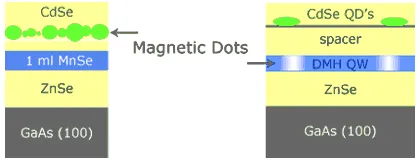
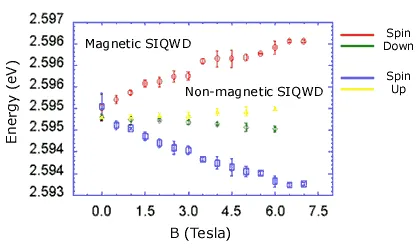
The plot below traces the spin splitting of one of the quantum dot photoluminescence peaks as a magnetic field is applied. The single peak at zero field is replaced with two peaks of opposite circular polarizations. The enhanced Zeeman splitting of the magnetic SIQWD sample is attributed to enhanced local fields resulting from contributions of nearby Mn ions.