
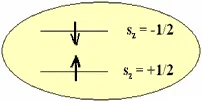
Recently, there has been increasing interest in developing spin polarized semiconductor devices and in exploiting spins within solid state systems for quantum information storage and computing. For those interested in using polarized electronic spins for these purposes, it is important to know how long such spins retain their orientation--that is, to what extent the spin of an electron is a good quantum number. We perform studies of electron spin coherence through time-resolved studies of spin precession. To understand how these measurements address issues of coherence, note that the spin of an electron is a two-level system whose degeneracy may be split by the application of a magnetic field:
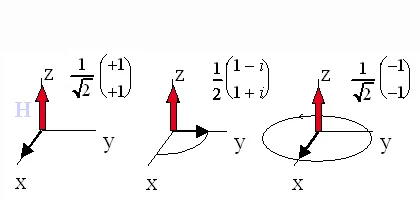
In our measurements we orient spins normal to the applied magnetic field, placing them in a superposition of the two energy-split spin states. As this state evolves in time, the classical magnetization vector precesses about the applied magnetic field. While this Larmor precession is a classical effect, the underlying mechanism is quantum mechanical, and involves a change in the relative phases of the spin-up and spin-down components of the electron wavefunction:
As we discuss below, our pump-probe technique measures only the bulk magnetization of the electronic system and does not directly probe the quantum wavefunction of the spin system. Nonetheless, we may use spin precession of an ensemble of spins to infer valuable information about the decoherence of individual electron spins. In particular, such decoherence will generally appear as a decay of the spin precession unless such decoherence is due to rotationally-invariant spin-spin interactions within the optically-excited electron sea. The latter contributions are 'hidden decoherences' because they conserve the total angular momentum measured by Faraday rotation. Hence, by measuring the decay of spin precession, we further our understanding of environmental contributions to electron spin decoherence and explore the intrinsic potential for storage spin coherence afforded by the host matrix.
Pump Probe Studies of Spin Precession
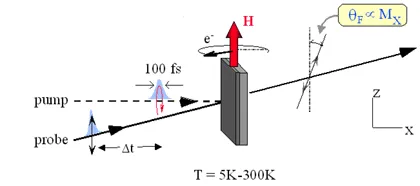
In this experiment we use a circularly-polarized pump beam to inject electrons into the conduction band, where the photons impart their angular momentum to electron-hole pairs. Subsequent precession of these spins about the applied magnetic field is then detected by a time-delayed probe pulse whose linear polarization rotates an amount proportional to the electronic magnetization upon transmission through the sample (the Faraday Effect). As the pump-probe time delay is swept, the Faraday angle oscillates and maps out the temporal profile of the spin precession. Earlier studies show that holes do not precess in these systems, so that the detected precession arises solely from electron spins.
We have used this technique to demonstrate the transfer of spin polarization to a two-dimensional electron gas. Similar studies in bulk GaAs reveal extremely long transverse spin lifetimes, which we study through a technique of resonant spin amplification. We have demonstrated lateral transport of upto 100 μm without losing the spin polarization.
This technique can also be used in chemically synthesized quantum dots, where the spin precession persists at room temperature and it has a strong field dependence.